Construction costs are rising. Capital is more expensive. Some markets are oversupplied. Together, those pressures have made buying existing self-storage facilities more attractive than building new ones, according to George Hristodoulou, a principal at RSG Development, a New Jersey-based developer. “We think it’s in many ways a better time to acquire than develop because of the increased cost,” he says. “We’re starting to see pricing get in line with expectations on current acquisitions.”
Across the industry, fewer developers are breaking ground on new facilities, while more investors are buying existing ones, according to data from Yardi Matrix and Marcus & Millichap.
The Cost Picture
Steel is the clearest pressure point. U.S. steel prices have climbed sharply over the past year to multiyear highs, according to Bloomberg. “These buildings are in their entirety steel,” Johnson says.
Fuel adds to the bill. The national average price of on-highway diesel hit a record $6.53 a gallon in late September, according to the U.S. Energy Information Administration, raising costs for every material that ships by truck. “There’s not a product in this country that does not ship on a diesel truck,” Johnson says.
Capital Costs More
Hristodoulou says the cost of capital has risen significantly, and some lenders have stepped back from self-storage entirely. “People are very hesitant to lend in this type of environment for this product,” Johnson says. But the money has not dried up; it is coming from different places. Banks have pulled back, and debt funds, government lenders, and CMBS lenders have stepped in to fill much of the gap.
Equity has proven steadier. Hristodoulou says RSG still finds investors who want to be in the space. “Good deals are good deals,” Johnson says.
On the acquisition side, prices have adjusted. Existing facilities now sell for less, relative to the income they generate, than they did a few years ago. That repricing is what Hristodoulou means when he says acquisition pricing is getting in line with expectations.
Oversupply Is Market by Market
Too much development in certain markets has pushed asking rents down significantly, Hristodoulou says, enough to turn some underwriting upside down. The softness is widespread: asking rents are down from a year ago across every major U.S. metro, Florida markets including Sarasota-Cape Coral, Tampa, and Orlando are among those with the heaviest new-supply pipelines.
That has made pipeline monitoring central to site selection. When supply was low nearly everywhere, competing projects mattered less. “Now since supplies have gone up, it’s an important metric to look at as we choose our sites,” Hristodoulou says.
Long timelines compound the risk. Projects now take longer to build than at any point on record, so a market can change before a facility opens. “A development deal takes a lot of time,” Hristodoulou says. “So once you start it, you don’t really pull the brakes on it.” Relief is coming, but slowly: industry observers expect fewer new facilities to open, though it still projects rents to keep slipping through the end of the year.
Boat and RV Storage
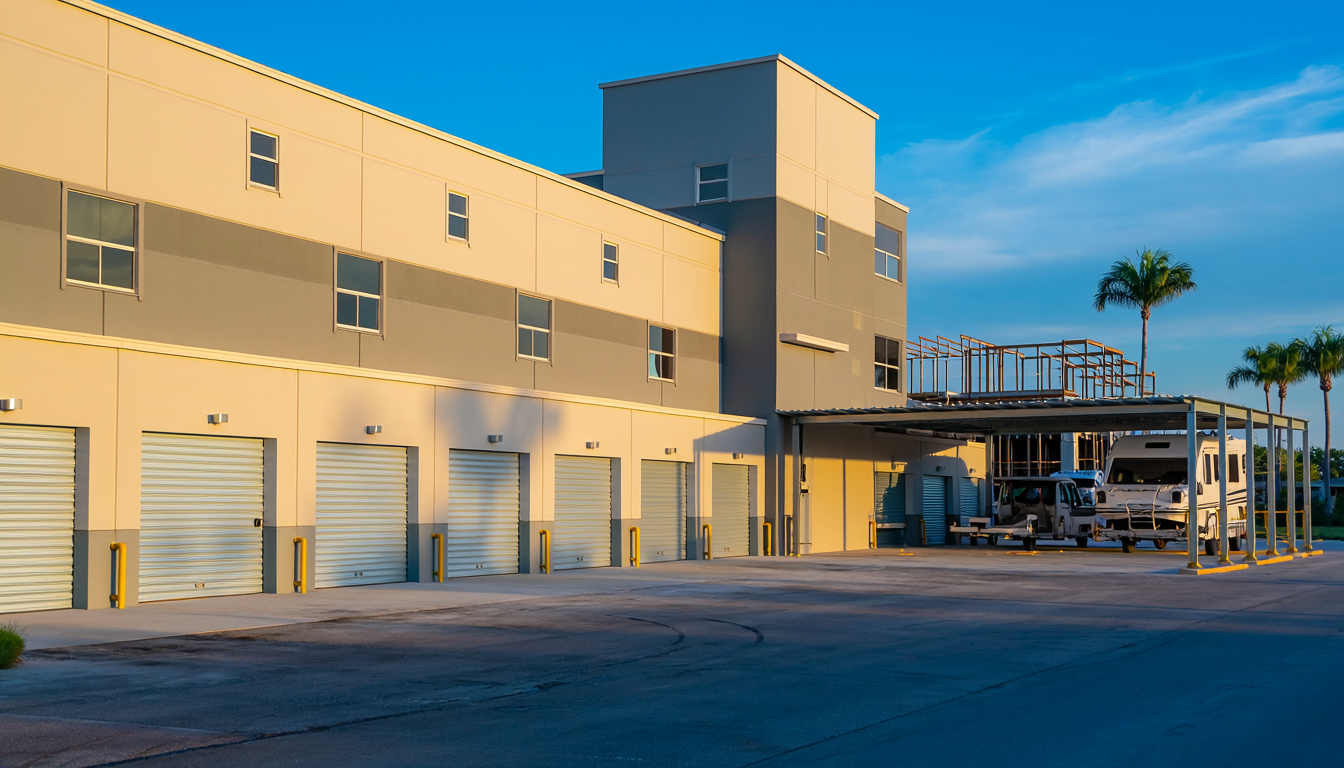
Boat and RV storage runs on different demand drivers than traditional self-storage. Homeowners association rules that bar residents from keeping boats, RVs, or trailers in their driveways create direct demand. “It’s directly correlated,” Hristodoulou says of the link between HOA restrictions and how fast units fill.
Customers will also drive much farther for boat and RV storage than for a typical self-storage unit, Hristodoulou says, which widens the pool of potential tenants. The trade-off is land: these facilities need substantially more of it, which can be harder to find in desirable markets. RSG builds boat and RV storage alongside self-storage when a site allows it, and as standalone facilities when the market calls for it. Hristodoulou says demand spans open, covered, and enclosed spaces, depending on budget and what customers are storing.
A Market That Rewards Patience
RSG’s shift reflects a broader reset in self-storage. The post-pandemic boom, when cheap capital and thin supply made almost any new facility work, is over. Building now costs more, takes longer, and carries a greater risk of opening into a crowded market. Buying, meanwhile, has become more attractive as prices adjust.
That does not mean development is finished. New facilities will still get built where demand justifies them, and acquisitions now offer a second path to growth. The opportunities are still there. Finding them simply takes more patience and discipline than it did a few years ago.
About the Expert: George Hristodoulou co-founded RSG Real Estate Development, an East Coast-focused self-storage and boat/RV storage developer operating approximately 1.4 million square feet.
This article is based on information provided by the expert source cited above. It is intended for general informational purposes only and does not constitute legal, financial, or real estate advice. Readers should conduct their own research and consult qualified professionals before making any real estate or financial decisions.