For buyers trading a dense metro for a few acres of open land, the shift involves more than square footage and views. Utilities that come standard in a city subdivision, including sewer service, water connections, and sometimes electricity, can no longer be assumed once a property sits beyond municipal systems. In the Texas Hill Country outside Austin, that gap is shaping how informed buyers approach land, according to Kristie Bryant, who leads the Best of Austin Living Team at Keller Williams.
“You have to understand what the restrictions are in that area. Don’t make assumptions,” Bryant says.
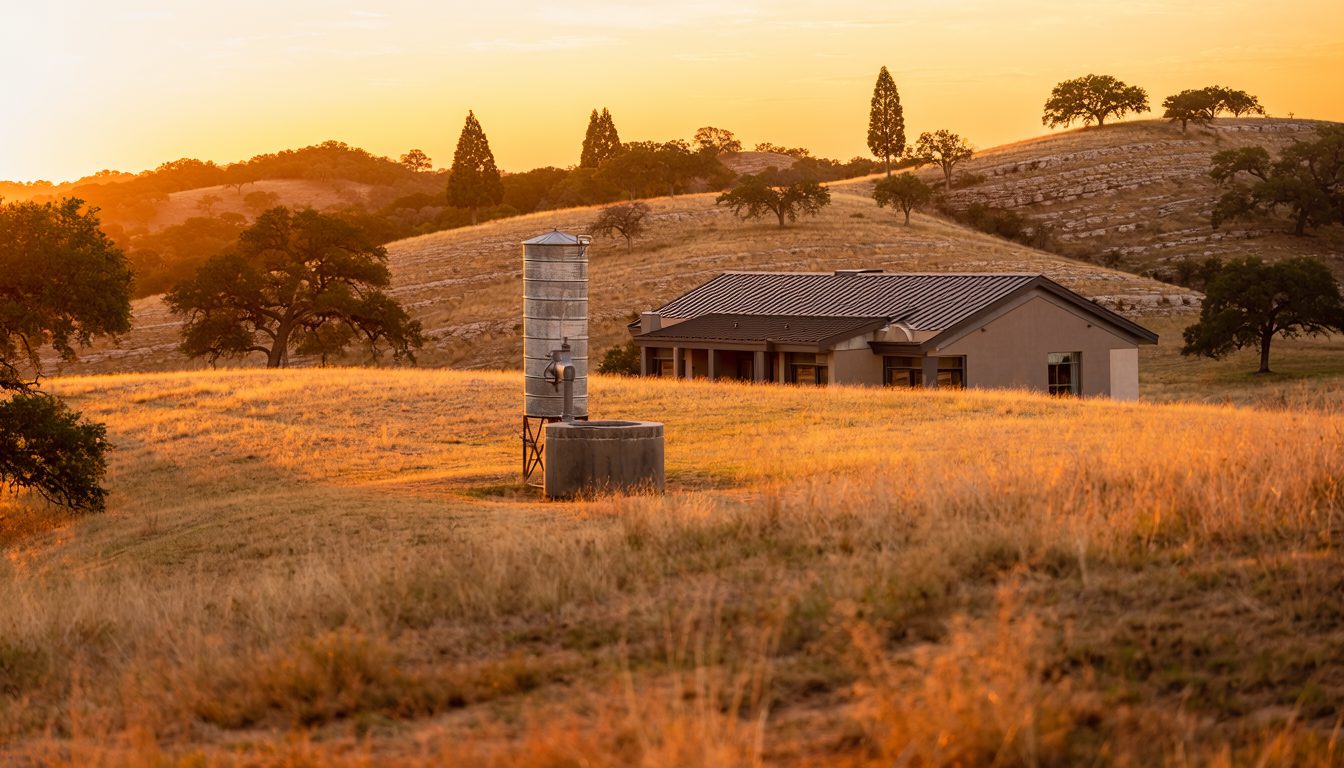
Her work includes Driftwood, a small unincorporated community in Hays County, and the surrounding Dripping Springs area, where properties commonly sit on half an acre to an acre or more. Buyers are arriving from across the country. At a recent open house, Bryant met relocating couples from Chicago and New York who wanted larger homes, more land, and fewer neighbors. For buyers coming from fully serviced urban markets, she says, water and infrastructure are where the closest due diligence belongs.
New Wells Face Resistance
The most consequential constraint involves wells. Bryant says buyers planning to drill a new well should not treat it as a simple construction expense. A drilling cost of around $20,000 would be expected, she says, but approval is the harder hurdle.
“Drilling the well is one thing. Actually getting the approval to drill it is another,” Bryant says. “Not many new wells are being approved these days.”
She has seen this play out firsthand. On a property she sold in the area last year, the buyer wanted to drill a new well and was not permitted to do so.
Existing Wells Need Scrutiny
For older properties that already have a well, Bryant says an inspection is essential. The presence of a well does not settle the question of supply.
“Even if there is a well, how much is it producing?” she says. “There’s no guarantee that that source is going to continue.”
Public Water Isn’t Guaranteed
Most properties in the area are plumbed with public water, Bryant says, even where public sewer is unavailable. Where a connection does not exist, the cost of adding one can change the economics of a purchase.
“Getting public water plumbed in, if it’s not already, is no small task,” she says. “It can be very costly to bring in both electrical and water to a property.”
Bryant advises buyers facing that question to confirm, before they purchase, that a connection is an option at all. On lots bought for a new build, she says, the builder is generally responsible for bringing in utilities, though those costs can run high.
Septic Adds a Step
Sewer is the other common gap. Many properties in the area rely on septic systems, which Bryant describes as standard rather than difficult. The difference is mainly procedural.
“It’s not anything difficult, but often permitting takes just a little bit longer,” she says. “It’s just an extra step.”
Otherwise, construction timelines have largely normalized since the pandemic, when material shortages and labor constraints stretched build times. Bryant says most builders can now complete a home in a six-to-eight-month cycle.
Builders Absorb the Groundwork
For many buyers, current inventory has reduced their exposure to these issues. Bryant says relatively few buyers in the area are building from the ground up, because there are enough completed homes on the market to choose from. Builders typically acquire the lots and handle utility work before the sale.
“Most of the people that are moving into the area are not building from scratch, so they’re not having to worry about that,” she says. “They’re working with builders who have already done that work for them.”
Buyers who purchase a lot independently and hire their own builder take on that responsibility themselves, along with a different financing structure. Bryant says a lot loan differs from a standard 30-year mortgage, with the land and home financing wrapped together once construction is complete.
A Longer-Term Water Question
Beyond individual properties, Bryant points to water supply as a regional concern. Hays County, where most of the Driftwood and Dripping Springs area sits, is challenged with water, she says, and she expects the issue to matter more over time.
“Moving forward with climate change, that is something that no matter where people live, water is going to be an issue,” she says.
Bryant has not seen a transaction fall apart over water, but she encourages buyers to weigh it as a possible future issue. Rainwater collection is one response already in use. Buyers have not been asking her about these systems, but she knows many owners who have them and recently visited a property with one. “I think that’s important,” she says.
For buyers drawn to the Hill Country by acreage, views and space, Bryant’s guidance comes down to sequence: confirm the water source, any permitting limits and the cost of utility connections before purchasing, not after.
About the Expert: Kristie Bryant leads the Best of Austin Living Team, a six-agent group with Keller Williams Southwest. The team covers the Austin, Texas metroplex, including the Dripping Springs, Driftwood, and southwest Austin markets.
This article is based on information provided by the expert source cited above. It is intended for general informational purposes only and does not constitute legal, financial, or real estate advice. Readers should conduct their own research and consult qualified professionals before making any real estate or financial decisions.