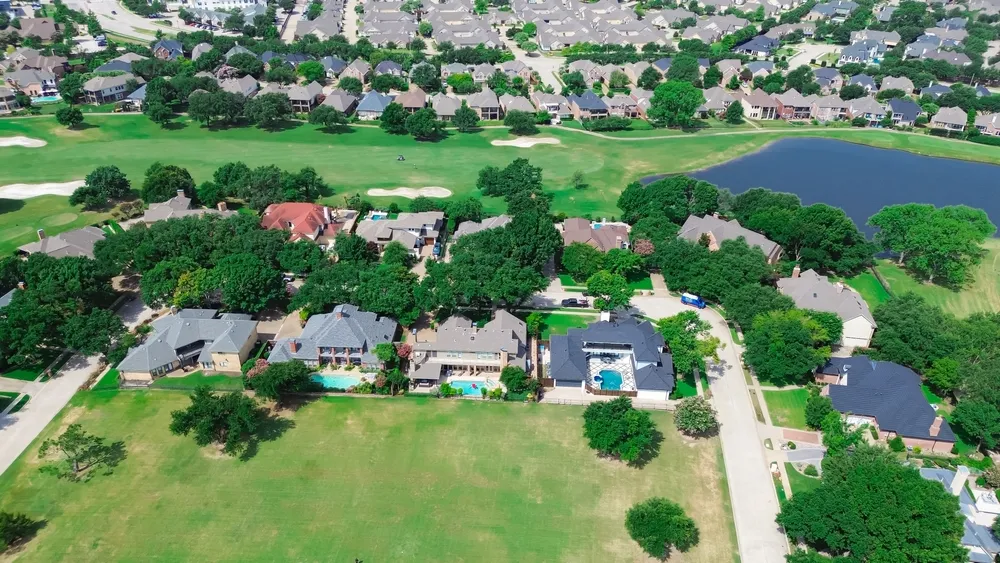
The North Dallas suburbs – McKinney, Frisco, Prosper, and surrounding Collin County – spent the past decade absorbing wave after wave of corporate relocations. Toyota moved its headquarters to the Plano-Frisco corridor. Texas Instruments is building a new facility in Sherman. Professional sports franchises set up training operations across the area. That inflow hasn’t stopped, but transactions have slowed considerably. According to Deborah Diviney, a Realtor with Coldwell Banker Apex who has worked the North Dallas market for nearly 26 years, inventory has roughly doubled over the past year while buyer activity has contracted – creating a market where sellers are anxious, and buyers are choosing to wait.
“People will fly in from different states,” Diviney says. “They come through the open house, and they’re like, ‘We’re just waiting for it to get lower and we’re going to come and move here.'”
Demand exists – people are visiting, touring homes, identifying neighborhoods – but it isn’t converting into closed deals. Interest rates, which Diviney expected to have fallen by now, have instead moved higher, keeping would-be buyers in a holding pattern that has stretched roughly a year and a half.
Choosing Between City and County
For the relocating families who are buying, the decision often isn’t about price alone. It’s about tax structure – specifically, whether to purchase inside city limits or in one of the unincorporated areas of Collin County governed by Municipal Utility Districts.
MUD districts levy their own tax to fund roads, plumbing, electrical infrastructure, signage, and bridges within and around a neighborhood. That additional tax makes the total annual cost of ownership higher than a comparable home inside a city. But the home itself is often cheaper. According to Diviney, the same floor plan can cost $30,000 less in the county than inside city limits, with the MUD tax covering the infrastructure costs that city services would otherwise handle.
“They’re going to get you one way or the other,” Diviney says.
For relocation clients unfamiliar with Texas tax structures – particularly those arriving from states with income taxes – this city-versus-county calculus is often the first major decision point, layered on top of school district preferences and proximity to employers.
What’s Moving and What Isn’t
About 80 percent of the North Dallas market is slow, by Diviney’s estimate. But pockets remain active. Fairview and Lucas, smaller communities in Collin County with larger lots, see limited inventory because homeowners rarely sell. When listings do appear, demand absorbs them quickly. Similarly, areas near the Star – the Dallas Cowboys’ practice facility – and the recently opened TPC Golf headquarters attract steady buyer interest.
The common thread among homes that sell quickly, regardless of location, is condition. Diviney, who works primarily on the listing side, describes a preparation process that starts well before a home hits the market: a professional stager conducts a walkthrough and produces a detailed spreadsheet of recommended improvements covering drive-up appeal, interior staging, scent, and backyard presentation.
“If you don’t have to sell, don’t sell,” she says. “But if you have to sell, then let’s get your house looking right.”
Homes with pools, she adds, are still selling quickly in the Texas heat. For sellers who cannot time the market, presentation is the variable they can control – and the one most likely to determine whether their listing sells in weeks or lingers for months.
Seller Concessions Are Back on the Table
The shift in leverage has brought concessions back into negotiations. Sellers are now weighing whether to reduce list price or offer buyer incentives of equivalent value – and the right choice depends on the buyer’s financial profile.
A buyer paying cash typically prefers a straight price reduction: $640,000 instead of $650,000. A buyer financing the purchase may prefer a $10,000 credit toward closing costs, which can be used to buy down the interest rate. Diviney frames this as a case-by-case decision tied to what works best for the specific property and the buyer sitting across the table.
This flexibility marks a clear departure from the seller-dominated market of recent years, when multiple offers and waived contingencies were common. Sellers who resist concessions entirely risk watching their listings age on the market while competitors adapt.
A Market Waiting for a Catalyst
The broader mood in North Dallas is one of patience wearing thin. Sellers want to know why no one is looking at their homes. Buyers want rates to drop before committing. Diviney says the economic conditions that would typically justify lower rates have been present for some time, but the reduction hasn’t materialized.
“If you look at the economic forecast and everything on the definition of when you should be doing that, it should have already happened, and it just hasn’t,” she says. “We’re keeping our fingers crossed it’s going to happen soon.”
The market’s underlying fundamentals remain intact. North Dallas continues to attract corporate relocations, its cities still rank among the safest and most livable in America, and it carries no state income tax – a draw Diviney says remains a decisive factor for buyers relocating from higher-tax states. The DFW metro area is roughly the size of Connecticut, and buyers arriving from out of state often underestimate how localized conditions can be within it.
“You wouldn’t go to an agent in Connecticut and say, show me the state,” Diviney says.
For now, the gap between interest and action defines North Dallas real estate. Buyers are identifying where they want to live. They are touring homes and attending open houses. They are not yet writing offers. If rates decline, Diviney expects the pent-up demand currently sitting on the sidelines to move quickly – a scenario that could tighten inventory again in the same neighborhoods where supply has recently built up.
About the Expert: Deborah Diviney is a Realtor with Coldwell Banker Apex, with nearly 26 years of experience serving the North Dallas market across McKinney, Frisco, Prosper, and surrounding Collin County.
This article is based on information provided by the expert source cited above. It is intended for general informational purposes only and does not constitute legal, financial, or real estate advice. Readers should conduct their own research and consult qualified professionals before making any real estate or financial decisions.