Most small mountain towns in the American West have a straightforward real estate story: pandemic-era demand inflated prices, and now those prices are correcting. Taos County, New Mexico, is not following that pattern. Per-square-foot prices there are still climbing, according to Karen Todd, a real estate professional with The Dragonfly Group at Berkshire Hathaway HomeServices Taos Real Estate, even as buyers have become pickier and the frenzy of 2021 and 2022 has faded. Todd, who has lived in the area for 30 years, points to a factor that shapes nearly every conversation she has with incoming buyers: Taos sits at 7,300 feet in elevation, and temperatures never reach triple digits.
“We have people coming from Texas, Austin in particular, just coming because we are quite a bit cooler,” she says. “As places are heating up, maybe that is why our market is actually still doing quite well.”
The Buyer Profile Has Changed
The buyer mix in Taos has shifted from its pre-pandemic composition. Todd estimates that about 40% of her business comes from locals upsizing or downsizing within the community, while the remaining 60% comes from outside the area. The market used to be dominated by second-home buyers. That is no longer the case.
Todd recently closed a transaction with a couple from Texas who initially came looking for a part-time residence. They ended up selling their Texas home and relocating to Taos full-time. She sees this as representative of a broader pattern: buyers arriving for early retirement, remote work, or a lifestyle oriented around outdoor recreation, skiing, hiking, biking, in a town bordered by national forest and the Rio Grande National Monument.
The trade-off is access. The nearest international airport is a two-and-a-half to three-hour drive away in Albuquerque. “If you come to Taos, you have to really want to be in Taos,” Todd says. The remoteness filters out casual interest and selects for buyers who are committed to a slower, quieter way of life.
Price Sensitivity Is Sharp and Segmented
The speed at which properties move in Taos depends heavily on price. According to Todd, homes listed under $500,000 tend to sell within 90 days or less. Between $600,000 and $800,000, sellers can expect roughly 160 days on the market. Above that range, the wait stretches even longer.
That segmentation creates a particular problem for sellers who purchased fixer-uppers at premium prices during the pandemic, invested heavily in renovations, and are now trying to recoup the full amount. Todd says those conversations are difficult. “It’s really hard to break the news to them that they’re probably taking a loss because of the time that they bought and the way the market has shifted,” she says. The renovation math that worked during the pandemic often does not work three or four years later, even in a market where per-square-foot values have recovered somewhat.
Buyers, meanwhile, have grown more selective. Todd describes today’s buyers as savvier and more detail-oriented, expecting every element of a property to be complete before committing. In a market with many owner-built and alternatively constructed homes, that scrutiny adds another layer of complexity for sellers.
Acequias, Adobe, and the Agricultural Draw
One of the most distinctive features of Taos real estate is the acequia system, an ancient network of irrigation ditches used to move water across agricultural land. Properties in outlying areas like San Cristobal often have active acequias, which allow small-scale farming: gardens, fruit trees, sheep, goats, chickens. Todd works with younger buyers who hold remote jobs and want to supplement their income through agriculture. The acequia infrastructure makes that viable in ways it would not be in most Western markets.
Todd helps these buyers navigate the system when they arrive and connects them with established local farmers. Northern New Mexico has a long agricultural history, and the acequia network is central to how that tradition continues in practice.
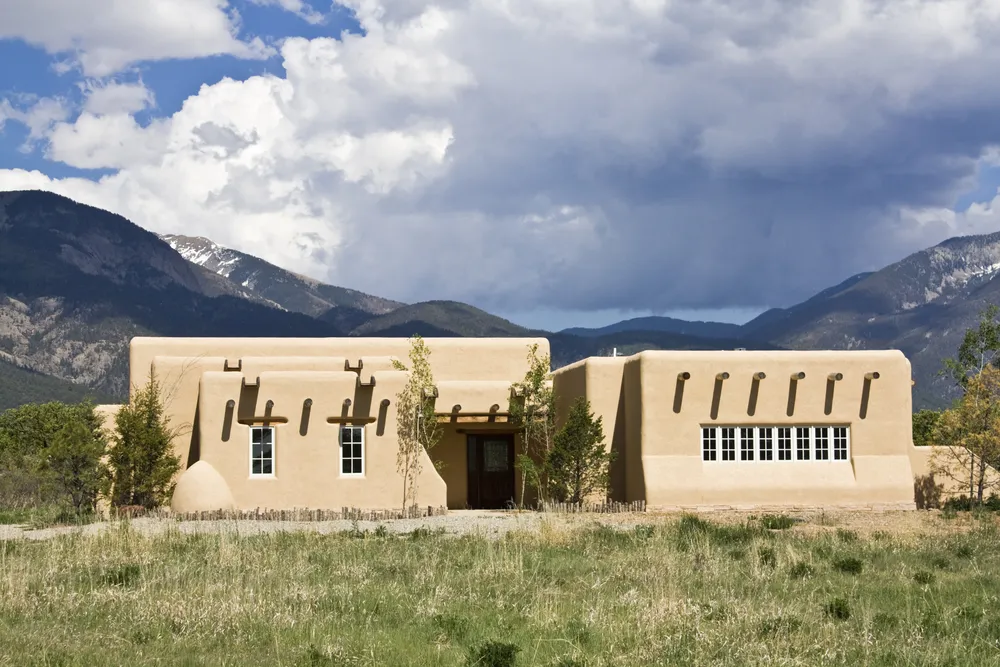
The building stock is equally distinctive. Adobe is the primary construction material, but Todd also encounters rammed earth, roster block, and earth bag construction. For buyers who understand these methods, the appeal is strong. For those unfamiliar, the materials can be intimidating, a gap Todd says she helps clients bridge by explaining what each material means for maintenance, durability, and livability.
Where the Opportunities and Risks Sit
Certain pockets of Taos County hold their value more consistently than others. Todd identifies Arroyo Seco as the most desirable submarket, an agricultural village bordering Pueblo land, close to the ski valley, with per-square-foot prices higher than anywhere else in Taos.
For investors considering the broader market, Todd points to two areas of opportunity. The first is workforce housing, which she identifies as a clear need. The second is the farm-to-table food service sector, which she says the community actively embraces.
The primary risk she watches is insurance. Taos is surrounded by national forest, and many homes border that forest directly. “That is something that we always have our ear to the ground on,” she says. In a market where wildfire proximity shapes underwriting decisions, insurance availability and cost remain a persistent concern for both buyers and existing homeowners.
Todd’s advice for anyone considering Taos is practical: visit first. “There’s nothing cookie-cutter about it,” she says. “Everything here, including the houses, is just different.” The town’s appeal is inseparable from its strangeness, its ancient irrigation systems, its adobe walls, its distance from anywhere else. Buyers who thrive here are the ones who came knowing that.
About the Expert: Karen Todd is a real estate professional with The Dragonfly Group at Berkshire Hathaway HomeServices Taos Real Estate and has lived in the Taos, New Mexico area for 30 years.
This article is based on information provided by the expert source cited above. It is intended for general informational purposes only and does not constitute legal, financial, or real estate advice. Readers should conduct their own research and consult qualified professionals before making any real estate or financial decisions.