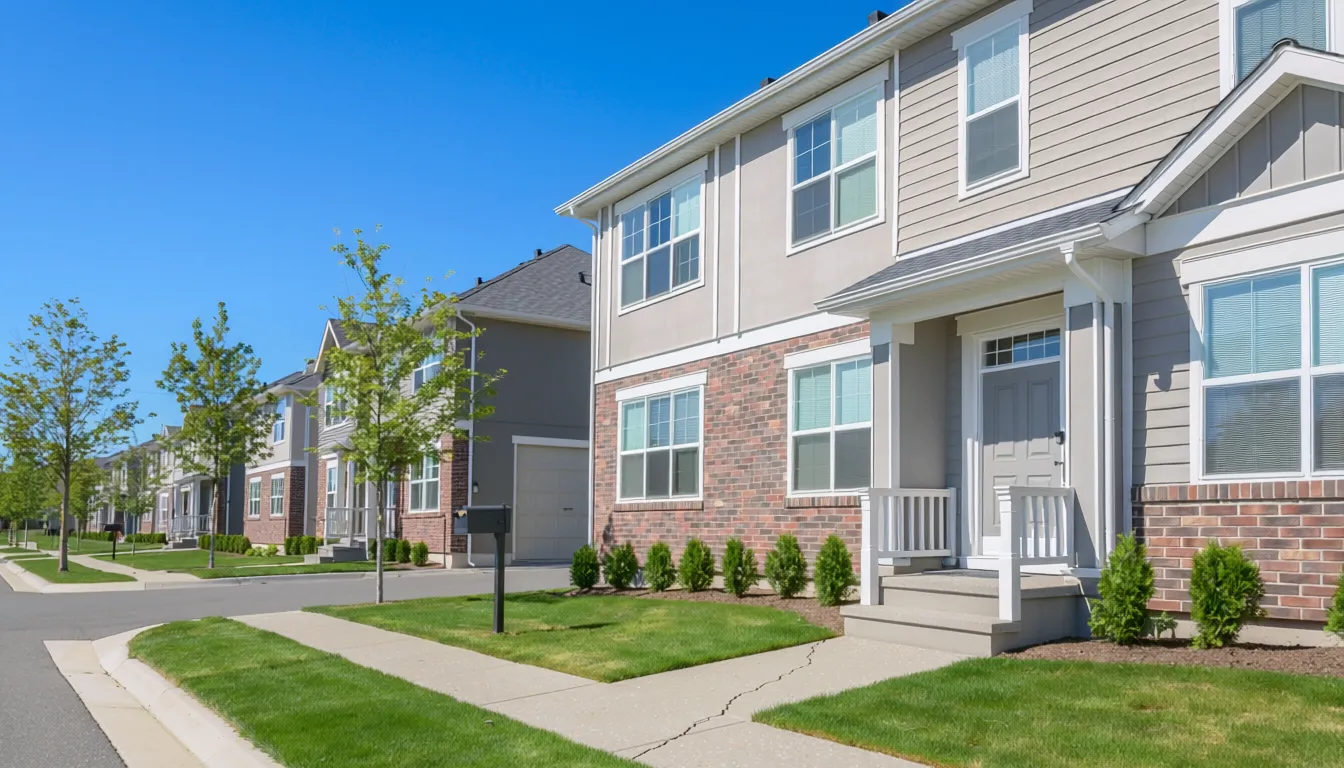
For years, townhouses in central New Jersey served as a natural entry point for buyers priced out of single-family homes. That math is changing. Rising association fees, new mortgage review requirements for townhouse purchases, and a broader shift in buyer sentiment are creating a split, one where the housing type that was supposed to be the affordable option is losing its advantage.
The split is visible across Somerset, Hunterdon, and Middlesex counties, where market conditions now vary sharply by housing type and proximity to New York City. Christina Duncan, who leads the Diamond Key Team at eXp Realty in Somerville, New Jersey, has been working central New Jersey real estate since 2000 and has sold over a thousand homes. She describes May 2026 as a turning point. “I would say this May was really a defining point where our market has shifted,” she says.
A Market That Runs on a Gradient
Central New Jersey sits between Philadelphia and New York City, and the New York commute corridor largely dictates how fast homes move. In Middlesex County, closer to the city, most properties sell in under 30 days, including townhouses. In Somerset County, the market is still active but starting to weaken. Move further west into Hunterdon County and listings routinely hit 30 days on market, a figure that would have been unusual two years ago.
“The closer you are to New York City, the hotter the market is,” Duncan says. “The further away you are from New York City, the quieter it is.”
Even within those geographies, the townhouse segment is underperforming. Duncan says townhouse inventory has grown noticeably, competition among sellers is rising, and prices are leveling off or dropping in some areas.
New Townhouse Rules Are Shrinking the Buyer Pool
Part of what is weighing on the townhouse market is a regulatory change. In August, new national rules requiring full reviews on townhouse purchases took effect, and Duncan says the impact has been immediate. Some townhouses are failing to get mortgage approval entirely.
“I’ve had some townhouses that are not getting approved for mortgages,” she says.
The lending issue compounds another pressure: association fees. Duncan says nearly every homeowners association has had to increase fees substantially in recent years. When buyers run the numbers, single-family homes are now more affordable than townhouses in many cases, a reversal of the traditional calculus. “When you start doing the math, it’s more affordable to buy a single-family home than a townhouse in most situations,” Duncan says.
The result is a buyer migration she considers typical of a cooling market. As townhouse prices soften and single-family homes become relatively more competitive, buyers who might have settled for attached housing are widening their search.
Sellers Are Adjusting
The broader seller’s market hasn’t disappeared, but the days of minimal effort are over. Duncan says the period when sellers could list a home in poor condition and expect a bidding war has ended. Staging, preparation, and realistic pricing are back.
“We’re definitely going back to staging, actually having to prep a home for sale,” she says. “Definitely not just throwing a house on the market and then going 10% above the last one and thinking it’s going to sell.”
Price reductions are now appearing across property types, including single-family homes. Duncan notes that buyers have become more cautious and deals are more fragile. Home inspections have become a daily source of friction – sellers reluctant to make repairs, buyers unwilling to compromise. Appraisal gaps remain a deal-killer too. She recounted a recent transaction where a first-time buyer’s bank under-appraised a property by roughly 20 percent, nearly collapsing the deal before a lender switch saved it and closed in 11 days.
The Fed’s recent rate increase, which pushed mortgage rates above 7 percent, has added another layer of anxiety. Duncan says she received a wave of calls from nervous clients after the announcement. “We had high hopes a week ago, but I think those hopes have been crushed a little bit in the past week,” she says.
The Lock-In Effect Persists in the Middle
One structural constraint continues to limit supply in a specific price band. Homeowners sitting in large homes with mortgage rates around 2 percent have little financial incentive to sell, even if they no longer need the space. Duncan says this is still a factor, though it is gradually loosening.
The effect is uneven. Townhouse inventory is growing, and the multimillion-dollar segment is slowing, but the middle of the market – where those locked-in owners would typically be selling – remains tight. “In that sweet spot, the middle class, we’re not seeing a slowdown because there’s no inventory still,” Duncan says. “And that’s still a problem and probably going to continue to be a problem for the next year or two.”
What Investors Should Watch
For buy-and-hold investors considering central New Jersey, Duncan’s advice is direct: wait. She believes the market will move out of seller’s territory by year-end or into 2027 and recommends watching for the next 12 to 18 months before deploying capital. Fix-and-flip opportunities still exist, she says, but the hold strategy doesn’t work at current pricing.
She also expects short sales and foreclosures to resurface. “There’s not really a market for it in this day and age, but I do think that will be making a surge as we enter 2027,” she says.
Employment is the other variable Duncan is tracking. Several major companies have relocated out of New Jersey or closed operations, and while she says the effects have not yet shown up in residential transactions, the risk is building. Warehouse construction and data center development in the region could also reshape demand patterns for nearby residential areas, though the direction of that impact is not yet clear.
For sellers, her message is equally direct: “I wouldn’t wait, because change is already happening, and waiting another year or two, it’s not going to go up for sure.” For buyers, Duncan says purchasing still makes financial sense even at 7 percent rates, because rents in the area remain higher than mortgage payments.
About the Expert: Christina Duncan leads the Diamond Key Team at eXp Realty in Somerville, New Jersey, covering Somerset, Hunterdon, and Middlesex counties since 2000.
This article is based on information provided by the expert source cited above. It is intended for general informational purposes only and does not constitute legal, financial, or real estate advice. Readers should conduct their own research and consult qualified professionals before making any real estate or financial decisions.