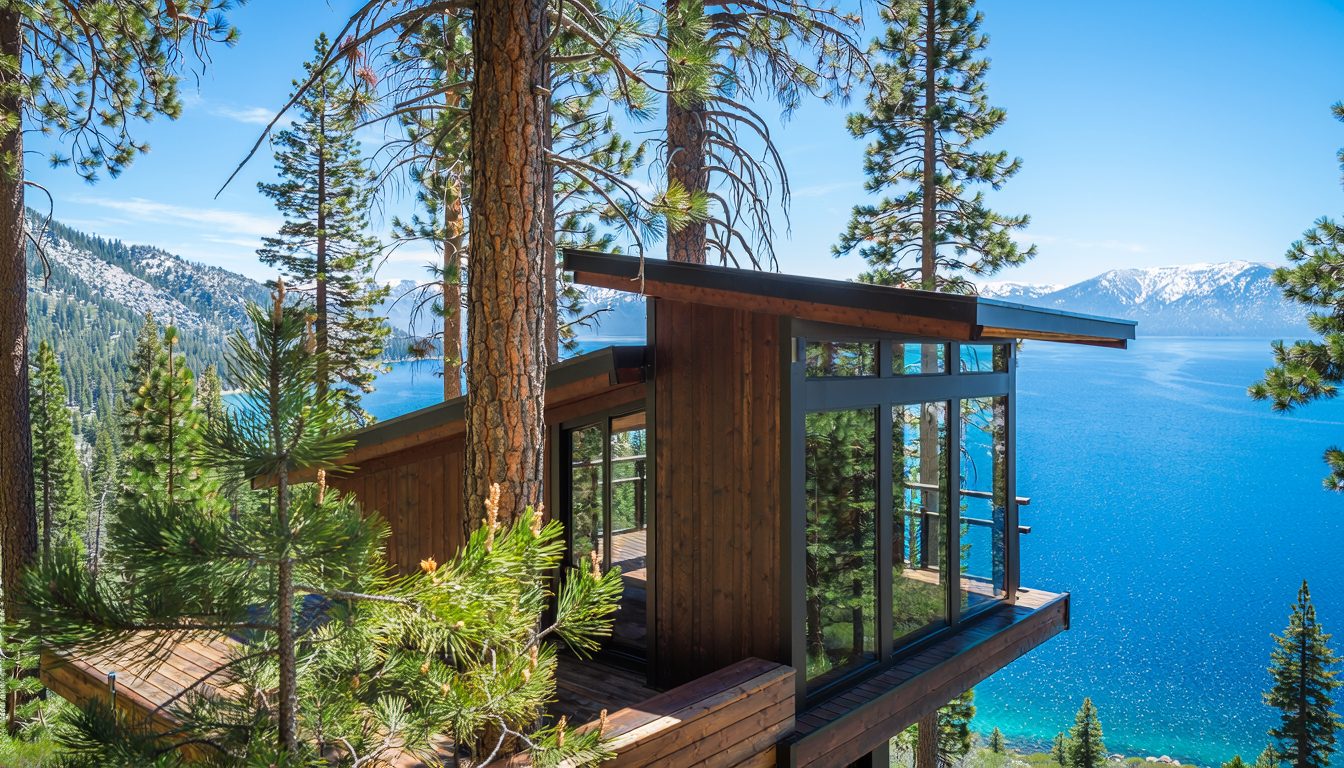
Recreation drives the Lake Tahoe real estate market, and the San Francisco Bay Area supplies most of the buyers. Within that pool, a younger cohort of AI-sector buyers is now arriving in greater numbers. But inside the Tahoe Basin, those buyers meet a supply of buildable land that regulation keeps small, along with building codes and insurance costs that raise the price of ownership.
The AI buyers are entering a market built mostly on second homes. Dave Westall, team lead of the Westall Real Estate Team with Sierra Sotheby’s International Realty, estimates that roughly 80% of his business involves vacation and second homes for buyers from San Francisco, Sacramento, and Reno who come to ski, hike, and spend time on the lake. The Bay Area, from Monterey Bay to Napa and Sonoma, supplies the most buyers, among them tech workers, attorneys, and medical professionals. AI workers have joined that mix in growing numbers, and like the buyers before them, they are purchasing for recreation rather than need.
A Younger Buyer
What sets the AI-sector buyers apart is their age. Westall sees buyers in their late twenties and early thirties purchasing vacation homes, and some of them don’t own a primary residence at all. They rent apartments in the city, which costs them less than owning there, and put their purchasing power into a Tahoe property instead.
These buyers know what they want. They look for polished, turnkey properties regardless of size, with distinctive views, a strong location, and a peaceful setting, and some gravitate to communities with their own golf courses or ski resorts.
In most other respects, Westall says, they resemble the tech buyers who came before them. The difference lies in volume: more people now work in AI, so more of them are buying. He expects that to continue, with Anthropic’s public offering arriving this month, OpenAI’s expected next year, and a long list of lesser-known startups run by young, athletic founders who want to spend time outdoors. That demand adds to sales volume. “We’ve always benefited from tech workers buying into our market, but I think that’s a trend that will continue in the coming years as more and more of these companies become successful,” he says.
Scarcity Inside the Basin
That demand hits a hard limit when buyers want to build, because regulation, not the market, sets the supply of buildable land inside the Tahoe Basin. The Tahoe Regional Planning Agency, which California and Nevada created through a compact Congress approved, governs development across the Basin with a mandate to protect the lake’s clarity by reducing the runoff that carries sediment into it. TRPA rates vacant lots for buildability, and steep slopes or stream environment zones, such as a wetland, stream, or seasonal creek crossing the property, can limit or rule out construction.
The last figure Westall heard put the number of buildable lots across the entire Basin at roughly 2,800, which leaves few in any single community. When one with a good coverage ratio comes up, buyers compete for it. Westall recently listed a level half-acre lot in the Pineland community near Sunnyside, twice the size of a typical parcel and with a strong coverage ratio, close to ski resorts, Tahoe City restaurants, and the lake’s beaches. He priced it at $570,000, a figure he felt pushed the market, and it still drew multiple offers. “Even in a more challenging market like we’re working in now, there’s a high level of interest in those properties,” he says.
Truckee, 15 minutes from the lake, shows what the market looks like without those limits. It has none of the Basin’s coverage restrictions, and most of its lots are buildable. “Your average lot in Truckee is going to cost a lot less than your average lot over at Lake Tahoe, and that’s because of the scarcity of the supply of vacant land,” Westall says.
Modular’s Smaller Savings
Buyers who do secure a lot face a second question, which is how to build on it, and modular construction appeals for several reasons. Many modular companies offer modern designs that buyers don’t find elsewhere in the market, and factory construction brings tighter quality control. Building indoors also sidesteps Tahoe’s short construction season. Westall notes that local builders were rushing to button up projects in early November ahead of a major snowstorm, while factories keep working all winter.
The design savings are real: modular companies sell the same in-house designs again and again, which spares buyers a custom architect’s fee of $20 to $50 per square foot. The overall savings, however, fall short of what buyers expect, according to what Westall hears from builders and clients. The prices modular companies post online typically reflect homes in places without heavy snow or seismic requirements. Tahoe’s codes account for both, since a big winter can bring 50 feet of snow, so the engineering calls for more wood, more steel, and more fasteners. Bay Area buyers rarely anticipate that, and they end up with “not as much savings as they would think,” Westall says.
Insuring a Tahoe Home
Whether buyers build or buy, insurance becomes one of the largest costs of ownership, though in Westall’s experience it hasn’t stopped a sale. The entire Lake Tahoe region carries a high fire severity designation, and most carriers won’t write fire insurance there. A buyer’s longtime insurer back home may warn right away that coverage is hard to get. Even so, “I have yet to have a client not be able to get an insurance policy,” Westall says, and none of his escrows has fallen through over insurance. He credits a network of brokers who work regularly in the Tahoe market.
The policies those brokers find aren’t cheap, and the cost climbs with home values. Many buyers end up on the California FAIR Plan, which Westall describes as relatively expensive and capped in coverage, but “a good option when there are no other options.” Higher-net-worth buyers have another route, because some secondary-market insurers write solid policies for luxury homes owned by people who already insure businesses and other assets.
Condition Over Fire Features
Fire risk shapes the paperwork of every sale, but it doesn’t set the price. California requires sellers in high fire-hazard zones to document defensible space compliance, so every Tahoe buyer receives an inspection report, and the parties negotiate over who obtains the fire agency’s sign-off. Class A roofs carry little weight either, because permitted roof replacements have earned that rating since around 2007, which makes them standard rather than a selling point. “It does play a factor, but it’s not the deciding factor in these transactions,” Westall says.
Condition, by contrast, does command a premium. Buyers pay more for polished properties at any size and price point, especially in the right location and setting. That premium reflects what AI-sector demand finds in Tahoe: buyers who can afford to be selective, a fixed supply of buildable land in the Basin, and construction and insurance costs that raise the price of owning there.
About the Expert: Dave Westall is team lead of the Westall Real Estate Team with Sierra Sotheby’s International Realty in Lake Tahoe, California, where he represents buyers and sellers of vacation homes, second homes, and land.
This article is intended for informational purposes only and does not constitute legal, financial, or investment advice. The views and opinions expressed herein reflect those of the individuals quoted and do not represent an endorsement of any company, product, or service mentioned. Readers should conduct their own due diligence and consult qualified professionals before making any investment decisions.