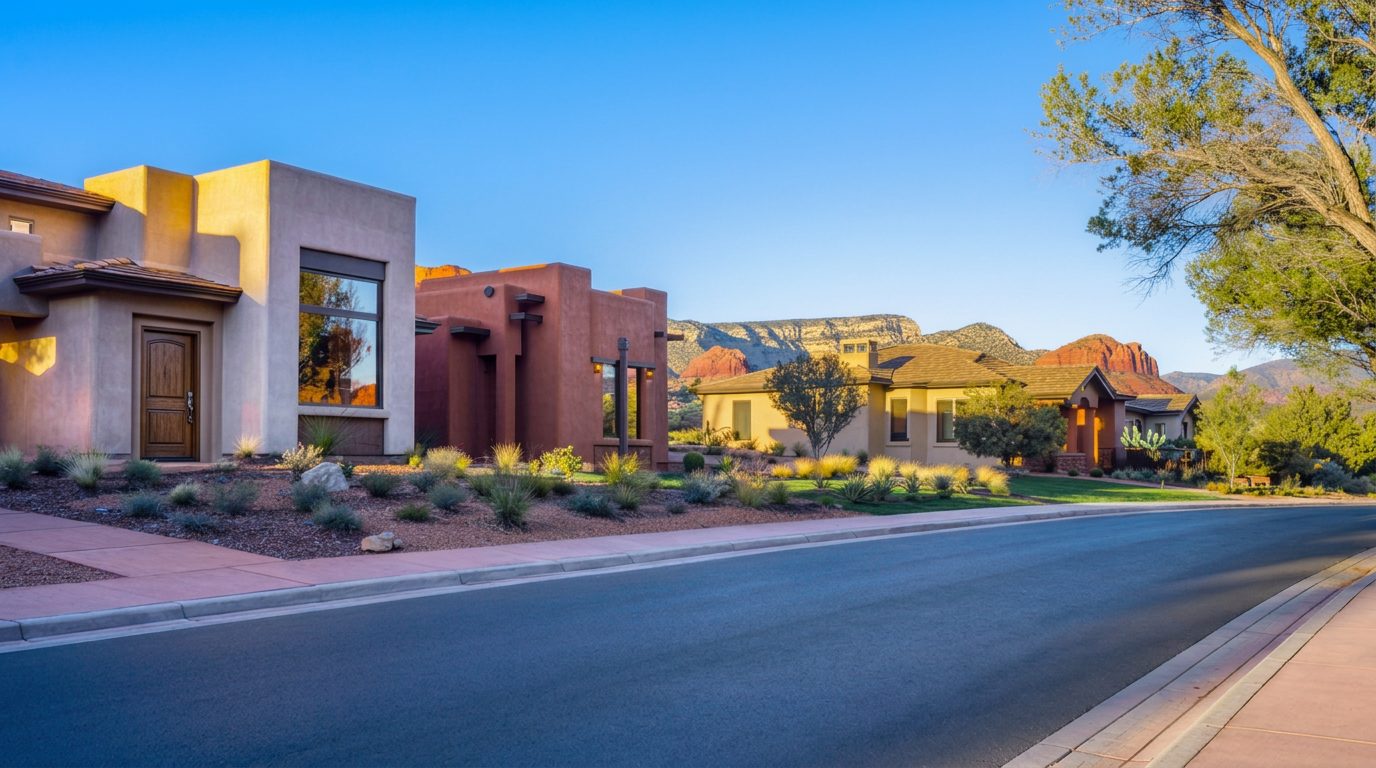
Most buyers in Sedona don’t need a mortgage. By the account of Dyanna Nichols, who leads a four-person team at Realty ONE Group Mountain Desert, more than half of the town’s buyers pay cash. On paper, that should make the market one of the least rate-sensitive in the country.
In practice, Sedona is moving slowly anyway. Nichols says the reason has less to do with financing than with how her buyers – mostly retirees – read the news. When the headlines look uncertain, both buyers and sellers wait. Local market data backs up the cash-heavy picture, with the all-cash share of Sedona purchases running at about 50 percent. For those buyers, a quarter-point move in mortgage rates changes little.
What does change their behavior, Nichols says, is the wider news cycle. Her typical client is a retired baby boomer who follows the stock market, cryptocurrency and the war with Iran, and who treats uncertainty as a reason to pause. “If something is not looking good, they will not make moves and they will sit on their hands, whether they’re buyers or their sellers,” she says. “They will simply pause until they feel more comfortable.” Elections have the same effect. “Every time there are elections, the market stalls a bit,” Nichols says. With the midterms now behind them, she says, many buyers and sellers had been waiting to see what changed.
What Waiting Looks Like
The pause shows up in volume. In the City of Sedona’s 86336 zip code, properties sold were down 13 percent year over year as of the fall. The slowdown is visible in pricing as well. Nichols, whose business leans toward listings, says roughly 37 percent of current listings in her data have taken price reductions – a sign, in her view, that many sellers started too high. Homes are taking months to move from listing to closing, she says.
On the buyer side, she describes a mindset more than a statistic. “Almost every single buyer that comes forward with offers is low balling because the sentiment right now is that it’s a buyer’s market,” she says. Those low opening bids are where negotiations start, and homes that sold in 86336 have closed at about 96.7 percent of list price on average.
Informed Buyers
The buyers who are active are selective, and one question often decides it. According to Nichols, about half of her buyers are purchasing a vacation home, and for many of them the deal breaker is whether the property can be rented nightly on platforms like Airbnb and VRBO. “They don’t want the property just sitting there,” she says. “They want the house to be used and to make money on it.”
In Sedona, that answer usually comes down to the neighborhood’s rules rather than the city’s. Arizona law limits how cities can regulate short-term rentals, but homeowners associations can still restrict them, and the City of Sedona leaves it to owners to check their HOA rules.
Nichols sees a generational pattern in who wants what. Her baby boomer clients, she says, often prefer neighborhoods without nightly rentals, where they know their neighbors. Buyers seeking rental eligibility tend to be more affluent Gen X and millennial purchasers adding a second or third home. “They want property that is multifaceted so that it can pay for itself,” she says. “Otherwise it’s not worth it to them.”
Who Is Still Coming
Nichols’ typical client is an outdoorsy retiree, either relocating full time or buying a winter home to escape colder climates. Her buyers come largely from the Northeast, the Midwest and the Pacific Northwest, she says, with more arriving from California, Florida and Texas since the pandemic.
Taxes are part of the draw, particularly for retirees on fixed incomes. Arizona’s effective property tax rate on owner-occupied homes is 0.48 percent, among the lowest in the country. Nichols points to buyers leaving high-tax states in the Northeast: “Connecticut, New Jersey, New York, Maryland. All those places have super high property taxes,” she says. “So when they come to Arizona, they’re really excited about saving money.”
Pricing also varies within Sedona itself. Nichols says the Village of Oak Creek, an unincorporated community in county territory, typically sells for 20 to 25 percent less than West Sedona, reflecting its more rural character. Entering 2026, the City of Sedona averaged $567 per square foot versus $443 in the Village.
Looking Into 2027
What would break the pause? Nichols lists a stabilizing stock market, calmer geopolitics, steadier cryptocurrency and lower mortgage rates. Even in a majority-cash market, she sees rates as a bellwether for mood. “It’s all tied in with the news and the media,” she says.
That mood has tracked rates closely this fall. The 30-year fixed dipped to about 7.17 percent in early November, down from the high 7s – “a relief to see,” Nichols says – before moving back to 7.28 percent by mid-month. In a market that waits on sentiment, that back-and-forth matters as much as the rate itself.
Nichols remains optimistic about where things go from here. “There’s been a negative attitude about the housing market,” she says. Once rates come down further and settle back into the 6 percent range, she expects to see renewed energy in real estate after a long stretch of high borrowing costs.
About the Expert: Dyanna Nichols is a real estate agent with Realty ONE Group Mountain Desert in Sedona, Arizona, where she leads Dyanna Nichols Real Estate Professionals. Her practice focuses on residential sales, with an emphasis on listings, in Sedona and the Village of Oak Creek.
This article is intended for informational purposes only and does not constitute legal, financial, or investment advice. The views and opinions expressed herein reflect those of the individuals quoted and do not represent an endorsement of any company, product, or service mentioned. Readers should conduct their own due diligence and consult qualified professionals before making any investment decisions.