Franklin County, Pennsylvania, does not behave like one housing market. It behaves like three, split along price thresholds that reflect a widening gap between buyers who can afford to move and those stuck in place. Under $350,000, homes sell fast, sometimes in days. Between $350,000 and $475,000, listings sit. Above $500,000, cash buyers close without hesitation. The pattern says less about local preferences than about an affordability squeeze playing out with unusual clarity in a county that depends heavily on a single economic engine: the logistics corridor along Interstate 81.
From Manufacturing Hub to Warehouse Bedroom Community
Waynesboro, the county’s anchor, spent decades as a manufacturing town with eight to ten large facilities employing much of the population. According to Josh Mummert, owner and broker of Iron Valley Real Estate of Franklin County, that identity collapsed around the 2007–2009 housing crash, when factories closed, foreclosures spiked, and the local economy hollowed out. What replaced it was geography. Waynesboro sits about 10 minutes from I-81, and roughly a third of the regional population lives within a three-hour drive of the interstate. That proximity attracted distribution centers – close to 70 or 80 warehouses now operate within a 45-minute radius, receiving goods from the Port of Baltimore and dispersing them to cities from Boston to Florida.
The jobs these warehouses created are not marginal. Mummert estimates warehouse workers earn $24 to $40 an hour – solid wages for a market where a new-construction home can still be purchased in the low $300,000s. “Our identity changed,” he says. “It went from a manufacturing community to a bedroom community for these warehouses.”
The Cross-Border Affordability Draw
Waynesboro’s location – an hour from Baltimore, 90 minutes from Washington, D.C., and an hour south of Harrisburg – places it at the edge of several expensive metro areas without carrying their prices. Mummert estimates that housing and rentals can run 20% cheaper on the Pennsylvania side of the Maryland line, a gap wide enough to pull buyers across the border. Pennsylvania’s tax treatment of retirees adds another draw.
The result is a buyer pool that skews heavily nonlocal. Mummert estimates that roughly 80% of the 35 to 40 homes he personally sells each year go to buyers who are not originally from Waynesboro. The mix spans young professionals, middle-class families, and retirees relocating from Maryland or West Virginia. New construction in the area, priced between $315,000 and $375,000, offers something buyers say they cannot find across the state line. “You go across the Maryland line to try to find something that’s new in that price range, and you’re not going to find it,” Mummert says. “It doesn’t exist.”
The Squeezed Middle
The three-tier dynamic maps directly onto how interest rates at 6% to 7% are sorting buyers by financial position. Households shopping under $350,000 can still make the math work. Buyers above $500,000 tend to pay cash, making rates irrelevant. The middle tier – $350,000 to $475,000 – is where dual-income families with children and existing debt find themselves unable to close the gap between what they earn and what current rates demand in monthly payments.
Mummert sold seven new homes under $350,000 in a 10-day stretch. Meanwhile, listings in the $350,000 to $475,000 range linger. “That market tends to be a little bit slower just because they don’t have enough cash on hand or for payments to be able to afford to buy at this point in time,” he says. The pattern reflects what he describes as a widening divide: “You’re either on the bottom tier of living day to day, paycheck to paycheck, or you have money and don’t have to. And that group is growing further and further apart.”
New Construction as an Affordability Strategy
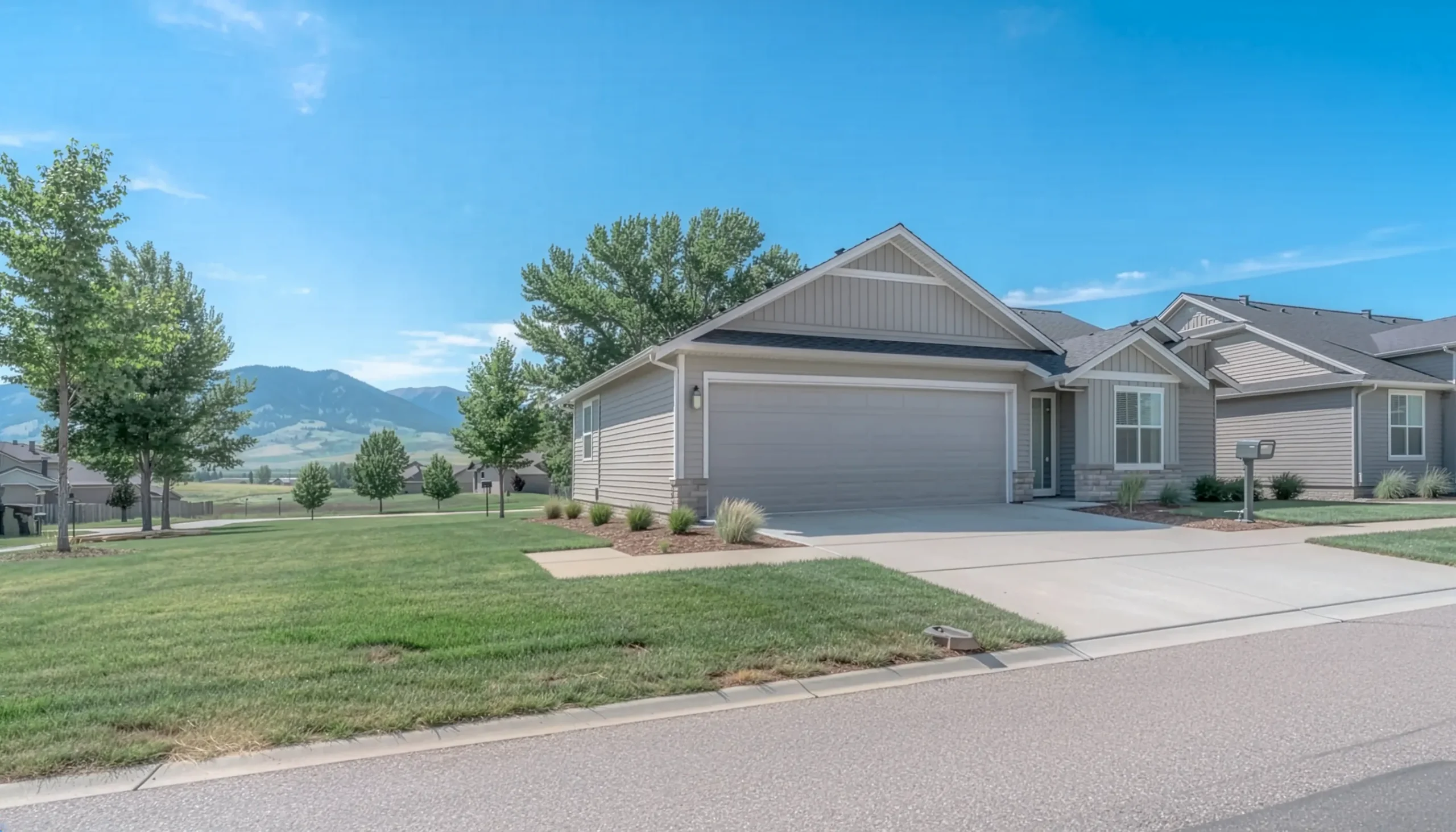
At Antietam Commons, Mummert’s development, the approach is to keep new homes as near as possible to that fast-moving sub-$350,000 range. The project offers split foyers ranging from 1,400 to 2,200 finished square feet and ranchers from 1,250 to about 1,800 square feet. By leaving the lower level unfinished – skipping a basement bathroom and family room – Mummert says he can cut $20,000 to $30,000 off the price. Buyers who want those spaces finished can add them later. The ranchers appeal to a wide range of buyers: first-time purchasers, single parents, and retirees drawn to single-level living. “We’re building that product at the 315 to 375 range, which is really selling,” Mummert says.
Farmland Under Pressure
Agricultural land in the area is climbing at a pace that would have been difficult to imagine five years ago. Mummert recalls that $10,000 an acre was considered a strong price not long ago. Two years ago, he helped a client purchase 108 acres at roughly $17,500 per acre – a number he calls unprecedented. A sale he handled two weeks before the interview, 140 acres about 20 minutes away, closed at $23,000 to $23,500 per acre. Farmers looking to expand are competing against these rising prices simply to keep ground in agricultural use. Development pressure exists but remains limited by high infrastructure costs for stormwater, utilities, and other site work. Most new construction is occurring on lots platted years ago rather than on freshly developed land.
What Investors Should Watch – and Avoid
For outside capital looking at Franklin County, Mummert draws a clear line. He cautions against commercial office space, citing weak leasing demand driven by remote work and online business. Multifamily, by contrast, looks more promising – apartment complexes going up in Waynesboro and a 60-unit townhouse project currently in infrastructure could eventually present acquisition opportunities. Rents locally remain strong enough to support returns across several property types, he notes, provided broader economic conditions hold.
That caveat matters. The same logistics corridor that rebuilt the local economy also makes it unusually exposed to one variable: fuel prices. With diesel reportedly approaching $6 to $7 per gallon, Mummert says he has heard that some trucking firms may refuse to drive for stretches of time. “If all that stuff along the 81 corridor would shut down by any means because of fuel prices, it’s really going to affect us locally here probably before it would affect everybody else,” he says, “just because these are the people that are working those jobs, live here in our communities.”
About the Expert: Josh Mummert is Owner and Broker of Iron Valley Real Estate of Franklin County, covering Franklin County, Pennsylvania, including Waynesboro. He is also the developer of Antietam Commons, a new-construction community in the area.
This article is based on information provided by the expert source cited above. It is intended for general informational purposes only and does not constitute legal, financial, or real estate advice. Readers should conduct their own research and consult qualified professionals before making any real estate or financial decisions.