When a home is not selling, the instinct is to lower the price. But how a seller reduces matters as much as whether they reduce at all. Across the Philadelphia metro and its surrounding Pennsylvania counties, listings that cut prices in small increments tend to linger, while those that drop in larger, strategically chosen steps attract new interest. The difference comes down to how buyers actually search for homes online.
Mike Severns, who covers Pennsylvania, Delaware, Maryland, and New Jersey with his team at eXp Realty and is the author of The Hungry Realtor’s Beginner’s Cookbook of Real Estate Investing, has recent transactions that illustrate the range of conditions sellers face in this corridor. A townhome in Chester County closed at $480,000. A renovated Philadelphia row home sold at $495,000. The pricing dynamics behind each were different.
Why Small Reductions Fail
Most real estate portals organize searches in $25,000 increments. A buyer pre-approved for $487,000 will typically search from $475,000 to $500,000. A seller who drops from $500,000 to $490,000 stays within the same search window and reaches the same pool of buyers who already passed on the property.
“If you’re at 500 and you go to 475, now you are exposed to everybody searching from 475 to 500 – the same buyer pool that can pay up to 500 – and now you’re introducing a new buyer pool for everybody searching between 450 and 475,” Severns says.
He argues the minimum effective reduction is $25,000, made all at once rather than spread across multiple weeks. Incremental drops of $5,000 or $10,000 do little beyond resurfacing a listing at the top of a portal temporarily – and they signal weakness to buyers watching the price history. “If I’m a buyer, I’m going to wait three more weeks and get another $15,000 off,” he says.
A Market Split Along the City Line
The Philadelphia region is not moving at one speed. The city itself has slowed significantly, while suburban counties – Delaware County, Montgomery County, Chester County – are still producing sales within the first two weeks when pricing is accurate.
“Philadelphia has slowed way, way down,” Severns says, “and then outside the city – Delco, Monco, Chester County – you could still get something to sell within the first two weeks. You just have to make sure that you’re pricing it correctly.”
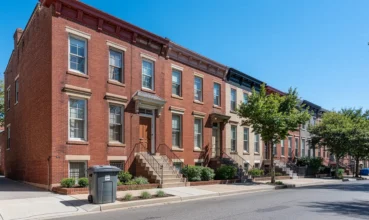
One case illustrates the risk of mispricing in a shifting urban market. A Philadelphia row home, originally a two-story property with a third-floor addition, sat on the market for over a year with a previous agent. The lot was shorter than comparable three-story homes, putting actual square footage around 1,300 to 1,400 rather than the 2,000-plus used to justify the original price. By the time Severns took the listing, the market had shifted further. He recommended $525,000; they started at $550,000, then adjusted down to $525,000 when interest did not materialize. The property was eventually pulled. “It’s actually gotten worse,” he says of that segment. “I don’t think we’re going to bring that one back to market.”
The Rate Lock Is Real – With Exceptions
The widely discussed mortgage rate lock-in effect is visible in this market. Severns estimates that over 70 percent of active mortgages carry rates below five percent, while new 30-year mortgages now sit above 7 percent for well-qualified borrowers – a gap wide enough to keep most homeowners in place.
The sellers who are transacting fall into identifiable categories: those with enough equity to make a large down payment on their next purchase and keep monthly costs manageable, and those compelled by life events – divorce, death, job relocation.
One additional group has become more active this year than in prior years: investors liquidating portfolios. Severns says he has been seeing portfolios of 11 to 15 single-family homes across Philadelphia listed for roughly $1.2 million. “I’ve been seeing a lot of that over this year, more than any other year,” he says. He attributes the trend to long-term buy-and-hold investors who accumulated properties over 15 to 20 years and are now choosing to retire or exit self-management rather than pay a management company 8 to 10 percent of gross rents.
Letting the Data Lead the Pricing Conversation
The pricing conversation itself is where many listings go wrong before they ever hit the market. Severns says he trains his agents to avoid asking sellers what they want – a common opener that invites anchoring on an emotional number rather than a market-supported one.
Instead, the process starts with comparable sales data, then adjusts for differences in condition and features, then layers in current competition: how many similar homes are active, how long they have been sitting, and at what prices. “If we have six homes that all sold for a million dollars apiece on average, but there’s 18 homes on the market for over 45, 60, 90 days, and they’re all at 850 – well, it doesn’t matter that those other ones sold for a million,” he says.
The goal is to let sellers arrive at a realistic number themselves rather than being told one. Severns says the approach reduces pushback because the seller draws the conclusion from the evidence rather than reacting to a number imposed on them. “If you just tell them what their home is worth, it’s cognitive dissonance, and it’s like talking to a wall,” he says.
For sellers weighing a price reduction now, the search-bracket math applies directly: a cut that does not move a listing into a new $25,000 search window reaches the same buyers who already declined. The first reduction that reaches a new pool of buyers is the one that matters.
About the Expert: Mike Severns covers Pennsylvania, Delaware, Maryland, and New Jersey with his team at eXp Realty.
This article is based on information provided by the expert source cited above. It is intended for general informational purposes only and does not constitute legal, financial, or real estate advice. Readers should conduct their own research and consult qualified professionals before making any real estate or financial decisions.