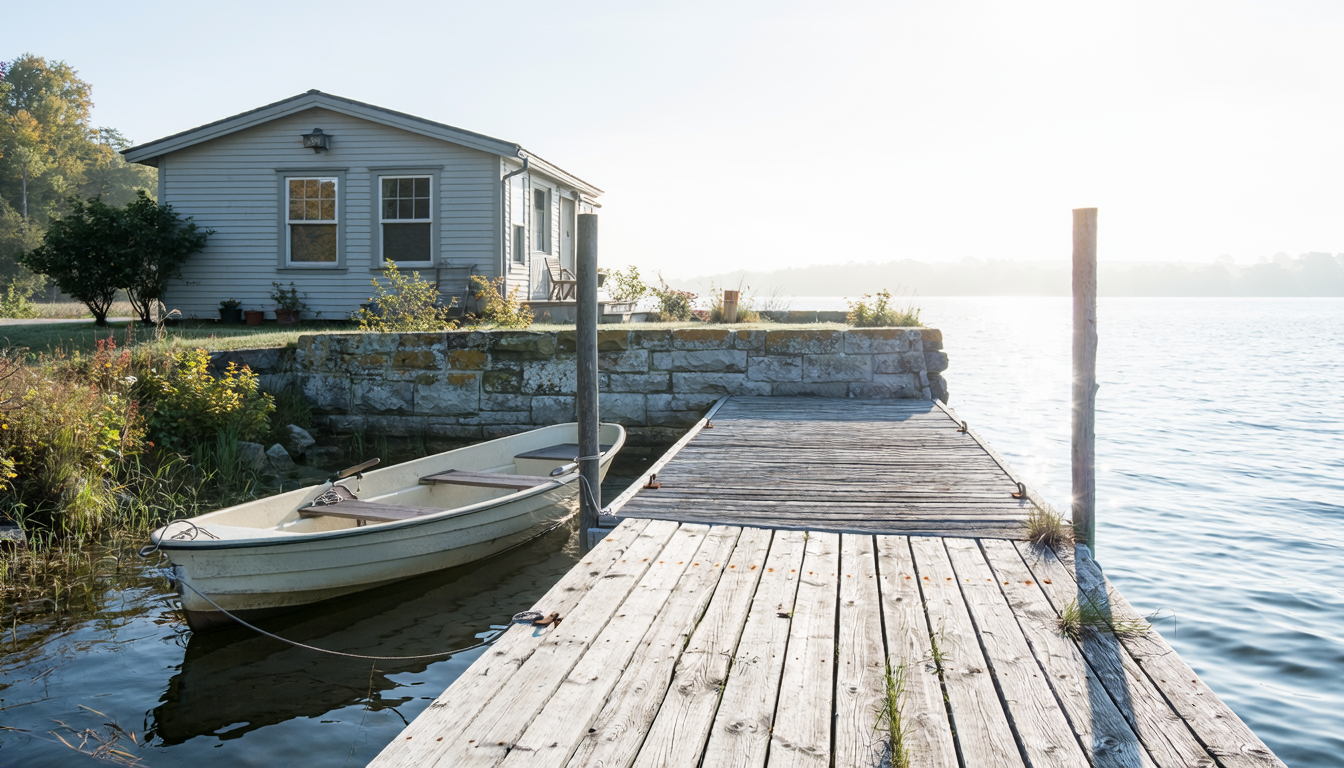
Almost everyone who shops for a place on the water carries the same picture: stepping off the deck and straight onto the sand, coffee on the dock at sunrise, a boat tied up a few seconds from the back door. That picture is what sells waterfront and second homes, and it’s also why so many buyers fall for the setting and barely examine everything else.
But for many, expensive surprises lie in store. Those surprises rarely show up in the purchase price. They hide in a deteriorating shoreline, an aging septic system, the fine print of an insurance policy, and the months each year when nobody is home.
Those lessons look remarkably similar across markets that otherwise share little. From upstate New York to the Florida Keys, the markets differ in climate, price, and buyer. Yet each still draws a buyer who arrives from somewhere else, falls for the place, and woefully underestimates what a house on the water will cost to own, insure, and maintain.
Frontage Isn’t Uniform
The first hard lesson is that being on the water doesn’t add value evenly. Two lakefront lots on the same lake can sell for very different prices, and a buyer who assumes otherwise can easily overpay. Matthew Sharman, team leader and real estate agent with The Sharman Team, part of Real Broker LLC, sells lakefront and second homes around Conesus, Honeoye, and Canandaigua lakes in New York’s Finger Lakes. He says waterfront value can’t be read off a spreadsheet. “Lakefront pricing is where generic real estate breaks down really fast,” he says. “You can’t just pull three comps, average them, and then pretend that you understand value.”
What separates one lot from another, Sharman says, are features a simple comparison misses: the quality of the shoreline, how usable the lot is, parking, elevation above the water, and the condition of the break wall. Buyers who have only owned inland homes often overlook them entirely.
On the ocean, the hidden variable is often what lies between the dock and open water. Sandra Tuttle, founder and owner of Island Welcome Real Estate, sells waterfront homes in the Lower Florida Keys and spent five years running a sailboat out of the islands. She points to control depth, the shallowest point along a property’s route to the ocean. A canal home that suits a center-console boat can be useless to a sailboat with a deep draft, and a listing rarely says so. Buyers who are purchasing around a specific vessel need to confirm that route before they fall for the house.
Below the Lawn
Frontage sets what a buyer pays, but what lies beneath the lawn often decides what the buyer can do with the house. Many older lake houses still run on septic systems built for small seasonal cottages, and those systems last only a few decades. In much of New York, nobody checks the system when the house changes hands unless the buyer orders an inspection.
The problem sharpens for buyers who plan to expand. Sharman says few of the region’s 1940s and 1950s cottages survive, because owners tear them down for larger, year-round homes. A bigger house, though, needs a bigger septic system, and shoreline rules such as those in the Adirondack Park limit how close new construction and leach fields can sit to the water. A buyer who intends to enlarge or rebuild needs to confirm what the land and local rules allow before making an offer, not after closing.
Beyond the Flood Map
Above ground, the risk that catches buyers is water arriving where the map says it shouldn’t. Lenders generally require flood insurance only in federally designated high-risk zones, and standard homeowners policies don’t cover flooding. Yet FEMA reports that from 2014 to 2024, almost one-third of National Flood Insurance Program claims came from outside those high-risk areas. A lake buyer who skips flood coverage because the lender didn’t ask for it is relying on a map, not on the water.
In the Keys, storm exposure has become a pricing variable rather than a background risk. Tuttle says buyers there are “critical of storm-safe features” such as metal roofs, impact-resistant windows and doors, and construction under newer building codes. Homes built in the 1980s and 1990s, often with manual shutters someone has to put up before every storm, are where she sees prices correcting. Smaller, older canal homes in the $750,000-to-$1 million range face the most resistance because buyers want turnkey houses, and that segment holds plenty of inventory.
Insurance compounds the gap. Tuttle says taxes and insurance can add $1,000 to $1,500 a month to the payment on an entry-level Keys home priced around $600,000. At the top of the market, buyers wealthy enough to self-insure increasingly do so, because coverage for high-end properties has become so difficult to obtain. For a buyer, storm hardening now shows up twice: in the purchase price and in whether the house can be insured at all.
The Empty Months
Storms come and go, but vacancy is a constant for most second homes, and both the house and the insurance policy behave differently when nobody is there. Under widely used standard policy forms, a home left vacant beyond roughly 60 consecutive days can lose coverage for theft, vandalism, and glass breakage, and some policies restrict water damage as well. A frozen pipe in a closed-up lake house can run for weeks before anyone finds it, so the policy’s vacancy terms deserve as much attention as its premium.
Winter makes an empty lake house expensive as well as vulnerable, because the heat has to stay on whether or not anyone is there. Chase Jermano, a licensed real estate broker with Tina Leonard Real Estate, LLC, in Lake Placid, also manages about 80 rental units across the Adirondacks. He says utility bills there have climbed sharply, with some households seeing costs triple in certain months. Owners also have to budget for plowing and shoveling so the house stays reachable through the season. For any buyer who can’t be on site, a reliable caretaker and a policy written for actual occupancy matter as much as the house itself.
Rental Math Rarely Works
Many buyers plan to cover those costs by renting the house out when they aren’t using it, and waterfront looks like the ideal rental: a lake house or canal home with a dock is exactly what vacationers want. The numbers rarely cooperate. In the Keys, most homes outside the cities can’t be rented for less than 28 days, which shuts them out of the weekly vacation market. Tuttle says an investor looking for an 8% to 10% return there will struggle to find it. “I don’t think that investment groups who are just straight up analyzing data would focus here,” she says.
Around the Finger Lakes, Sharman says a rental pencils out only for homes that sleep eight or more, and smaller ones no longer cover their costs. Some of his buyers use what he calls the zero-out method, renting just enough to break even while keeping the house for their own vacations. That approach, treating rent as a partial offset rather than a return, is the one that holds up on the water, from the Finger Lakes to the Keys.
About the Experts: Matthew Sharman is team leader and a real estate agent with The Sharman Team, part of Real Broker LLC, in Greater Rochester, New York. Chase Jermano is a licensed real estate broker with Tina Leonard Real Estate, LLC, in Lake Placid, New York. Sandra Tuttle is the founder and owner of Island Welcome Real Estate in Summerland Key, Florida.
This article is intended for informational purposes only and does not constitute legal, financial, or investment advice. The views and opinions expressed herein reflect those of the individuals quoted and do not represent an endorsement of any company, product, or service mentioned. Readers should conduct their own due diligence and consult qualified professionals before making any investment decisions.