In most of Bucks County, Pennsylvania, the housing market runs on familiar suburban logic: limited inventory, competitive bidding, and first-time buyers stretching to qualify. In Pipersville, at the county’s northern edge, the math works differently.
Farms outnumber listings, acreage is measured in dozens rather than fractions, and the buyers who show up are coming from Philadelphia, New York, and northern New Jersey with equity from a prior sale already in hand, according to David Siwy, broker of record for Pennsylvania, Delaware, and Maryland at New and Modern Group.
More Land Than Houses
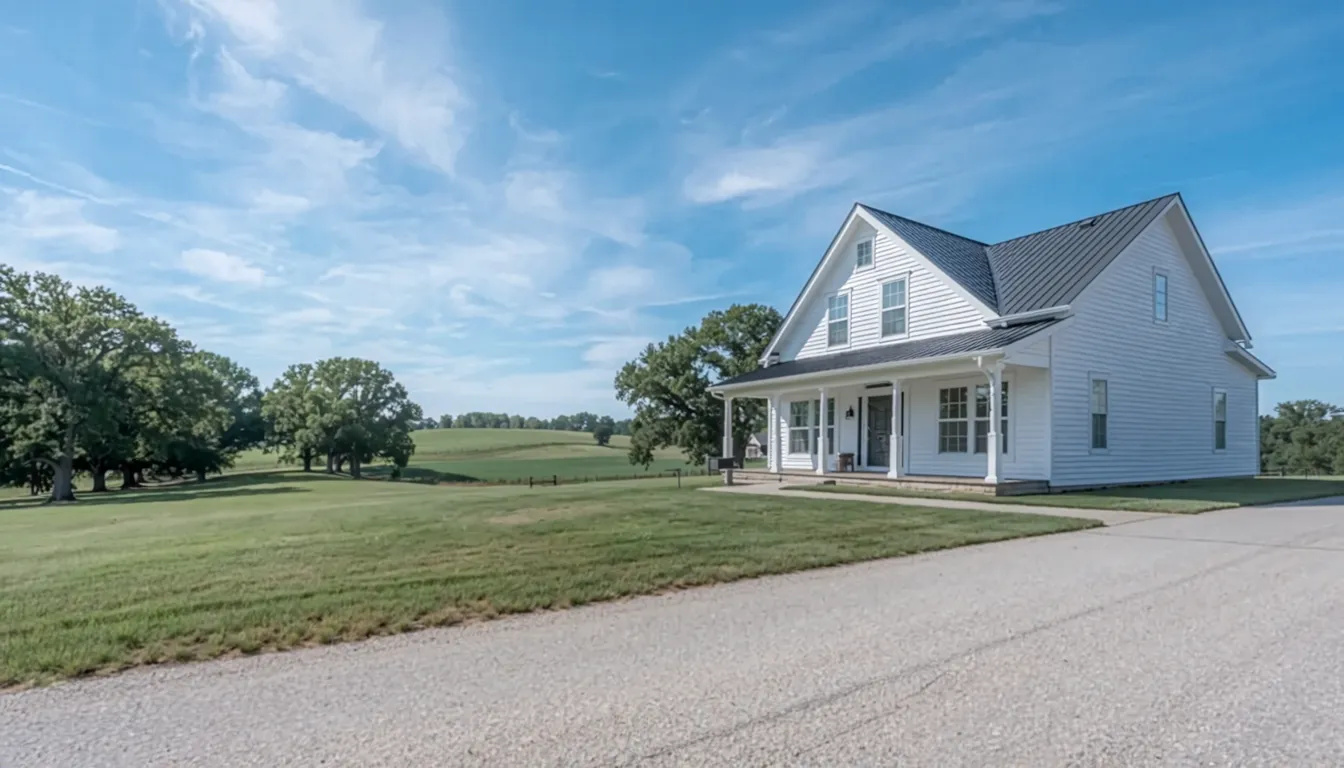
Most suburban markets are defined by density, amenities, and school district rankings. Pipersville is defined by what it lacks. Siwy says the area’s appeal is rooted in its underdevelopment – a condition that is not a temporary gap but a structural feature of a market where farmland owners have held their parcels and density has never taken hold.
“There’s houses, but there’s not a lot of houses,” Siwy says. “There’s more land, I feel, than there are houses.”
That ratio shapes who buys and why. A buyer in Pipersville can acquire 12 or 50 acres – a scale of land ownership that has disappeared from closer-in suburbs like Uppermoreland, where Siwy grew up and where a quarter-acre lot is considered generous.
Where Buyers Come From
The most active buyers in Pipersville are not local households moving up from a starter home in Doylestown. They are increasingly relocating from New York and northern New Jersey, drawn by lower taxes relative to their origin markets and the ability to reach Manhattan by train from Trenton in roughly an hour to an hour and a half, according to Siwy.
“A lot of people from Jersey, but even more people from New York because it’s affordable,” Siwy says. “Jersey is more expensive with taxes.”
Philadelphia buyers represent a separate but related stream. Siwy describes a generational pattern in which families who have lived in the city for decades are now seeing their adult children look outward – not to the near suburbs, but to areas with more space and a different pace of life.
“There’s a lot of people that want to slowly move out of Philly,” Siwy says. “They’ve been there for a while, or they’re the first generation that wants to leave.”
A Move-Up Market
Pipersville’s price floor – predominantly $400,000 and above, with little available under $300,000 – positions it as a destination for buyers on their second or third purchase. Siwy says a search across all of Bucks County for homes under $300,000 turns up almost nothing in Pipersville.
“I wouldn’t say Pipersville is necessarily a first-time homebuyers market,” Siwy says. “It’s more for your second home purchase, your third home purchase. You’ve moved up and you’ve sold your first or second home. Now you’re in your hopefully forever home.”
That buyer profile affects how the market behaves under pressure. Move-up and second-home buyers typically carry substantial equity from a prior sale, making them less dependent on grant programs and less sensitive to marginal interest rate changes than first-time buyers stretching to qualify.
Pipersville is also not a natural rental market, according to Siwy. The rent levels required to justify investment in the area would limit the tenant pool to a narrow segment – corporate relocations or pharmaceutical industry households on temporary assignments – rather than the broader rental demand that supports investor activity in denser parts of the county.
Bucks County’s Affordable Areas
Across southeastern Pennsylvania, inventory below $400,000 to $500,000 still moves fast. Above $500,000, the buyer pool shrinks sharply, and properties that need work face particular resistance.
Siwy points to a current listing at $1.25 million as an example: an older home on six acres with a pond, a pool, two large pole barns, and a two-bedroom cottage. The property has development potential – a buyer could potentially add one or two homes on a flag lot – but requires a buyer who sees that potential and is willing to invest in an older structure rather than new construction.
“A lot of people who are spending over a million dollars want new construction,” Siwy says. “They don’t want to have to go in and fix something.”
The property is not overpriced in Siwy’s view. It is narrowly suited – the kind of listing that rewards patience and precise buyer matching rather than broad market exposure.
Where Bucks County Gets Affordable
Pipersville’s price levels are not representative of Bucks County as a whole. Siwy describes a geographic gradient: lower Bucks County – Croydon, Bristol, Levittown, Feasterville, Bensalem – offers more affordable housing, often accessible to buyers priced out of the central and northern parts of the county. Central Bucks, including Doylestown and New Hope, runs hotter and more expensive. North of Pipersville, toward Quakertown, prices moderate again.
For buyers coming from Philadelphia who cannot afford a $600,000 home, Siwy says lower Bucks County is where they are most likely to land. Pipersville and its neighboring towns serve a different segment entirely.
What Comes Next
Siwy says he does not expect a housing crash in his market. Homeowners in the area have built significant equity over recent years, which means most could sell at a reduced price and still pay off their mortgages rather than face foreclosure. If adjustable-rate mortgages reset higher and push some owners to sell, Siwy expects the pressure to concentrate at the upper end of the market rather than in the sub-$400,000 range where buyer demand remains strong.
“I don’t see a crash coming for houses under two, three, $400,000,” Siwy says. “If a crash does come, it’ll be for higher-end homes.”
For Pipersville, that distinction matters. A market built on large parcels and high price floors would feel a correction at the top more directly than the affordable pockets of lower Bucks County – but the area’s limited inventory and steady inbound migration from higher-cost markets provide a cushion that denser, more speculative markets lack.
About the Expert: David Siwy is broker of record for Pennsylvania, Delaware, and Maryland at New and Modern Group, working across Bucks County, Pennsylvania, from his base near Pipersville.
This article is intended for informational purposes only and does not constitute legal, financial, or investment advice. The views and opinions expressed herein reflect those of the individuals quoted and do not represent an endorsement of any company, product, or service mentioned. Readers should conduct their own due diligence and consult qualified professionals before making any investment decisions.