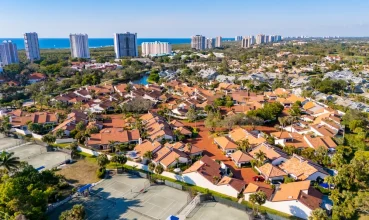

Houston’s reputation as an affordable alternative to coastal metros has drawn steady relocation traffic for years. But buyers treating the region as a single market, scanning listings ...

In Northern Virginia, Federal Job Uncertainty Is Reshaping Who Buys and Who Sells

Written by:
Date:
03 Sep 2026
Share via Facebook

Share via Linkedin

Share via X

Copy to clipboard


The Washington, D.C. metropolitan area has long operated under what local professionals call a federal government blanket, a stabilizing force that insulated housing demand from the volatility other markets experienced during downturns. That insulation is weakening. Federal employment disruptions are filtering directly into purchase decisions, listing timelines, and concession rates across Northern Virginia, creating a market that shifts week to week rather than quarter to quarter.
Allen Johnson, Team Leader and Associate Broker at AJ Team Realty (powered by eXp Realty), has sold real estate in the region for 25 years and currently closes over 100 transactions annually. His read on the current environment is direct: “We don’t have that warm blanket of being able to be covered by the federal government and everything that comes with it.”
Life Events Are Driving Transactions
The buyer pool in Northern Virginia has narrowed to people whose circumstances force a move, job relocations, growing families, divorces, deaths, or financial distress. Discretionary purchases have largely stalled.
One recent transaction illustrates the dynamic. A buyer contracted for new construction in a local community when conditions felt stable. During the eight-to-ten-month build period, their employment situation changed. Rather than take on a higher mortgage amid job uncertainty, they chose to sell the new home at a loss, competing directly against the builder still active in the same community. “This buyer decided that it was going to be better for them to lose money on that property than hold it over the long period of time when there was so much uncertainty about the job market for them,” Johnson says.
That calculation, absorbing a known loss to avoid an unknown one, reflects the decision-making framework operating across the area right now. Johnson estimates that 5 to 10 percent of homes in his own community have been affected in some way by federal employment disruption, whether through early retirement, job loss, or families consolidating into multigenerational arrangements.
Concessions Are Widespread but Invisible to Most Sellers
More than 50 percent of sellers nationwide have had to offer some type of concession, rate buydowns, inspection credits, or closing cost contributions, according to figures Johnson cites. The problem for DMV sellers considering a listing is that this reality does not show up on aggregator sites.
“When they look at Zillow or one of these aggregates, it doesn’t show the closing costs. It only shows the price a home was sold for,” Johnson says. “Sometimes those closing costs can represent 3, 4, or 5% of the sales price, which means that seller you think made a certain number actually got 5% less.”
Sellers who anchor to recent comparable sales without accounting for hidden concessions may be overpricing from the start. Johnson’s advice: “Price to attract attention and think about the price that gets the most buyers in the door instead of the number you think you need to price at.”
Planned Communities Face the Steepest Headwinds
Two property types are struggling most. Condominiums across D.C., Maryland, and Northern Virginia face rising inventory, increasing condo fees driven by special assessments, and financing difficulties triggered by delinquencies and high investor ratios.
Large planned communities where builders remain active present a different version of the same problem. Johnson points to communities where original buyers who purchased five to ten years ago are all listing at once, creating internal competition layered on top of builder inventory.
The sellers still performing well invested in renovations during the low-rate years. “They’re the people that took the money they saved with the low interest rate and put it into their kitchens, their decks, their bathrooms,” Johnson says. In a market where buyers are scarce, move-in condition separates homes that sell from those that sit.
Where Demand Holds Steady
The strongest activity remains in established neighborhoods with limited inventory and no new construction competing for buyers. Johnson points to Lake Ridge in Woodbridge, where no new builds exist, and specific zip codes in Manassas – like 20112 – where school districts and proximity still pull buyers in. Areas like Alexandria, Arlington, and Springfield, where land for new construction is scarce, continue to outperform communities with active builders.
The pattern is consistent: neighborhoods where supply cannot expand are absorbing demand that might otherwise spread across the broader market.
Where Investors Should Look
For capital seeking deployment in the DMV, Johnson identifies several angles. In the Quartz District, a new community where commercial development, including a Whole Foods, is expected to drive future residential demand, one of his clients recently purchased an investment property. Cash flow is modest, but a cost segregation study on the new build generated significant tax benefits.
In established areas like Lake Ridge, Manassas, and Dumfries, all-cash purchases of properties needing light renovation offer a different profile: sweat equity paired with cost segregation and rental income.
A third opportunity involves a new construction community in Manassas where the builder bought down interest rates in bulk, available to investors, not just owner-occupants. “When that interest rate came down, that’s where the cash flow started to go up,” Johnson says.
In Prince William County, active listings are up 18 percent, new listings are up 10 percent, and median sold prices are down only 1 percent. Johnson sees the next six to eight months as a buying window, particularly for investors willing to hold through a rate environment he expects to improve within three to five years. “Everyone who’s a smart investor knows you buy when everyone else isn’t buying,” he says. “Right now there’s a lot of fear in the market. So if you’re an investor, this is go time for you.”
About the Expert: Allen Johnson is Team Leader and Associate Broker at AJ Team Realty (powered by eXp Realty), and has sold real estate in the Washington, D.C. metropolitan area for 25 years.
This article is based on information provided by the expert source cited above. It is intended for general informational purposes only and does not constitute legal, financial, or real estate advice. Readers should conduct their own research and consult qualified professionals before making any real estate or financial decisions.
Similar Articles
Explore similar articles from Our Team of Experts.