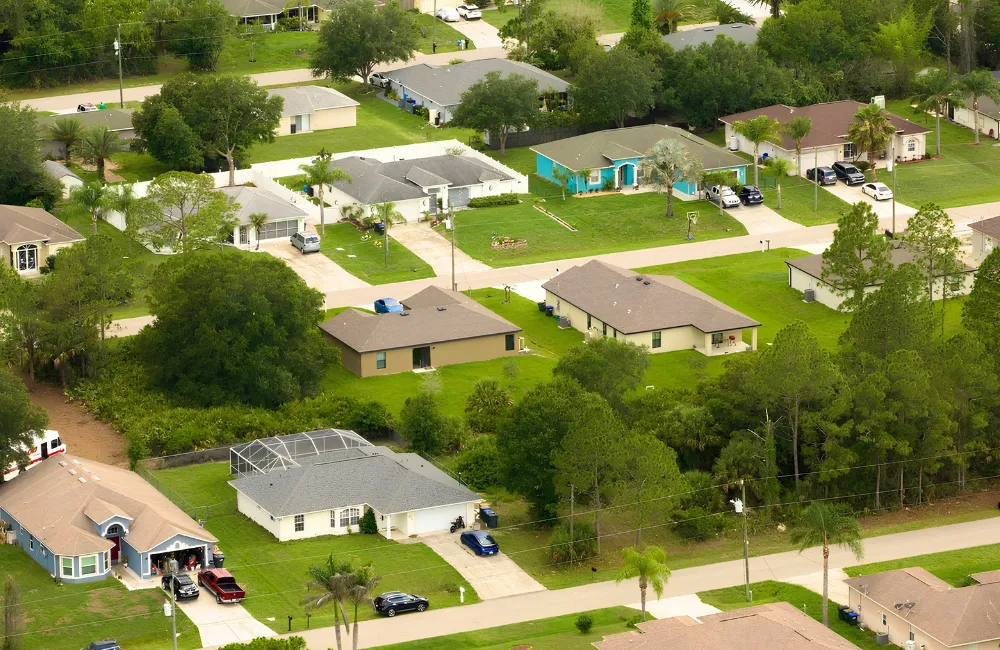
Buyers priced out of South Florida’s coastal markets are increasingly looking inland, and agents working rural Marion County say the migration is real and still building. The pattern is driven by a widening affordability gap: as South Florida home prices rose steeply during and after the pandemic, ownership moved out of reach for buyers who wanted to stay in the state but could no longer afford where they were living.
John Wayne “Duke” Rountree, broker and owner of Rountree Realty Corp. in Fort McCoy, Florida, has watched this pattern develop over the past several years. His argument is straightforward: Marion County’s position as one of the least expensive places to buy a home in Florida is not just a local curiosity; it is an active draw for buyers relocating from parts of the state where values have climbed sharply out of reach.
Properties in his area, which covers a large rural zip code in the northeast part of the county, range from small lots near the Ocala National Forest priced as low as $5,000 or $6,000, to waterfront homes on lakes and rivers that have sold above $1 million. That breadth makes the market accessible to buyers coming from higher-cost areas who are looking to get more for their money without leaving Florida.
A Lifestyle, Not a Compromise
The rural character of the area is central to this appeal. Marion County is one of the largest counties in Florida by land area, and the zip code Rountree works in is the largest in the county. Buyers are not choosing a small town with limited options. They are choosing a lifestyle: more land, more privacy, lower price per square foot, and proximity to natural features like rivers, lakes, and the Ocala National Forest.
That lifestyle pitch has a specific audience. Rountree describes investor interest from buyers in larger Florida cities who see the area’s price point as an opportunity. For owner-occupants – particularly those who can work remotely or are approaching retirement – the tradeoff between a lower cost of entry and a longer drive to urban amenities is one many are willing to make.
Risks Worth Naming
The risk in this picture is worth naming directly. Marion County’s affordability advantage is real, but it is not insulated from the same forces slowing markets elsewhere in Florida. Higher interest rates are suppressing buyer activity across price ranges, and the middle of the market – homes priced between roughly $150,000 and $350,000 – has slowed noticeably. Buyers relocating from South Florida are not immune to rate sensitivity. And the rural lifestyle that attracts some buyers will actively deter others, limiting the depth of demand.
What makes Marion County’s position distinct, Rountree argues, is that the affordability gap between it and South Florida’s major markets has widened enough to create genuine value even after accounting for current financing costs. A buyer who sells a home in a high-cost coastal market and brings equity north can often purchase in Marion County with a smaller mortgage, which softens the impact of today’s rates.
Rountree is also watching a generational dimension to this trend. Younger buyers face steeper entry costs almost everywhere – on a $250,000 FHA purchase, the combination of down payment and closing costs approaches 8% of the purchase price. In markets where median prices are higher, that barrier is proportionally larger. Marion County’s lower price floor means the dollar amount of that barrier is smaller, even if the percentage holds.
Local Data Tells a Different Story
The national news cycle, Rountree notes, tends to focus on large metro markets – Orlando, Tampa, Jacksonville – and the conditions reported there do not always reflect what is happening in smaller rural markets. Buyers and sellers in Marion County who anchor their expectations to statewide or national headlines may be working with an inaccurate picture. Local inventory levels, local price trends, and local buyer demand are the relevant data points, and they have been diverging from the broader Florida story.
One concrete marker of that divergence: while some Florida counties are reporting inventory surpluses and price reductions, Rountree says Marion County is not seeing broad price drops. Values are holding. The market is slower, but the floor has not given way, a distinction that matters for anyone evaluating the area as a place to buy or hold property.
How Long Can It Last?
Looking ahead, the durability of this trend depends on whether the affordability gap continues to widen, or whether rising demand from relocating buyers begins to compress it. If migration from South Florida accelerates, Marion County’s price floor could rise faster than expected, narrowing the very advantage that drew buyers in the first place. For now, the county occupies an unusual position in Florida’s housing landscape: affordable enough to attract new demand, but rural enough that the pace of change remains measured.
About the Expert: John Wayne “Duke” Rountree is a Broker and Owner of Rountree Realty Corp., serving the Marion County market in northeast Central Florida since 1999, with a primary focus on the Fort McCoy and Salt Springs area.
This article is intended for informational purposes only and does not constitute legal, financial, or investment advice. The views and opinions expressed herein reflect those of the individuals quoted and do not represent an endorsement of any company, product, or service mentioned. Readers should conduct their own due diligence and consult qualified professionals before making any investment decisions.
After a historic run of rapid appreciation, the South Florida real estate market is beginning to cool. Larry Mastropieri, Broker and Owner of The Mastropieri Group, a boutique luxury brokera...
The devastating impact of recent wildfires and extreme weather is driving a fundamental shift in how homes are being built, with resilience becoming as important as sustainability, according...
Rhode Island’s real estate boom may be setting the stage for a market correction, according to leading coastal broker Matthew Antonio, broker/owner at Corcoran Chart House Realty, who warn...
The Dallas luxury real estate market is breaking with conventional buyer’s market patterns, according to Darwin Stephens, Owner and CEO of RADDR Group. Despite a 30% year-over-year increas...
California policymakers have promoted accessory dwelling units (ADUs) as a solution to the state’s housing shortage. But Wendy Rawley, Team Leader at The Wendy Rawley Team, says most h...
Seller psychology and demographic trends are creating a housing shortage in Rhode Island that extends far beyond the 20% of homeowners holding onto low mortgage rates, according to local rea...