Austin’s widely cited year-over-year price decline of roughly 20 percent aggregates dozens of submarkets with vastly different fundamentals, and the distortion may be costing investors who rely on metro-wide data to evaluate opportunities, according to Nitin Kumar, an agent with eXp Realty who was the brokerage’s top-producing agent nationally by homes sold last year.
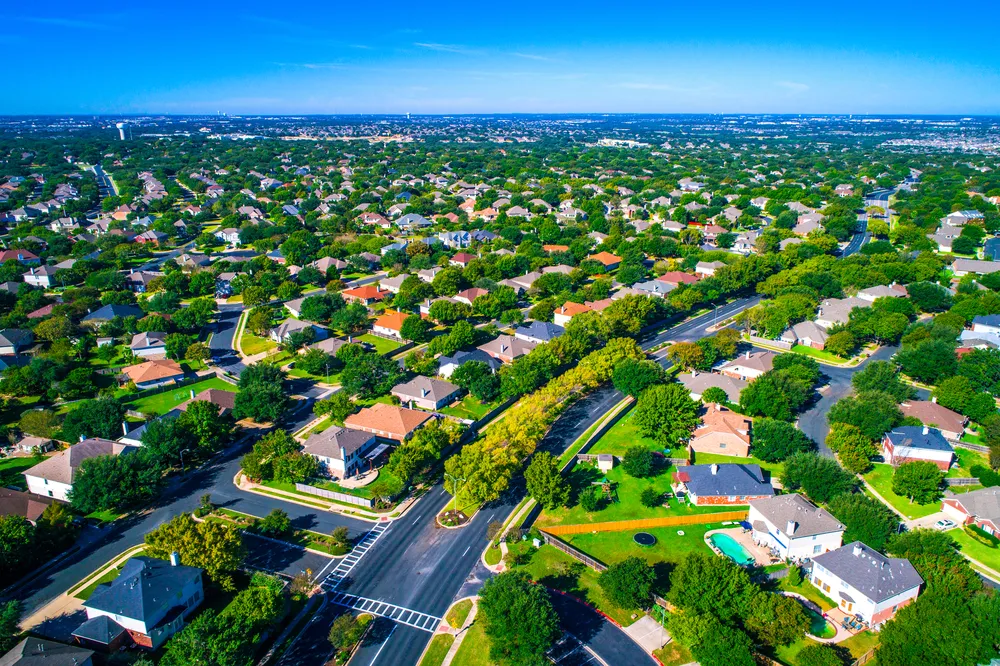
In established core suburbs like Round Rock, Cedar Park, Leander, and Pflugerville, prices are down an estimated 10 to 20 percent from peak levels. In outer suburbs that exploded during the pandemic, places like Elgin, Jarrell, and Killeen, values have fallen 70 to 80 percent. Blending those two realities into a single metro statistic produces a number that accurately describes neither.
“It is unfair for Austin the way the data is pulled up,” Kumar says. “We are pulling up data from all the suburbs which people who are living in Austin didn’t even know existed.”
The Suburbs That Matter
The outer suburbs that saw the steepest pandemic-era gains – some nearly doubling in value – lacked the infrastructure, population density, and amenities to sustain those prices. Kumar, who owns roughly 50 properties in Austin and has lived in the metro since 2010, says those areas attracted speculative demand that has since evaporated.
The established suburbs tell a different story. Round Rock, a city of 120,000 residents, currently has fewer than 40 new-construction homes available on the MLS, spread across just three or four projects, starting around $700,000 and running up to $1.5 million. That inventory tightness means well-located properties are still trading, even in what most commentators describe as a difficult market.
“If the market changes, the number of available homes in Round Rock can be sold in one weekend,” Kumar says. “For 120,000 people, 40 homes are nothing.”
Downtown Condos Are Moving
Austin’s downtown condo market illustrates a separate dynamic. Several buildings that sold out entirely in a single day during peak conditions have since seen cancellation rates around 30 percent as prices dropped below what original buyers paid. Rather than listing these units publicly, builders have been working directly with agents and their investor networks at prices roughly 30 percent below peak.
Kumar says he personally sold six condos in one downtown building and eight in another over a two-month stretch, all at steep discounts. The volume points to genuine demand at the right price, even in a segment that appears stagnant from the outside. Builders are also buying down interest rates on new construction below $400,000, keeping that segment more active than headline data implies.
Who Is Buying
About 90 percent of Kumar’s clients come from outside Austin, primarily tech workers relocating from the Bay Area, Seattle, New Jersey, New York, and Pennsylvania. He estimates that 20 to 25 percent of Austin properties are currently being purchased by out-of-market buyers as investments alone, separate from primary home purchases.
The value gap drives much of this migration. Kumar, who lived in the Bay Area for three years, says a $500,000 home in Austin would cost a couple of million dollars in San Jose or Santa Clara. A recent client from New Jersey purchased a five-bedroom, five-and-a-half-bath home on a 15,000-square-foot lot in Leande, a house that would have cost well over a million dollars in their previous market.
For investor clients, the pitch centers on tax strategy rather than rental yield. Texas has no state income tax, and Kumar says his clients use real estate investment to reduce their federal tax burden. He acknowledges that Austin is not a strong rental-yield market because of high property taxes, but says investors in the right areas, where tax rates run between 1.5 and 1.7 percent, can focus on appreciation in a metro with strong long-term population and employment growth.
Austin’s draw for younger workers reinforces that growth picture. Kumar points to six universities in the metro, including UT Austin with its 160,000 students, producing what he estimates at 400,000 to 500,000 graduates across the city’s campuses each year. Both software and hardware companies now have a presence in Austin, and he says the metro’s housing costs remain roughly one-fifth of comparable tech hubs.
What the Next Six Months Look Like
Kumar expects the next six months to bring additional price pressure, driven primarily by sustained high interest rates. But he draws a distinction between pain and opportunity.
“This is not a buyer’s market. This is not a seller’s market. This is actually an investor market,” he says. “It’s the best time for investments because there are so many deals.”
His practical advice: stay within a 15- to 20-minute drive of Austin’s two main employment centers, the Domain and downtown, where inventory is tightest, and recovery will come first. He expects conditions to begin easing around March of next year, though that timeline depends entirely on rate movement. “The only thing Austin needs is the interest rate correction,” Kumar says. “As soon as that happens, there are so many jobs available in Austin already that the whole inventory can be gone in three, four months.”
For investors evaluating Austin from a distance, the central risk Kumar identifies is mistaking the metro-wide data for a uniform market condition. The suburbs where values collapsed 70 to 80 percent, and the neighborhoods where inventory sits in the low double digits are both called Austin, but they require entirely different investment decisions.
About the Expert: Nitin Kumar is an agent with eXp Realty, covering the Austin, Texas metro area, and has lived in the region since 2010.
This article is based on information provided by the expert source cited above. It is intended for general informational purposes only and does not constitute legal, financial, or real estate advice. Readers should conduct their own research and consult qualified professionals before making any real estate or financial decisions.