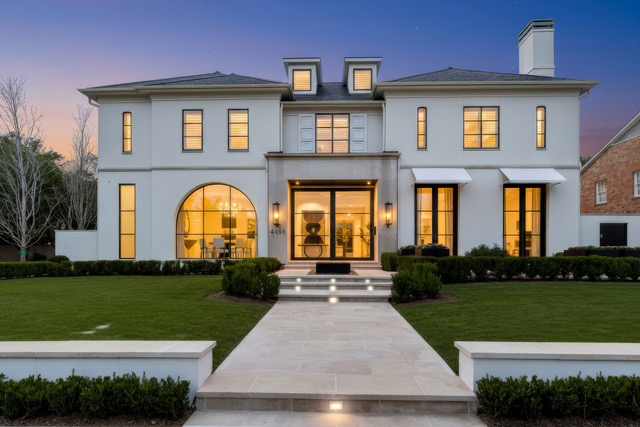
Two vacant lots on Beverly Drive in Highland Park recently sold for $5.5 million each, side by side. A two-year-old home on just under an acre is coming to market at nearly $32 million in a neighborhood with no views and no mountains. The numbers sound like coastal pricing, but this is Dallas, and the force behind them is not lifestyle amenities or scenery. It is the disappearing supply of buildable land in a market that has no room to expand.
Highland Park and University Park, collectively known as the Park Cities, sit five miles north of downtown Dallas. The two municipalities share a boundary, a top-ranked public school district, and a combined population of just under 40,000. They are surrounded entirely by Dallas but operate independently, with their own police, fire departments, and city services.
“It’s so scarce, and you can’t find that many teardowns anymore because over the years they’ve done so much new construction in different areas,” says Eve Sullivan, a 26-year veteran of the Park Cities market at Allie Beth Allman & Associates. “It’s becoming more and more difficult to find just the lot itself to build.”
Land as the Primary Asset
In most residential markets, the structure accounts for the majority of a home’s value. In the Park Cities, the land accounts for a larger percentage of the total value. The median home price in Highland Park sits around $4.6 million, and Sullivan attributes the bulk of that figure to the underlying land. The two Beverly Drive lots she sold – each 70 by 225 feet – went to a builder at $11 million with no structure on them.
That scarcity has pushed land prices per square foot steadily higher. In the more desirable pockets, Sullivan says the increases have been large enough to change the math for builders, who now face tighter gaps between what they pay for land and what finished homes can sell for. Some builders are purchasing land and reselling it to other builders, or packaging it with construction plans for buyers who have not been able to find buildable sites on their own. “They can buy the land and sell it with their package to their end user that’s looking to build, and they can inflate that price and cover all their costs,” Sullivan says.
Who’s Buying and Where They’re Coming From
The Park Cities buyer pool is increasingly made up of relocating professionals rather than local move-up buyers. Sullivan says the showings on her current listing – priced at just under $12 million on Belclaire – have drawn interest almost entirely from out-of-state buyers, particularly from the Bay Area and Seattle. She is also seeing some movement from the Northeast and Florida.
The pattern connects to a wave of corporate relocation into Dallas. Goldman Sachs, Morgan Stanley, and JP Morgan are among the few of the financial firms expanding their Texas presence, and many of those offices are located nearby on Turtle Creek, close enough that Park Cities residents do not need a highway commute. Texas’s lack of a state income tax adds to the draw.
Sullivan says many of these incoming buyers arrived from markets where real estate was considerably more expensive. “They thought our prices were cheap and it drove all of our prices up,” she says, “and they haven’t really gone down since then.”
For buyers considering the Park Cities, this relocation-driven demand has a direct consequence: pricing is being set not by local incomes or local comparisons, but by what transplants from higher-cost markets consider reasonable. That dynamic keeps prices elevated even when local demand softens.
The $9 Million Line
Demand is not evenly distributed across price ranges. Sullivan sees a clear dividing line at roughly $9 million. Below that threshold, homes generally sell faster. Above it, inventory is thinner, but absorption is slower.
The market has also returned to seasonal patterns after the disruption of 2021, when transactions ran at a steady pace year-round. Sullivan describes a market where pricing discipline still matters. “Generally, like everywhere in the United States, if it’s way overpriced, it will sit,” she says. At the same time, well-priced properties in adjacent neighborhoods can still attract multiple offers before hitting the market; she recently had a listing in Greenland Hills, just east of the Park Cities, that drew three offers before going active.
Limited Room for Traditional Investors
For capital looking to enter the Park Cities, the opportunities are narrow. Prices are too high for most traditional residential investors, and returns depend almost entirely on land acquisition, a resource that is getting harder to source.
Sullivan says the more active investor market sits in surrounding neighborhoods like Preston Hollow and Midway Hollow, where lot sizes are comparable, but prices run somewhat lower. The tradeoff: those areas lack the Highland Park Independent School District, which means private school tuition becomes part of the cost of living.
Within the Park Cities themselves, the investment approach that still works is land-to-build, acquiring a teardown or vacant lot and either constructing for a buyer or reselling to a builder. But even that channel is narrowing as developable parcels become scarcer. “We’re seeing those prices go up so much because the land has gone up so much,” Sullivan says.
What’s Ahead
Sullivan is watching the next wave of corporate relocations expected over the next two years. In her experience, demand at the higher end of the Park Cities market is now driven more by out-of-state movement than by local transactions. “So much of what I have seen, especially at a higher price point, those people mostly are all relocating to Dallas,” she says. “The local movement isn’t as great. It’s more out-of-town movement.”
If that pattern holds, the Park Cities market will continue to be shaped less by what local buyers can afford, and more by what arriving executives from higher-cost cities are willing to pay, with land scarcity ensuring that each new wave of demand pushes prices further from where they started.
About the Expert: Eve Sullivan is a 26-year veteran of the Park Cities market in Dallas, Texas, with Allie Beth Allman & Associates.
This article is based on information provided by the expert source cited above. It is intended for general informational purposes only and does not constitute legal, financial, or real estate advice. Readers should conduct their own research and consult qualified professionals before making any real estate or financial decisions.