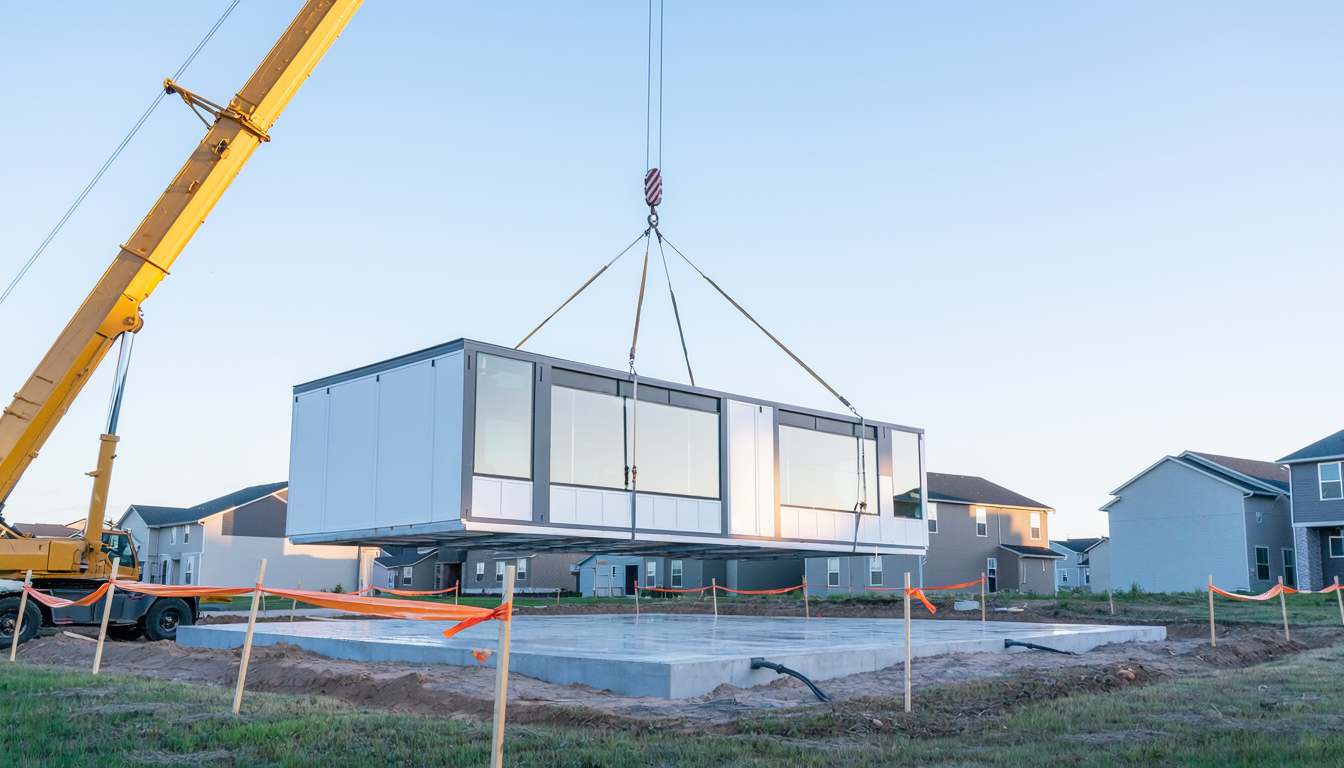
When the 21st Century ROAD to Housing Act became law on July 11, 2026, one change drew most of the attention. For decades, federal law required every manufactured home to sit on a permanent steel chassis, the steel frame the home is built and towed on. The new law dropped that rule. The chassis can add as much as $10,000 to a home’s cost, and removing it lets builders design these homes more like regular houses. But a new law doesn’t put a home on a lot. Getting there still requires an updated federal building code, action by every state, and local zoning approval. Each step takes time.
Ed Pinto, co-director of the AEI Housing Center at the American Enterprise Institute, has worked in housing finance since 1974. He points out that Congress changed the definition of a manufactured home, but not the HUD building code that governs how one is built. Updating that code requires a formal federal process. “I estimate that’s a couple-year process because Congress is very specific about who and how this code gets amended,” Pinto says.
HUD has begun that work, releasing an action plan this fall that revises standards for chassis-free homes. States face a separate deadline: each has until July 11, 2027, or 2028 where legislatures meet every other year, to certify that chassis-free homes get the same legal treatment as chassis-built ones. Pew researchers found that nearly every state still needs to update its statutes. In states that don’t certify, new chassis-free homes can’t be built, installed, or sold.
Siting Is the Harder Problem
A new building code does not give anyone the right to place a home on a lot. Zoning is still the binding constraint, Pinto says. Even in North and South Carolina, where manufactured housing is relatively common, he notes that it clusters in rural counties rather than around Raleigh or Charlotte.
Some state legislatures have begun passing siting reforms. Local governments often answer with what Pinto calls “poison pills,” workarounds designed to block what the legislature intended. Each one has to be struck down in turn. He points to California’s accessory dwelling unit laws as a guide to how long that can take. The state first legalized ADUs in 1982, but local barriers kept construction low for decades, and it took a series of state laws beginning in 2016 to clear them. “It took them 30 years to go through the whack-a-mole process at the state legislature relative to the municipalities,” Pinto says.
The Financing Trap
The ROAD Act also raised FHA Title I loan limits for manufactured homes and lengthened loan terms. Pinto, a former chief credit officer and executive vice president at Fannie Mae, is cautious about what happens when financing expands faster than supply.
He walks through an illustrative example. Suppose a manufactured home sells for about $100,000 less than a comparable site-built home, and buyers who once faced 12-year loans at 11% can now get 30-year loans at 7%. Their monthly payment drops sharply. But if siting limits and factory capacity keep supply flat, that new buying power goes into bidding up the homes that already exist. “Instead of selling for 175,000, it’s going to start selling for 215,000,” he says, “not because there was any improvement in quality or value.”
Factory capacity is its own constraint: housing runs in boom-and-bust cycles, and factories carry fixed costs that are hard to sustain through a downturn. Higher loan limits alone may not help, either. FHA raised its Title I limits in March 2024, the first increase since 2008, and Pinto says lending volume barely moved.
Where Institutional Investors Fit
The ROAD Act also bars large institutional investors, defined as entities controlling 350 or more single-family homes, from buying most existing single-family homes. Build-to-rent communities are exempt, as are renovation purchases where the investor spends at least 15% of the purchase price on improvements. Treasury released proposed rules in October, and the restrictions take effect in January 2027. The provision’s title, “Homes are for people, not corporations,” signals how its backers see the issue.
The Senate’s version went further, requiring investors to sell build-to-rent homes after seven years. The House dropped that requirement, and Pinto argues the narrower final law was the better outcome. Small landlords, not large funds, own most of the single-family rental stock. AEI estimates that 77% of the roughly 13 million households renting single-family homes live in properties owned by investors with one to nine homes.
Pinto also credits large investors with renovating older homes at scale, something he says federal programs tried and failed to do for decades. “If the federal government had instituted a program that had renovated thousands and thousands of homes for rental … everybody’s saying what a great job they did,” he says. “Yet when the private sector does it, they say, wait a minute, what are you doing?”
Smaller Lots, More Starter Homes
The research Pinto considers most consequential has nothing to do with chassis rules or investors. AEI defines a starter home as one selling for less than four times the county median household income. Its research finds that builders produce more of them when local rules allow smaller lots, because less land means smaller, less expensive homes that are still family-sized.
AEI estimates that somewhat smaller lots could have produced roughly 3.1 million additional starter homes over the past decade, at prices about 10% to 15% lower. The gains reach beyond those buyers: someone who buys a new starter home often leaves behind a rental or a home they owned, which opens up for the next household. AEI calls this the “move-up, free-up” chain.
“This costs not a dollar in subsidies,” Pinto says. “You don’t need any subsidies. You just need to get out of the way. You just need to allow smaller lots.”
The catch is in the word “just.” Allowing smaller lots takes action from roughly 33,000 state and local jurisdictions, the same layer of government that has slowed manufactured housing siting and took California decades to move on ADUs. The ROAD Act settled the federal question. The harder decisions now sit with states and city councils.
About the Expert: Ed Pinto is co-director of the AEI Housing Center at the American Enterprise Institute in Washington, D.C., where he researches housing supply, starter homes, and housing finance policy.
This article is intended for informational purposes only and does not constitute legal, financial, or investment advice. The views and opinions expressed herein reflect those of the individuals quoted and do not represent an endorsement of any company, product, or service mentioned. Readers should conduct their own due diligence and consult qualified professionals before making any investment decisions.