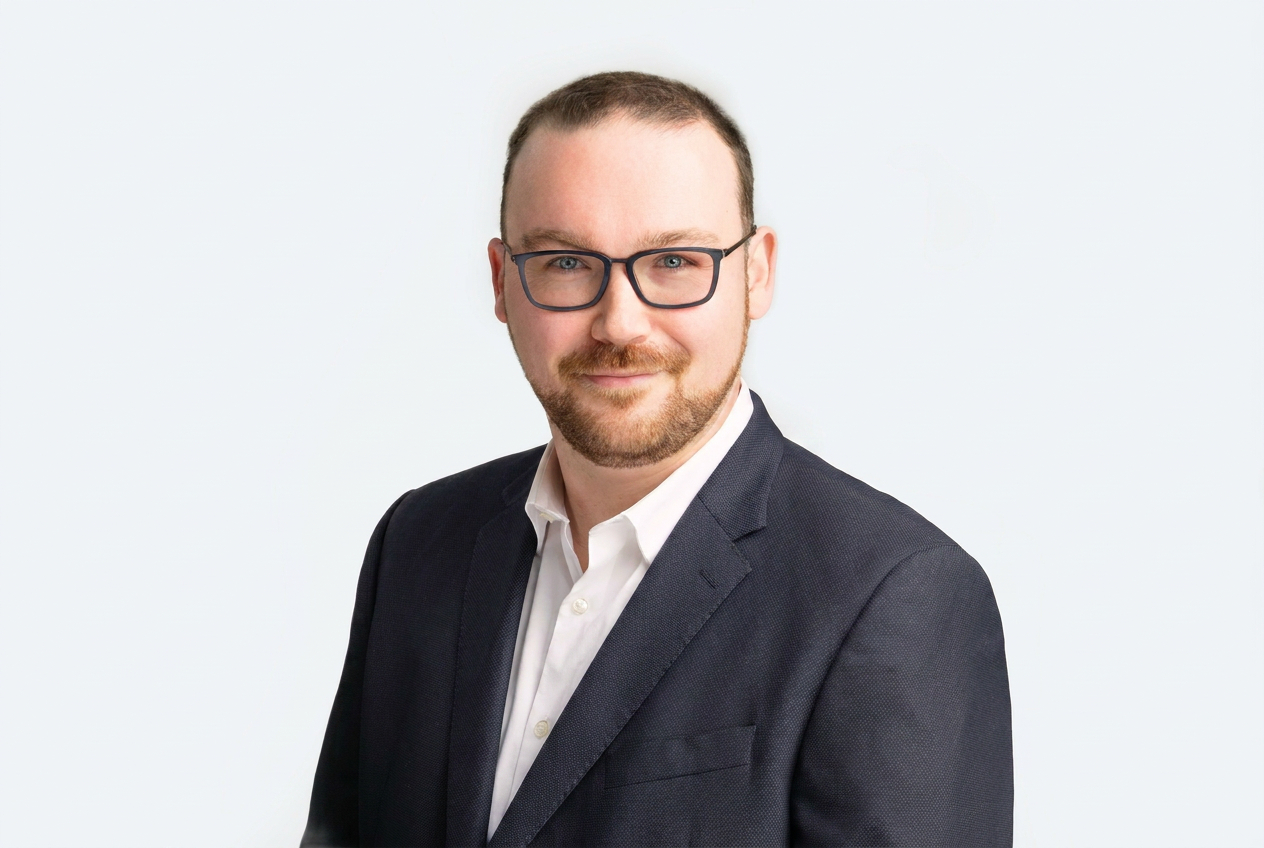
Christopher Tiessen grew up between two engineering cultures. Now he’s applying what Europe figured out decades ago to some of the most constrained development sites in the United States.
When Christopher Tiessen talks about parking, he is not talking about parking. He is talking about land: who controls it, how much it costs, and what gets built on what remains after the cars are accommodated.
Tiessen is the President and CEO of KLAUS Multiparking America, the U.S. subsidiary of KLAUS Multiparking GmbH, a German manufacturer of mechanical and automated parking systems with decades of heritage. He has spent his career moving between the engineering culture of Germany and the development economics of American cities, and what he has observed in that gap, he argues, is the source of one of the most overlooked inefficiencies in U.S. real estate.
“In Europe, the relationship between land scarcity and parking design has been understood for a very long time,” Tiessen says. “The assumption that you solve a parking problem by buying more land, that assumption was never available to most European developers. So they engineered their way around it. In the United States, that discipline is only now becoming necessary.”
The Problem With American Parking Logic
For most of the past century, U.S. development operated on an assumption of spatial abundance. Land was cheap enough, and zoning generous enough, that dedicating large portions of a project to surface parking or conventional structured garages carried an acceptable cost. That calculus has shifted dramatically in urban and high-growth suburban markets, but the mental models of many developers and architects, Tiessen contends, have not kept pace.
“The parking decision is typically made too late in the design process,” he says. “By the time the architect is looking at where the parking goes, the site constraints are already locked in. The footprint is set. The budget is set. And suddenly parking is the problem you’re trying to solve around everything else, rather than the tool you used to unlock the rest of the design.”
This, he explains, is the difference a European engineering tradition creates. In markets where land has long been expensive and sites have long been constrained, parking systems were engineered to adapt to the site, rather than the site being planned around parking’s requirements.
What German Engineering Looks Like on an American Job Site
KLAUS’s automated systems range from semi-automatic puzzle parkers to fully automated tower systems that can retrieve any car in under a minute, regardless of its position in the stack. The company’s U.S. installations span multifamily housing in Jersey City, senior living communities in Virginia, luxury condominiums in Manhattan, student housing developments in Florida, and mixed-use projects in California.
At Swift & Co. in Jersey City, KLAUS was involved early in the design process to address significant spatial constraints. By integrating TrendVario automated parking systems with full-height privacy doors, the project maximized residential and retail space while maintaining ample parking. Tiessen emphasizes that such outcomes are achievable only when parking considerations are included from the start.
At The Mather in Tysons Corner, Virginia, KLAUS faced the challenge of creating 390 parking spaces for a valet-operated facility while enhancing resident experience and green space. By installing 130 SingleUp 3015 stacker systems in a three-high, no-pit configuration, the project significantly reduced the parking footprint and allowed for expanded amenity space.
“Every site has its own engineering logic,” Tiessen says. “Florida has high water tables. Manhattan has bedrock and neighboring foundations. New Jersey has tight lots and complex approvals. We have to understand all of those variables before we can engineer a solution. That is not a product conversation; it is an infrastructure conversation.”
A Bigger Idea About Cities
For decades, he says, the design of the built environment has subordinated human uses to vehicle storage. The scale of that tradeoff has been enormous, and it is only recently becoming legible as housing costs have risen and the cost of conventional parking infrastructure has grown harder to absorb in project pro formas.
“The future of cities depends on how wisely we use every square foot,” he says. “Smarter infrastructure is not just a design choice, it is a responsibility to the generations that will inherit the cities we build today.”
It is a framing that goes well beyond parking. But Tiessen is careful to bring it back to the concrete: the lot that couldn’t pencil until the parking was redesigned, the senior living development that found space for a rooftop amenity by reclaiming square footage from the garage level, the mixed-use project where early engineering engagement unlocked density that late-stage problem-solving never could have recovered.
“Every square foot you recover from inefficient parking,” he says, “can support housing, community amenities, or economic growth. That is not a parking story. That is a city-building story.”
About KLAUS Multiparking America: KLAUS Multiparking America is the U.S. subsidiary of KLAUS Multiparking GmbH, a German manufacturer of mechanical and automated parking systems with more than 60 years of engineering heritage. The company provides turnkey parking solutions for multifamily, mixed-use, senior living, hospitality, and commercial projects across the United States. Learn more at us.multiparking.com.