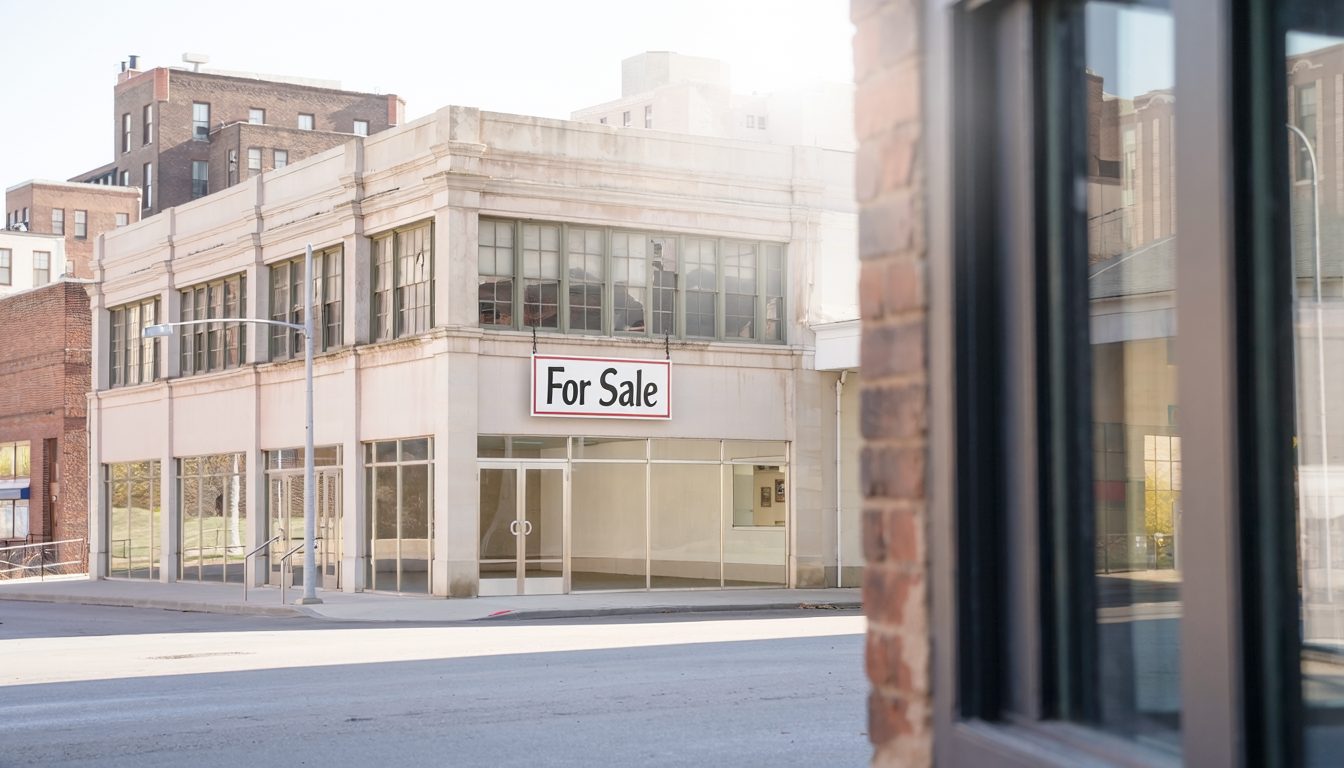
Commercial property deals have stalled because buyers and sellers cannot agree on what buildings are worth, and two forces keep that question open. Volatile long-term rates make it hard for buyers to settle on a price, and banks extending troubled loans let sellers avoid accepting one. The freeze hits hardest where returns were already thin, such as apartments, and barely touches sectors like data centers, where returns are high enough to absorb the swings.
That is the picture Matt Werner describes from his seat at Chilton Capital Management, a Houston-based investment management company with roughly $3.5 billion in assets under management, where he is managing director and senior portfolio manager. Werner says the transaction market will not meaningfully recover until two things happen: rate volatility settles down, and banks stop extending loans they know are impaired.
Why Deals Stalled
When long-term borrowing costs move as sharply as they have, buyers and sellers end up with different ideas about what a property is worth. Sellers need time to accept lower prices. Buyers cannot underwrite with confidence when locking in the debt they need to close takes 60 days or more and rates can shift meaningfully in that window.
The past two months show why. The 10-year Treasury yield climbed above 5.3 percent in early October, fell below 4.9 percent in early November, and climbed back above 5 percent within a week. Werner welcomes any decline, but the swings themselves are the problem. When rates can climb a full percentage point in a few months and then fall back, he says, buyers have no stable number to build a price around.
The damage varies by sector. In data centers, where returns are high, a rise of half a percentage point, or even a full point, in borrowing costs does not change the math much. In apartments, where returns were already thin, it changes the math substantially, and sellers are not yet ready to take the cut buyers need. Retail and industrial capital markets remain relatively healthy. Office was already depressed before rates rose, so the freeze there sits on top of an existing problem.
Werner notes that sellers typically need three to six months to adjust to a rate move this large, and the market is only a month or two into this one. He does not know when the gap will close.
Extend and Pretend
Rate volatility explains why buyers hesitate; the banks explain why sellers can afford to hold out. Banks have been granting extensions on loans made at much lower rates, accepting small payments and hoping conditions improve in six months or a year. Werner argues this keeps the market from learning what properties are actually worth.
“At some point they should have the conviction to say, ‘We both know that your equity is gone and we’re going to foreclose on this property, or you’re going to sell it, and we’re both just going to take our hit right now,'” he says. Instead, banks want to avoid losses and take over as little real estate as possible, and their stakeholders do not want to see losses either, even though those losses probably already exist.
If a bank or group of banks began foreclosure proceedings, or even threatened them, Werner argues, it would establish what properties will actually sell for. That is a hard outcome for the owners who would lose their buildings, but Werner’s point is that their equity is already gone; foreclosure would only make the loss official. That would make it acceptable for other owners to sell at valuations they do not like and would get buyers and sellers making deals again. Public REITs, he notes, would sit on the buy side of that trade. They may not get fire-sale prices, but their purchases would help reset values.
That structural advantage extends beyond distressed situations. Public REITs can buy back shares or pay down debt during slow periods, and because they traditionally borrow on an unsecured basis, they do not face the maturity walls that hang over private owners. A private fund with a loan coming due, or one nearing the end of its life, may have to sell into a weak market. Public REITs “could really benefit when the transaction market falls because they’re the ones that have access to capital and can afford to wait,” Werner says.
AI Beyond Data Centers
The freeze has not stopped demand from a new class of tenants. Beyond data centers, AI companies are filling empty office space in New York and San Francisco. San Francisco is the expected case, but New York has become the East Coast hub for AI companies, and those tenants are willing to pay high rents in what Werner describes as a very hot office market.
Cell towers are a less obvious beneficiary. Since reports emerged in early October that SpaceX, which now owns AI company xAI, might build a U.S. mobile network that would need space on existing towers, some tower REITs have risen as much as 20 percent, according to Werner. No leasing deal has been confirmed.
The towers also have power at the base of their sites, which revives a longer-running idea: edge data centers, smaller facilities located closer to end users that shorten the round trip between a device and the computing that serves it. “That argument hadn’t really played out yet,” Werner says. Now that power is getting harder to secure in states such as Georgia and Texas, the towers’ existing power access could move to the forefront. Tower companies raised the idea on their earnings calls, and while it remains a small part of their business, Werner sees it emerging over the next one to five years.
Senior Housing and Office
Two sectors investors once avoided have also turned around, for very different reasons. In senior housing, supply, more than demand, drove the recovery. Anyone could chart the aging of the baby boomers years in advance, and developers did, but they built for that demand too early. The oversupply before 2020 sent values down, construction dried up after 2020, and many properties went undermanaged and underfunded while the sector struggled. That combination now lets REITs that know the business buy at attractive prices while participating in what Werner calls “durable, very strong fundamentals.”
Office turned around because the fear surrounding it faded. A year ago, uncertainty about the sector’s long-term role made underwriting difficult. A February sell-off, driven by speculation that AI would eliminate the need for office workers, became a buying opportunity, and office went on to post what Werner calls the best performance of any REIT sector in the second quarter.
The question of whether office space will become obsolete now appears to be on the back burner. “People can start underwriting office real estate for what it is in terms of current fundamentals,” he says. Tenant retention is down but not zero, and values are lower but not headed to zero. Apartments moved the other way: the turn many investors expected this year has not arrived.
What to Watch
Looking ahead, the biggest variable is still the 10-year Treasury yield. Some REITs must replace cheap debt from five to ten years ago at higher rates, which Werner says poses no bankruptcy risk but will slow growth. Weak housing also weighs on apartments, single-family rentals, and self-storage. Apartments could recover next year if Sun Belt supply is absorbed and higher rates curb new building, though Werner doubts a return to the growth that banks and private equity funds were counting on a few years ago.
For investors, that environment strengthens the case Werner makes for public REITs over private real estate: they can sell when they need to, never face a forced sale on a fund’s timeline, and can buy when distressed sellers finally accept lower prices. Whether that chance arrives depends on steadier rates and banks ending their loan extensions, and neither is within the REIT sector’s control.
About the Expert: Matt Werner is managing director and senior portfolio manager at Chilton Capital Management in Houston, Texas, where he focuses on public REIT strategies.
This article is intended for informational purposes only and does not constitute legal, financial, or investment advice. The views and opinions expressed herein reflect those of the individuals quoted and do not represent an endorsement of any company, product, or service mentioned. Readers should conduct their own due diligence and consult qualified professionals before making any investment decisions.