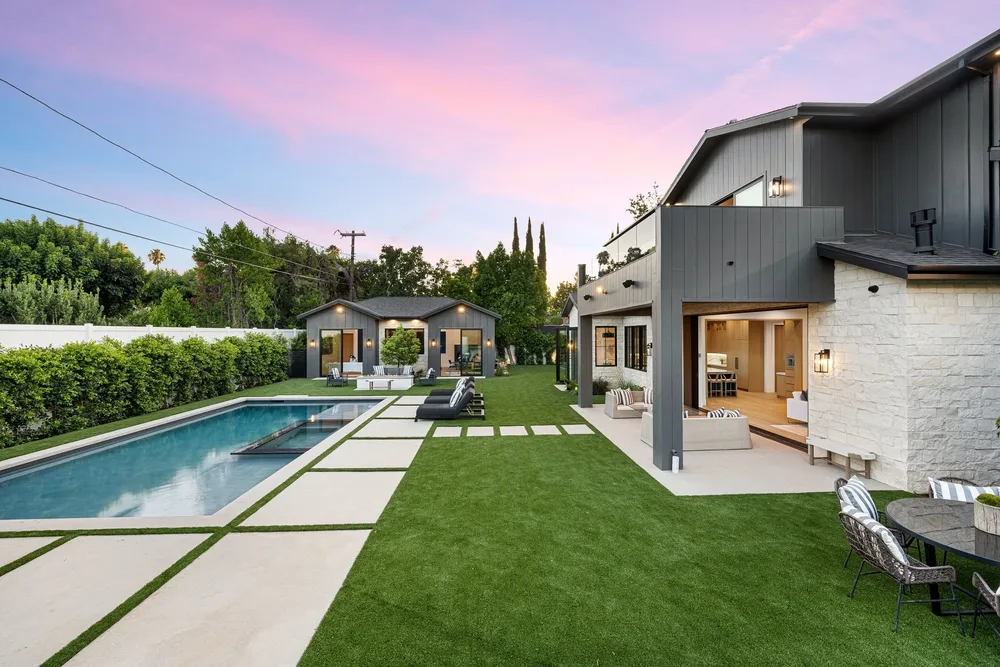
The accessory dwelling unit market has quietly moved from a niche housing concept to a more mainstream solution. Affordability pressures, an aging demographic, and a wave of supportive local policies are pushing more homeowners and investors to consider what a backyard structure can actually do for them. Peter Anadranistakis, Founder and CEO of OxygenHaus and Circle Stone Capital, is building a business around exactly that opening.
OxygenHaus manufactures prefabricated ADUs, compact studios and one-bedroom units designed to be shipped flat-packed and assembled on site. Price points run from just under $50,000 to roughly $100,000, with financing options available for buyers who cannot pay out of pocket.
The use cases extend well beyond guest housing. Units serve returning adult children, aging parents moving in with family, home offices, long-term rentals, short-term vacation rentals where permitted, and equity-building additions for homeowners who want to increase property value without selling. “Sometimes it’s needed for a guest, sometimes for a son or daughter coming back from college, sometimes for a mom or dad moving in with their kids,” Anadranistakis says.
The company is currently focused on residential backyards, but the product has broader applications in retail, commercial land, and small rental communities. Longer-term, OxygenHaus is exploring national distribution, strategic partnerships with larger developers, and technology integrations that it plans to announce later in 2026.
Policy Ahead of the Market
One of the more surprising dynamics in the ADU space is how far government policy has outpaced private sector adoption. Anadranistakis, who has been in business for over 30 years, says this is genuinely unusual; public policy is “rapidly outgrowing or way in advance of private capability,” he notes.
In Tucson, for example, a middle housing ordinance allows homeowners to place multiple ADUs on a single lot in some cases and even convert them into individually purchasable condominiums. Arizona more broadly has been progressive on ADU zoning, but the trend is national. Cities are actively encouraging ADU adoption as part of their affordability strategies, and that policy support reduces friction that has historically slowed the market.
For developers and investors paying attention to regulatory tailwinds, this is a meaningful signal. The infrastructure of permission is largely in place; what lags is the private sector’s ability to deliver at scale.
Where Projects Actually Stall
Despite favorable policy and genuine consumer interest, many ADU projects never get off the ground. The reason is not a lack of desire but a lack of guidance. Connecting to utilities, understanding setback requirements, and navigating permitting across multiple agencies are routine for contractors but unfamiliar territory for most homeowners.
“Almost everybody says, ‘I want one of these.’ And most people tell me, ‘I’ve looked into it, and I’ve stopped after I had to talk to the power company and get a permit,'” Anadranistakis says.
The solution is straightforward: a reliable guide through the process. Whether that is a company like OxygenHaus walking a buyer through each step or a knowledgeable general contractor, having someone who understands the workflow removes the friction that causes projects to stall.
Financing is the second major barrier. Even with units priced accessibly, not every homeowner has $50,000 to $100,000 available. OxygenHaus offers its own financing options, and buyers can also choose to add the cost to an existing mortgage or secure a separate loan, since an ADU qualifies as an addition that increases property value.
The Case for Prefabrication
A common assumption in the modular housing space is that factory-built means lower quality. Anadranistakis pushes back on that directly, the OxygenHaus units are designed to be visually appealing and feel spacious despite their footprint. “People walk up to them and touch them, and they want to live in it right now,” he says.
Beyond aesthetics, the prefabricated model addresses a practical problem: time. Weather delays, contractor scheduling, and the relatively small scale of a single ADU project can make traditional builds slow and expensive. A flat-packed unit with a predictable delivery and assembly timeline gives buyers something on-site construction rarely offers: certainty.
For families planning around a parent’s move or a returning college graduate, knowing a unit will be delivered in January, assembled in March, and ready by spring matters more than most design choices.
The Investment Layer
Circle Stone Capital, the boutique investment platform Anadranistakis manages alongside OxygenHaus, adds a separate dimension. The platform is invitation-only and limited to accredited investors, typically individuals earning $250,000 or more annually or carrying a net worth above $1 million outside their primary residence.
The investor base tends to favor income-producing assets with long-term appreciation potential. Circle Stone’s current portfolio includes apartment buildings and Tucson Gastro Park, a commercial land and restaurant lease project spanning nearly two city blocks. OxygenHaus is now being positioned as an investment opportunity within that ecosystem.
The overlap between investor and end customer has been notable. “Almost every single investor I’ve talked to about OxygenHaus has said, ‘I want one for my backyard,'” Anadranistakis says, a signal the company treats as meaningful validation.
Investors are being offered three entry points: equity participation in OxygenHaus as a growing business, investment in land and ADU rental projects, and potential access to a pre-IPO position. A public offering is under consideration, though no timeline has been confirmed.
Investor Sentiment in Mid-2026
The broader investment climate connects directly to how quickly capital flows into newer asset categories like ADUs. A year ago, many Circle Stone investors were sitting on cash pulled from equity markets. That posture has softened somewhat – moving from defensive to selectively optimistic – but has not returned to the more open conditions of 2023 or 2024.
In a crowded market where investment platforms compete for attention through social media and digital advertising, personal relationships and clarity of communication remain the deciding factors. “You still need to have one-on-one conversations with people to make it understandable and simple for them to invest,” Anadranistakis observes.
Looking Ahead
OxygenHaus enters the second half of 2026 with several initiatives underway: evaluating acquisitions of additional manufacturing facilities, pursuing partnerships with larger developers, and preparing technology-related announcements not yet publicly disclosed. A potential IPO remains on the table as the business scales.
For real estate professionals and investors following the ADU space, the core takeaway is practical. The demand is real, the policy environment is supportive, and the main obstacles are execution-level problems that a well-organized process can solve. The companies and investors who move first into this gap between policy permission and private delivery stand to benefit most, provided they can guide homeowners through the steps that currently cause most projects to stall before they start.
About the Expert: Peter Anadranistakis is Founder and CEO of OxygenHaus, a prefabricated ADU manufacturer, and Circle Stone Capital, an invitation-only investment platform for accredited investors, with over 30 years in business.
This article is based on information provided by the expert source cited above. It is intended for general informational purposes only and does not constitute legal, financial, or real estate advice. Readers should conduct their own research and consult qualified professionals before making any real estate or financial decisions.