A new home that costs 12 to 18 percent more than a conventional wood-framed house sounds like a hard sell. But Neil Prakash, an architect working in mass timber construction in British Columbia, argues that sticker price is the wrong number to focus on. He says the real cost of a home should be measured across its full lifespan, not just at closing.
Prakash, Principal and Architect at Prakash Architecture Inc. in Vancouver, has been designing prefabricated mass timber housing for First Nations and remote communities in the province. His firm’s work with the Nak’azdli Development Corporation in Fort St. James produced a prototype now being refined into a commercialized, one-story version.
According to Prakash, that premium reflects the higher upfront cost of more durable materials and construction methods. But he argues the comparison is misleading without the second number: how long the house lasts.
Lifespan Lowers Cost
Prakash says the mass timber version is designed to last roughly twice as long as a conventional wood-frame home. The structural panels, made of solid engineered wood panels, are more robust than typical stud framing. The building’s outer shell also places insulation and the air barrier between the structural wall and the exterior siding. This protects them from physical damage and weather exposure.
That arrangement shields the elements most likely to degrade in a traditional home. In Prakash’s assessment, “the longevity of this house will mean that its overall life cycle cost per square foot would ultimately be lower” than a conventional build, meaning the total cost of owning the home over time. If the home lasts significantly longer, the annual cost of ownership drops, even if the buyer paid more on day one.
For buyers, this framing is unfamiliar. Mortgage calculators, appraisals, and listing prices all anchor to upfront cost. But in remote communities where replacement housing is expensive and difficult to deliver, total cost of ownership is a practical concern, not an abstract one.
Developer Incentive Gap
The reason most homes are not built this way comes down to who is building them and why. Prakash says “most developers are driven by profit.” A developer building homes to sell, not to a specific buyer’s request, in a suburban subdivision has no financial incentive to add 15 percent to construction costs for durability that won’t pay off for decades. By then, the home has been sold, and the warranty has expired.
The Nak’azdli project is structured differently. The community is both client and long-term owner. There is no resale margin to protect. Prakash describes the goal as “developing for community in mind as opposed to kind of the bottom line,” meaning building for the people who will live there rather than for profit. That alignment between builder and occupant makes the higher upfront investment rational in a way it typically is not in speculative development.
This does not mean the model translates easily to private buyers in urban markets. A household stretching to afford a home in greater Vancouver is unlikely to voluntarily pay a 15 percent premium for durability benefits that arrive decades later. The incentive mismatch remains real for most of the housing market.
Carbon Storage Benefits
Mass timber locks carbon into the structure for as long as the building stands. Prakash describes this as “embodied carbon that’s creating living spaces that are lasting longer than what we currently design for them,” referring to the carbon stored in the building’s materials. A home that stands for over a century keeps that stored carbon out of the atmosphere for over a century. That climate benefit does not show up on a balance sheet, but it may eventually factor into building code requirements or incentive programs.
British Columbia’s building code already includes tiered energy-efficiency building standards that push toward higher performance. The Nak’azdli show home was designed to Step 4 of the B.C. Building Code, a high-performance energy tier. For buyers in the province, the policy direction points toward stricter energy and durability standards. This could eventually narrow the cost gap between mass timber and conventional construction.
Community Design Goals
The design process began with a community survey of roughly 110 respondents and an open house to set project goals. Prakash says one recurring theme was building “a seven-generation house,” a concept common among First Nations in Canada where decision-making carries a multi-generational horizon.
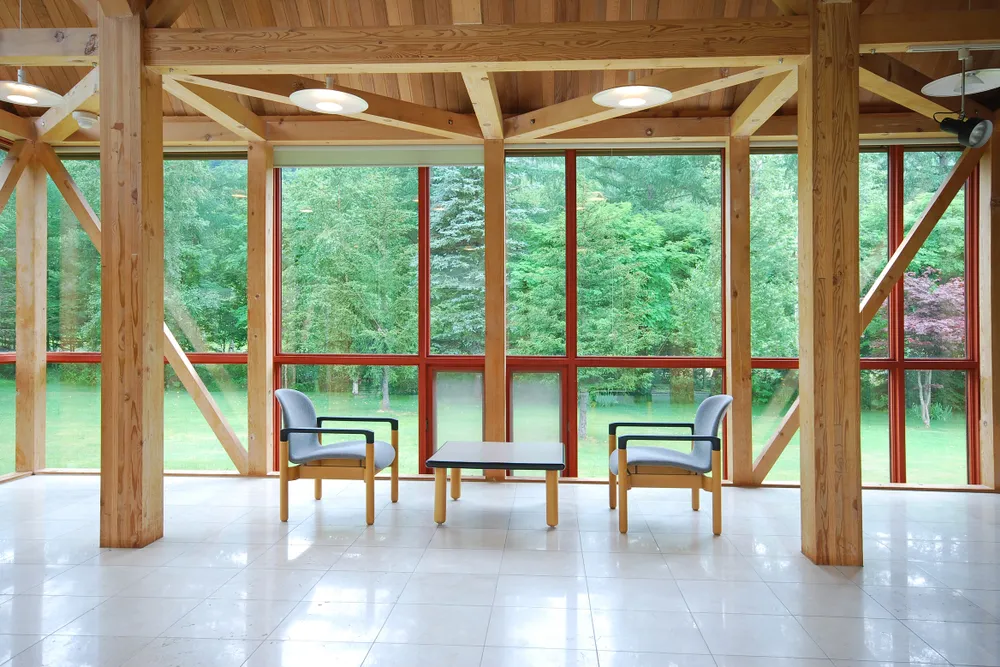
The design responds to that in several ways: the structural system’s durability, interior partition walls that can be reconfigured as family needs change, fire resistance on both exterior and interior surfaces, and high energy efficiency that keeps cooling and heating costs low year-round. Prakash says the expressed wood interior also mattered to a community surrounded by the forestry industry. “They are a people of the forest, and having the forest represented in their house was a really important consideration.”
Prakash poses a question to anyone evaluating a home in a remote or northern British Columbia community: is the number that matters most the one paid at signing, or the one paid across a full lifetime of ownership?
About the Expert: Neil Prakash is Principal and Architect at Prakash Architecture, based in British Columbia, with a focus on mass timber and prefabricated housing design, including work with First Nations communities in Canada.
This article is intended for informational purposes only and does not constitute legal, financial, or investment advice. The views and opinions expressed herein reflect those of the individuals quoted and do not represent an endorsement of any company, product, or service mentioned. Readers should conduct their own due diligence and consult qualified professionals before making any investment decisions.