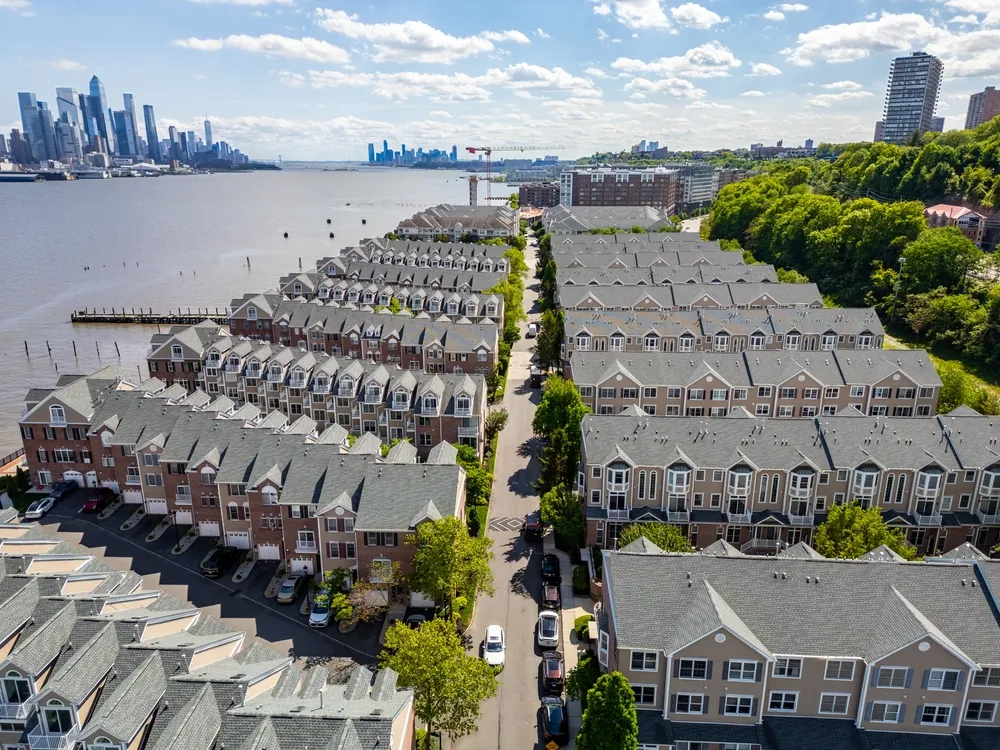
Jersey City has spent the past several years absorbing buyers priced out of Manhattan, drawn by shorter commutes and significantly more space per dollar. But the city is not a single market. Its neighborhoods: downtown, the Heights, Journal Square, are each at different stages of development, attracting different buyer profiles, and responding differently to the current rate environment. Which submarket a buyer enters matters more now than it did when remote work first reshuffled demand during the pandemic.
Amanda Pereira, a Realtor with Prominent Properties Sotheby’s International Realty who has worked the New Jersey market for over 13 years, describes a city where the value gap between neighborhoods is wide enough to entirely change what buyers can afford. “You go $700,000 in downtown, you’re not going to get much,” she says. “But if you go up in the Heights, you get a three-bedroom, two-bath, rooftop, nice new construction, 10-year warranty.”
That price difference is not just a matter of taste or lifestyle preference. It determines whether a buyer gets a one-bedroom or a family-sized home, and whether an investor can generate rental income or gets buried under HOA fees.
The Heights Grew During COVID. Journal Square Is Next.
The pandemic reshuffled demand within Jersey City in ways that have persisted. Downtown residents stuck in small apartments during lockdowns moved to the Heights, where new construction offered more space despite the lack of a direct train line to Manhattan. That wave of development made the Heights one of the fastest-growing areas in northern New Jersey during that period.
Journal Square, by contrast, lagged. Pereira lived in the neighborhood for years and watched it wait for investment that took longer to arrive. Now towers are going up, and the surrounding area is visibly changing. “I believe Journal Square is going to get flooded by young professionals and families,” she says. The infrastructure, Journal Square sits on the PATH line, was always there. The construction is catching up.
For buyers, the practical implication is timing. The Heights already went through its rapid appreciation phase during COVID. Journal Square is earlier in that cycle, with new inventory arriving and prices not yet reflecting the density that’s coming.
A Broader Suburban Pull
The sorting isn’t confined to Jersey City’s internal neighborhoods. Across both New Jersey and South Florida, where Pereira also works, buyers are bypassing urban cores for suburban locations that offer more space, better school systems, and hybrid-work compatibility.
“A lot of people now, instead of buying the smaller apartment in the urban area, they are moving straight to the suburbs,” she says. The pattern shows up in pricing dynamics: Jersey City has adjusted prices downward in recent months and functions as a buyer’s market, but certain suburban areas nearby still attract multiple offers. “You don’t see highest and best in Jersey City so much, but you see it in a suburban area for sure.”
The driver is straightforward. Buyers who don’t commute daily can trade proximity for square footage. As long as a train line exists for the days they do go in, the suburban trade-off works financially. Jersey City’s position in the middle – more affordable than Manhattan but more urban than true suburbs – means it competes on both sides simultaneously.
The Investor Case for Two-Family Homes
For investors considering Jersey City, Pereira steers toward two-family homes rather than condominiums. Condos carry HOA fees that erode returns, and at current prices, she says an apartment purchase “makes no sense” as an investment – the numbers don’t produce positive cash flow.
Two-family homes, by contrast, offer rental income from a second unit and better prospects for turning cash-flow positive within a few years. For higher-income investors, there’s also the depreciation benefit. “For you to get cash flow is going to be tough,” she acknowledges. “It’s more like for the depreciation, you have a very high income, and then you get the tax write-off.”
The distinction matters because Jersey City’s condo inventory is large and growing, particularly downtown and in Journal Square. Investors who default to condos because they’re familiar with the format may find that HOA fees and current pricing leave no margin between carrying costs and rental income.
Affordability as the Binding Constraint
The common thread across both markets Pereira works, northern New Jersey and South Florida, is affordability pressure. Interest rates, insurance costs, and property taxes have all risen simultaneously, compressing the pool of qualified buyers.
“When you raise everything at once, you really hurt the average American buying their homes,” she says. In South Florida specifically, insurance availability is a structural issue she sees as needing state-level intervention, opening markets to more carriers to drive premiums down.
Pereira says she tells hesitant buyers to act within their means rather than wait for conditions to improve. “Do what you can afford,” she says. “Five years from now, you’re going to say that five years before, you should have jumped in and you didn’t.”
Her logic is that buyers who wait for lower rates or a larger down payment often find that prices have moved further away from them in the interim. The advice isn’t to stretch beyond what’s financially safe; it’s to stop treating perfect conditions as a prerequisite for entry.
South Florida’s Wellness-Driven Development
In South Florida, Pereira sees new construction increasingly organized around wellness amenities – cold plunges, pickleball courts, outdoor entertainment spaces – rather than traditional luxury finishes alone. Developments that lack these features struggle to attract buyers in a market where quality of life drives purchasing decisions.
“If you don’t have a development that has a bunch of amenities that makes that place a community, you’re not going to sell,” she says. This trend has not yet reached Jersey City in the same way, partly because adding extensive amenities raises HOA fees in a market already sensitive to monthly costs.
For buyers comparing the two markets, the difference is structural: South Florida competes on lifestyle infrastructure, while Jersey City competes on access to Manhattan and relative affordability. Each market rewards a different set of priorities.
About the Expert: Amanda Pereira is licensed in Florida with Top Florida Homes and has over 13 years of experience serving the market.
This article is based on information provided by the expert source cited above. It is intended for general informational purposes only and does not constitute legal, financial, or real estate advice. Readers should conduct their own research and consult qualified professionals before making any real estate or financial decisions.