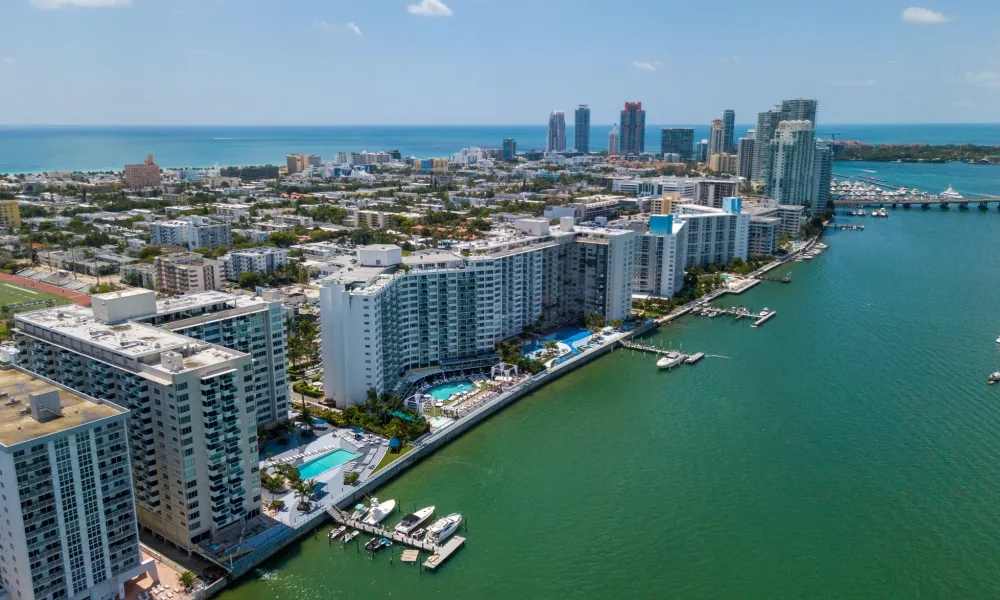
With roughly 165 active projects across Miami-Dade and Broward County, buyers can afford to be choosy. Brandon Talalaevsky of Property Pro Partners argues that aggregate inventory numbers miss the real story: which projects meet today’s higher standards and which don’t.
When headlines describe Miami’s condo market as slowing, they typically draw on metro-wide or county-level data that flattens enormous variation across dozens of distinct sub-markets. Brandon Talalaevsky, Founder and Principal Broker at Property Pro Partners, says that framing creates a distorted picture of how new development actually performs on the ground.
His estimate of the current competitive landscape is striking: approximately 165 new development projects are active in Miami-Dade and Broward County simultaneously. That volume means any individual project operates in a highly specific competitive context – defined by price point, location, unit mix, amenity package, and buyer profile – that market-wide statistics cannot capture. “It’s hard to just always judge an entire market, especially because South Florida has a lot of sub-markets,” he says.
A project in Aventura targeting Latin American second-home buyers at $600 per square foot is not competing with a luxury tower in Brickell targeting domestic high-net-worth buyers. Treating them as part of the same market story produces analysis that is accurate about neither.
The Seven-Out-of-Ten Buyer
What has changed across sub-markets is the threshold buyers apply when evaluating projects. During the pandemic-era seller’s market, demand was strong enough that buyers would move on projects, checking only a handful of their criteria. That dynamic has reversed.
Buyers now have enough options to be selective, and they are exercising that selectivity. Projects that fall short on pricing, finishes, HOA structure, amenities, or developer credibility are more likely to stall, not because the market is failing, but because buyers can find alternatives that come closer to meeting their full criteria. “If you can check seven or eight of those boxes, that’s basically what you’re going to find in today’s market,” Talalaevsky says.
He is clear that this creates opportunity as much as risk. Some developers who aren’t selling at their target pace may offer concessions or flexibility that wasn’t available a year ago. For well-positioned projects, a buyer’s market can accelerate absorption by drawing in purchasers who might otherwise have waited. “The buyer does have an advantage today, because there is lots of inventory,” he says.
Seasonal Signals
Compounding the sub-market problem is the seasonal nature of South Florida demand, which creates false signals when viewed in isolation. Summer months consistently produce slower sales activity, families are traveling, school schedules shift, and the region’s seasonal residents are elsewhere. A slowdown in June or July is not evidence of structural market weakness; it is a predictable pattern.
When that seasonal dip coincides with broader national narratives about rising inventory or softening demand, it can produce coverage that overstates the degree of market deterioration. “In the summer months, you do see a natural slowdown, kids are out of school, families on vacation, people are visiting other places,” Talalaevsky says.
The longer-term picture, in Talalaevsky’s view, is one of a market absorbing a supply surge that was itself a response to being dramatically undersupplied during the Covid-era demand spike. “Prices went a little crazy last time, because we were definitely undersupplied for what happened during Covid,” he says. The current inventory buildup, in his reading, is preparation for the next demand wave rather than evidence of a broken market.
Project-Level Approach
While market narratives focus on broad trends, Property Pro Partners operates from the premise that project-specific execution determines outcomes. The firm’s current projects, Eden and Lev, are positioned around a value proposition designed to hold up under buyer scrutiny: competitive pricing, high-specification finishes including Bosch appliances and porcelain tile, and an HOA held at $1.03 per square foot while covering cable, internet, and reserves.
The firm’s strategy centers on front-end discipline, feasibility work before launch rather than price adjustments after. “It’s very important that, before launching any project at all, the right marketing and sales strategies and feasibility studies are done, so that you can truly understand the correct pricing for your product from the start,” Talalaevsky says.
As South Florida’s inventory continues to expand, that kind of pre-launch rigor may prove to be a structural advantage. Projects priced accurately from day one and designed to meet today’s more demanding buyer criteria are better positioned to absorb steadily, while those relying on market momentum or post-launch corrections face a longer path to sell-through. Other developers and brokerage teams across the region are adopting similar feasibility-first approaches, but the margin for error has narrowed considerably.
About the Expert: Brandon Talalaevsky is Founder and Principal Broker of Property Pro Partners, a brokerage handling new development sales across Florida, New York, and international markets, with a current focus on projects in Miami-Dade and Broward County.
This article is based on information provided by the expert source cited above. It is intended for general informational purposes only and does not constitute legal, financial, or real estate advice. Readers should conduct their own research and consult qualified professionals before making any real estate or financial decisions.