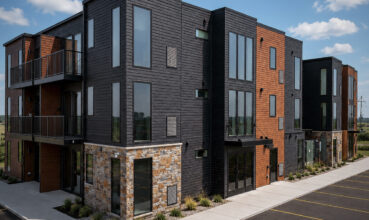
A Midwest workforce housing developer explains how accelerated depreciation on ground-up projects can generate tax offsets close to an investor’s full capital contribution, and what investors should sort out with their CPA before committing capital.
Reading the Tax Code as a Roadmap
Many high-income professionals treat federal income tax as a fixed cost of success. Dusten Hendrickson, founder of Mailbox Money Real Estate, a developer of ground-up workforce housing in secondary and tertiary Midwest markets, sees it differently. In his view, the tax code tells investors exactly where the government wants private capital to go.
“They write the code for a reason,” Hendrickson says. “They want you to invest in certain things. Energy is one thing they want you to invest in. Real estate’s one thing they want you to invest in, and agriculture is one thing.”
He says the results show up among experienced investors. “When you talk to long-term real estate investors, most of those investors pay close to zero federal income tax,” he says.
A Policy Trade-Off That Favors Depreciation
The same federal tax legislation that phased out the 45L energy efficiency tax credit at the end of June 2026 also restored 100% bonus depreciation. Hendrickson says the exchange works out well for many investors. “The trade-off was actually, in my opinion, better,” he says.
He notes that the two tools serve different investors. A tax credit reduces the tax owed dollar for dollar and is never recaptured, so it benefits nearly everyone who receives it. Depreciation is most valuable to investors with significant passive income they want to offset.
How Bonus Depreciation Creates an Early Tax Benefit
Under bonus depreciation, building components with a useful life of 15 years or less can be deducted in the first year instead of over their normal schedule. That includes appliances, carpet, lighting fixtures, and similar items.
On a new ground-up development, Hendrickson estimates that about 30% of total project cost falls into these shorter-life categories. Because his firm typically raises equity equal to 30–35% of project cost, the depreciation available to limited partners can come close to the amount they invested. “If someone brings in 100k, it’s roughly 80 to $100,000 worth of depreciation as the buildings go into service,” he says.
The timing follows construction. Depreciation is passed to investors on a K-1 in the tax year each building is placed in service. Because the firm’s first buildings typically finish within about nine months of breaking ground, most of the benefit lands in the first two years of a project.
What an Investor’s CPA Should Know Before Tax Season
Hendrickson says the most important conversation happens between the investor and their CPA, ideally well before a K-1 arrives. The central question is how much of the investor’s income is passive. For most limited partners, depreciation offsets passive income, meaning returns from investments rather than wages.
Investors who qualify for real estate professional status under IRS rules may be able to use real estate losses against other income. The general test is at least 750 hours a year in real estate activities, making up more than half of the investor’s total working hours. How those rules apply to a limited partnership interest depends on the investor’s specific situation, so it is worth confirming with a qualified tax advisor.
“If you make a huge wage and you’re paying 40 to 50% to Uncle Sam, you can implement some strategies and reduce that,” Hendrickson says.
Opportunity Zones: The Next Lever
Hendrickson is also watching the next round of the Opportunity Zone program. The program lets investors defer capital gains by reinvesting them in qualified opportunity zones and can reduce or eliminate tax on the new investment’s appreciation over a long hold. He calls the coming “Opportunity Zone 2.0” round potentially “extremely powerful” for investors with capital gains exposure.
Why New Construction Fits the Strategy
For Hendrickson’s firm, which builds ground-up workforce housing in markets including Sioux Falls, South Dakota, new construction is what makes the depreciation picture work. Building new means a full set of fresh short-life components placed in service on a predictable schedule, rather than an older asset with a partially used-up depreciation basis.
He frames the strategy as working with the policy, not around it. “The government is incentivizing you to invest, and they want you to invest in certain things, and that’s why they incentivize it,” he says.
This article is for informational purposes only and does not constitute tax or investment advice. Readers should consult a qualified tax professional about their individual circumstances.
Dusten Hendrickson is the founder of Mailbox Money Real Estate, a vertically integrated developer of ground-up workforce housing in secondary and tertiary Midwest markets, with a concentration in Sioux Falls, South Dakota, and surrounding communities. With 25 years of real estate experience, Hendrickson and his team have delivered roughly 1,300 units, including Crooks Reserve in Crooks, South Dakota, and Fosfield in Sioux Falls.
This article is based on information provided by the expert source cited above. It is intended for general informational purposes only and does not constitute legal, financial, or real estate advice. Readers should conduct their own research and consult qualified professionals before making any real estate or financial decisions.