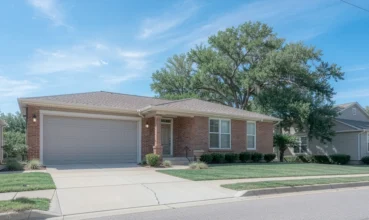
Stock portfolios get diversified. Bond holdings get diversified. Even alternative investments get spread across categories and geographies. But the single largest asset on most American household balance sheets – the home – sits as a fully concentrated position in one property, in one neighborhood, in one local market.
Economists have been documenting the cost of that concentration for years. Research from the Federal Reserve Bank of St. Louis has found that homeownership should constitute a limited share of a household’s assets, despite its role in a sound portfolio. The reason is volatility: individual home prices can swing roughly twice as much as broad house-price indexes, and combined with the leverage built into a mortgage, that lack of diversification can meaningfully increase a family’s risk. Stanford economists Monika Piazzesi and Martin Schneider have made a related point using the language of portfolio theory – that the high volatility of individual house prices, paired with high transaction costs, produces a lower risk-adjusted return on housing than the concentration would suggest is worth bearing.
The affordability side of the problem is just as well established. First-time buyers made up just 21% of nationwide home sales last year, the lowest share ever recorded, and most of the ones who do buy aren’t putting down anything close to 20%. A recent National Association of Realtors poll put the median down payment at 19% overall, but only 10% for first-time buyers specifically, which means a large share of first-time purchases are still carrying private mortgage insurance or an FHA premium on top of the mortgage itself.
A handful of companies have tried to chip away at the concentration problem directly. Hometap is among a group of firms – including Unison, Unlock, Point, and Aspire – that offer what’s known as a home equity investment: a lump sum of cash in exchange for a share of a home’s future value or appreciation, positioned as a new, debt-free asset class alongside traditional home-equity borrowing. Unison and Point have each pushed the model far enough to securitize the contracts and sell them to institutional investors, arguing the structure gives investors access to one of the largest asset classes in the world – residential home equity. That category of product is now well established enough to have its own competitive landscape and its own secondary market, even if it remains a small corner of housing finance overall.
Most of those products, though, are built for homeowners who already have equity to trade. A smaller and more experimental strand of proposals asks a different question: could the same diversification logic be applied at the point of origination, to reduce the credit risk a lender takes on and make zero-down, no-PMI lending viable in the first place? Home Diversification Corp., founded by CFA charterholder and former bank profitability analyst Marc Biron, is one attempt at that version of the idea.
How a Risk-Swap Structure Works
The mechanism Biron has designed operates as a pool rather than a direct cash payout. Homeowners who participate swap their individual home’s price trajectory for the return of a national home price index. Those whose homes underperform the index receive the difference; those whose homes outperform pay back the spread.
“We have a closed system, which is important for commercial and risk management purposes,” Biron says. Homeowners retain full ownership and occupancy under the structure. The arrangement is secured not by a lien but by a memorandum, a legal instrument that cannot trigger foreclosure and is always subordinated to existing debt, with its sole function being to ensure the homeowner settles any amount owed at contract maturity.
According to Biron, the credit-risk reduction from this structure is substantial: he cites published studies showing four to six basis points of expected loss on a zero-down mortgage originated under the framework, compared with 29 basis points of credit risk on a conventional mortgage carrying 20% down or PMI. He also points to a separate published study modeling the diversification benefit – available even to homeowners who already own free and clear, with no new mortgage required – at roughly 14% of a home’s value in risk-adjusted economic benefit. None of those figures have been tested in a live lending environment.
The Affordability Pitch
Biron is candid that concentration risk isn’t what motivates most homeowners. “Homeowners don’t wake up every day thinking, my goodness, my home is entirely concentrated,” he says. The more immediate appeal, in his telling, is the absence of a down payment and PMI, and a lower monthly payment as a result.
A simulated survey the company conducted – which Biron describes as directional rather than definitive – found the product preferred two-to-one over PMI and FHA options combined. The primary target for this kind of structure would be the same borrowers reflected in the industry data above: buyers relying on FHA loans or paying PMI because they can’t put 20% down. Biron argues the underlying logic extends further than that entry point, though: “Everyone should diversify their home,” he says. “Theoretically and even practically speaking, it just makes sense for everyone.”
Whether lenders will actually originate loans on these terms depends on whether the credit-risk model performs the way the published studies project once it meets real underwriting.
An Idea Still Looking for Its First Loan
The concept hasn’t reached the market. Home Diversification Corp. isn’t a lender; it needs a lending partner willing to originate the first pool of loans, plus secondary-market buyers willing to purchase them, and neither piece is in place yet. That gap is a familiar one for new financial products: getting the first institution to commit is usually the hardest part, after which, as one advisor to the company put it, “there’s 800 people lining up.”
Biron points to the run-up to the 2008 financial crisis as a frame for the kind of risk his model is meant to avoid: non-prime lending that concentrated credit risk in individual, undiversified properties rather than spreading it across a broader index. It’s a useful illustration of the theoretical case for risk-sharing structures in mortgage lending generally, though it’s worth noting the comparison is Biron’s own reading of history rather than a tested claim about what his specific product would have done.
The Larger Question
Concentration risk in housing isn’t a new observation; economists have been making the case against it for over a decade, and the affordability numbers driving first-time buyers toward low- or no-down-payment loans aren’t going away on their own. What’s less settled is whether any risk-sharing mechanism, whether structured as an equity investment after the fact or a credit enhancement at origination, can move from a modeled paper case to something lenders are willing to originate at scale. The home equity investment industry took the better part of two decades to build a securitization market around its version of the idea. Whether an index-swap approach aimed at the point of purchase follows a similar path – or stalls at the pilot stage – is likely to say as much about lender appetite for a new asset class as it does about the underlying math.
About the Expert: Marc Biron is a CFA charterholder and former bank profitability analyst who founded Home Diversification Corp.
This article is based on information provided by the expert source cited above. It is intended for general informational purposes only and does not constitute legal, financial, or real estate advice. Readers should conduct their own research and consult qualified professionals before making any real estate or financial decisions.