Rents in Chicago’s multifamily market are rising faster than in any other major U.S. market, according to Lawrence Dunning, a broker with The Dunning Team at Fulton Grace Realty. Yet buyers and sellers cannot agree on what buildings are worth.
Rising construction costs and higher borrowing expenses have created a valuation standoff. Transaction volume is falling even as the market’s fundamentals strengthen.
Rising Costs Stall Deals
Chicago’s multifamily market is caught in an unusual bind. According to Dunning, both sides of the transaction are under financial pressure. That pressure pushes buyers and sellers in opposite directions at the negotiating table.
Developers who built or are building today have absorbed construction costs that rose sharply with inflation. Dunning says a builder who needs to replicate an existing project from scratch faces costs up roughly 10% compared to prior years. That cost basis sets a floor on what sellers will accept.
Buyers, meanwhile, are contending with financing costs that have risen substantially. Their monthly debt service is higher, their cash-on-cash returns are compressed, and their instinct is to push for a price reduction to compensate.
“The builder’s costs have gone up with inflation,” Dunning says. “At the same time on the buyer’s side their interest rate costs have gone up as well. So they’re looking for a discount in price.”
The result: in areas with meaningful inventory, properties are sitting unsold. Deals only close when buyers and sellers can agree on value. That common ground has become harder to find in recent years.
Rent Growth, Frozen Prices
What makes this standoff striking is that rent fundamentals in Chicago are among the strongest in the country. Dunning says Chicago and the broader Midwest have recorded some of the fastest rent growth of any major U.S. market over the past 12 months. That kind of growth would normally push asset prices higher.
“The rent growth is the fastest done anywhere in the country. So that is naturally going to impact the prices going forward,” Dunning says. He describes the Midwest as a historically undervalued market, with cap rates that have long been higher than coastal alternatives. Now, rent growth is being added to the mix. Over time, that growth should compress those cap rates and push valuations higher.
Yet that forward-looking logic is not resolving the current standoff. Buyers focused on today’s financing costs are discounting tomorrow’s rent trajectory. Sellers anchored to their construction cost basis refuse to absorb a discount to accommodate buyer financing constraints. The long-term investment case is strong by Dunning’s assessment, but short-term transaction volume is being suppressed by disagreement over how to price that future.
“The opinion on what value is is definitely more than the last few years disputed between buyers and sellers,” Dunning says. “The deals that happen is when they can agree on where value is.”
Low Offers, Rate Fears
The valuation dispute is showing up in deal flow. Dunning says he is receiving a high volume of offers that fall far short of what developers will accept. These low bids are shaped more by rate anxiety than by asset fundamentals.
“I’m getting a lot of calls with people putting in low offers that aren’t even close to getting accepted by these developers,” Dunning says.
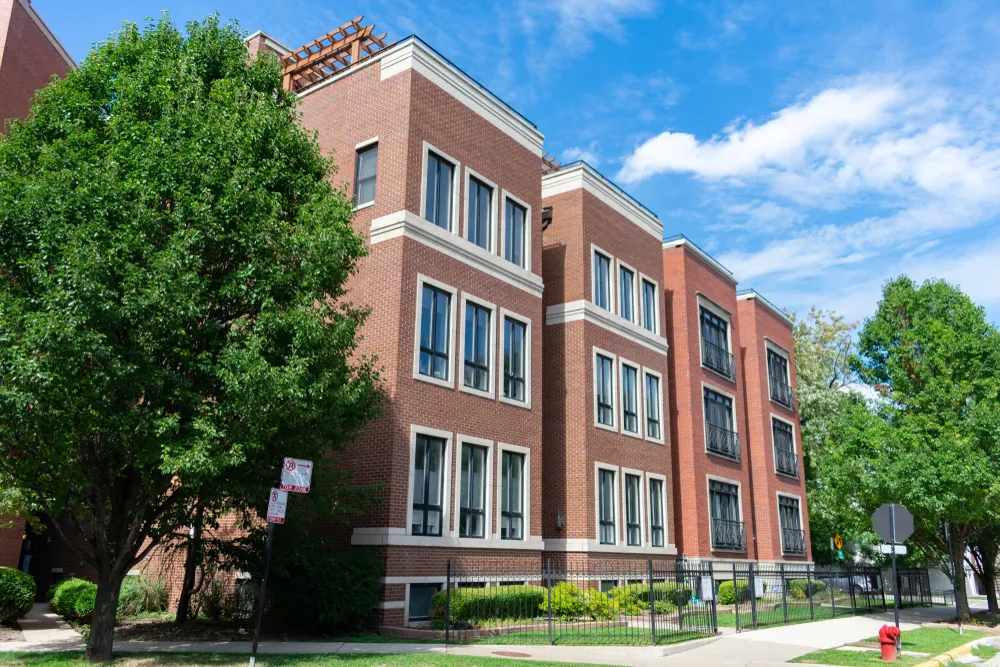
He says this pattern is particularly visible in Chicago’s new construction three-flat segment, where the math is transparent. Standard city lots with multifamily zoning allow developers to build three-unit buildings. New construction three-units typically trade at cap rates between 7.5% and 8.5%, a range that works for both builders and buyers when financing costs are manageable. With rates elevated, that sweet spot has narrowed considerably.
Reframing the Rate Debate
Dunning’s approach is to redirect buyers away from fixating on today’s financing costs. His core argument: the building is the long-term commitment, the interest rate is not.
“In real estate you marry the building but you’re only dating the interest rate, meaning you’re going to be able to refinance the building when rates go down and then your cash flow is going to get a lot better,” Dunning says.
He tells buyers to evaluate deals on cap rate, which is net operating income relative to purchase price, independent of financing costs. He also advises building in a refinancing assumption within 9 to 15 months. That framework lets investors look past today’s rate environment and judge whether the asset holds durable value in a market with historically high cap rates and strong rent growth.
Dunning says he is putting his own capital behind this logic. He is currently purchasing a new construction development for his own portfolio, expecting to sit on equity once rates decline.
Where demand already validates this thesis, properties are moving despite rate headwinds. Dunning describes a new construction building near Chicago’s Illinois Medical District that drew multiple offers and went under contract, even though it was still three months from completion and not yet drywalled. In pockets with limited inventory and strong institutional demand drivers like hospitals, the buyer-seller standoff dissolves because scarcity overrides rate concerns.
For investors weighing Chicago multifamily now, the decision hinges on whether they share Dunning’s refinancing timeline. Those who believe rates will decline within 9 to 15 months can buy at today’s cap rates and expect improved cash flow later. Those who expect rates to stay elevated longer face a different risk: inventory in oversupplied submarkets could keep piling up, and sellers may eventually cut prices without these investors having locked in a position.
About the Expert: Lawrence Dunning is a broker with The Dunning Team at Fulton Grace Realty in Chicago, with 20 years of experience investing in real estate.
This article is intended for informational purposes only and does not constitute legal, financial, or investment advice. The views and opinions expressed herein reflect those of the individuals quoted and do not represent an endorsement of any company, product, or service mentioned. Readers should conduct their own due diligence and consult qualified professionals before making any investment decisions.