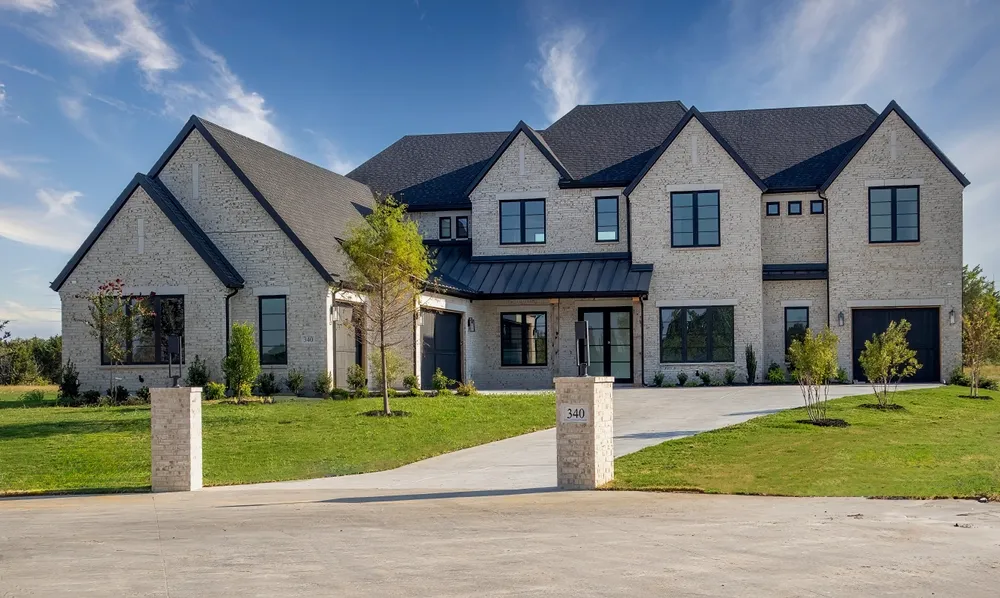
In central Collin County, Texas, homes priced between $1.3 million and $1.6 million sold briskly during the 2020–2022 run-up. Now they linger on the market.
The reason is not poor condition or weak marketing. The buyer who once dominated that price band has disappeared from both directions.
When the Middle Disappears
According to Sean Elliott, Team Leader at The Grisak Group with Keller Williams Realty, the dynamic is simple: the two ends of the buyer spectrum have moved apart. “During the height of the market in our particular area, the 1.3 to 1.6 range moved pretty quickly,” Elliott says. “And now that the market has stabilized, the 1.3 to 1.6 range is much harder because younger families who could stretch to 1.3 before are now spending 1.1.”
At the same time, buyers capable of spending $2 million or more have not moved down into the mid-range. They continue buying at the upper end. The result is a segment squeezed between two buyer pools moving in opposite directions. One pool has been pushed downward by higher monthly costs. The other remains unaffected by them.
How Rates Split Buyers
Elliott says one of the most misunderstood ideas in today’s market is that rising mortgage rates affect all buyers equally. That assumption breaks down sharply above a certain price point.
“The people who are going to spend $2 to $3 million on a home don’t care as much about mortgage rates,” he says. Those buyers respond more to equity markets and investment portfolios than to monthly payment calculations.
But for households stretching into the low-to-mid luxury range, the current rate environment compresses what they can afford. These are families that might have reached $1.3 million when rates were in the low threes. Elliott says the segments under $1.1 million and above $2 million both remain healthy, while the middle absorbs pressure from both sides.
“It’s not like homes aren’t selling – they are – it’s just more of a saturated market.”
Why Average Prices Mislead
When average home prices in a given area decline slightly, the instinct is to read that as falling home values. Elliott says that in central Collin County, the explanation is different.
Because more buyers are purchasing at the lower end of the luxury spectrum, the average sale price pulls downward. This does not mean individual home values have dropped. It means the mix of what is selling has shifted. “It doesn’t mean home values have fallen,” Elliott says. “It just means people are going after the cheaper options.”
This distinction between falling prices and a shifting sales mix matters for investors, appraisers, and lenders who rely on aggregate pricing trends. A market may look like it’s softening based on average price data. In reality, it may just reflect a shift in which homes are trading, not a drop in underlying value. Conflating the two leads to mispriced listings and misread risk.
For sellers in the $1.3 million to $1.6 million range, the practical consequence is longer time on market and more pressure to price precisely. Elliott describes two recent sales that show the gap: a home near a busy road, with a dated layout and no pool, took about three months to sell at around $1 million. A home priced at $1.8 million on a private, tree-lined lot sold in two weeks. Properties with clear advantages, such as privacy, mature landscaping, updated interiors, or a pool, can still move quickly. Homes that lack those features and sit at the top of the price band face a shrinking pool of motivated buyers.
Why Local Knowledge Matters
Elliott says navigating this segmented market requires neighborhood-specific knowledge that broader averages can’t provide. Agents who know a specific street, lot type, or micro-location can judge which features justify a premium and which factors will slow a sale.
“We know, oh man, that one with those trees and that privacy, we can push the pedal to the metal on price,” Elliott says.
That kind of calibration matters more now that the market no longer forgives mispricing. In a segment where buyer pools have narrowed and inventory has built up, the margin for error on initial pricing is smaller than it was three years ago.
Elliott is direct about the responsibility that comes with setting a price: “If somebody wants a number that we truly can’t stand behind and we think it’s going to be a waste of their time, then what good are we doing them?”
For sellers holding properties in the compressed mid-range, the biggest decision is not which upgrades to make before listing. It is whether to trust the comparable sales data on day one, rather than risk joining the growing inventory that signals softness to future buyers without actually reflecting lower values underneath.
About the Expert: Sean Elliott is Team Leader of the Grisak Group at Keller Williams Allen, serving central Collin County, Texas.
This article is intended for informational purposes only and does not constitute legal, financial, or investment advice. The views and opinions expressed herein reflect those of the individuals quoted and do not represent an endorsement of any company, product, or service mentioned. Readers should conduct their own due diligence and consult qualified professionals before making any investment decisions.