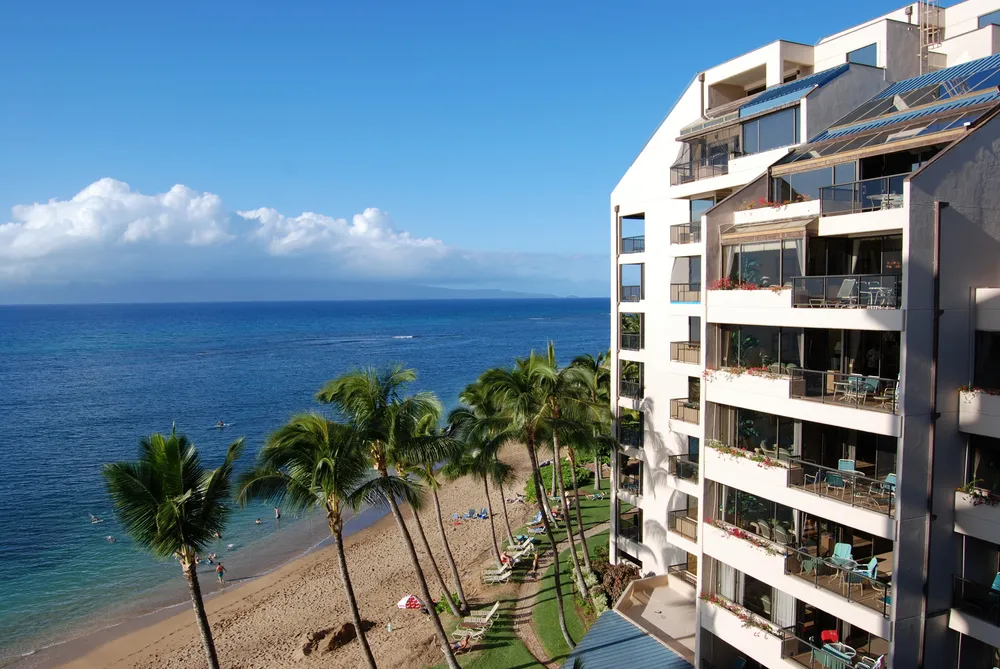
For a brief window when mortgage rates hovered near 3 percent, buying a vacation rental condo on Maui was straightforward math. Borrow cheap money for 30 years, collect nightly rental income that comfortably exceeded carrying costs, and build equity in a place you could visit a couple of weeks a year. The numbers worked on their own, regardless of how you felt about the property.
That math no longer holds. What was once a clean financial calculation now requires something the spreadsheet cannot capture: a genuine personal reason to own the property.
Evan Harlow, a Realtor and luxury real estate agent with Maui Elite Property at Coldwell Banker, works with condo investors, second-home buyers, and 1031 exchange clients across South and West Maui. He puts it directly: “This isn’t just a pure financial play at this point.”
At today’s higher rates, the gap between carrying costs and rental income has narrowed. A condo that generated positive cash flow at a 3 percent mortgage may only break even at current rates. The property is not necessarily losing money, but it is no longer the passive income generator it appeared to be during the low-rate era.
Harlow frames the implication for buyers considering Maui: “If it’s going to break even or do a little bit better, then it needs to be something that you’ve got that’s part of your lifestyle.” If you would not want to spend time on Maui regularly – if you are buying purely to park capital and collect rent checks – the return probably does not justify the illiquidity, the management headaches, and the regulatory uncertainty that now surrounds Maui’s short-term rental market.
Who Is Still Buying
The buyers Harlow sees closing deals in 2025 tend to share a profile. They already have a connection to the island. They have been visiting for years. They have a specific complex or neighborhood in mind. They see the property as something they will use, and the rental income offsets costs rather than serving as the primary reason for the purchase. The financial case supports the lifestyle decision rather than driving it.
For pure investors comparing returns across asset classes, Harlow directly acknowledges the competitive disadvantage, noting that “real estate in general isn’t like the same type of investment that you can get from the stock market.” In Maui’s current environment, the gap between what a vacation condo yields and what a diversified portfolio might return is harder to justify on numbers alone.
What the Spreadsheet Undervalues
A 1031 exchange into a Maui condo offers significant tax deferral for investors rolling proceeds from other real estate. The property provides a tangible asset in a market with constrained land supply. And personal use, even limited to a few weeks per year, carries value that does not show up in a cap rate calculation.
The risk is buying with pure-investment expectations and discovering that the reality is break-even at best. If rates drop in the future, the math improves. But betting on rate cuts as an investment thesis is speculation, not strategy.
Where Buyers Are Cautious
Maui’s condo market currently favors buyers on price, but that has not translated into urgency. According to Harlow, buyers are actually more cautious in a buyer’s market than in a seller’s market. During the run-up, fear of missing out drove fast decisions. Now, with prices easing and no competitive pressure, buyers are taking their time. “Let’s play it safe and let’s make a good decision,” Harlow says, describing the prevailing attitude.
That caution creates opportunity for buyers with patience and clarity about what they want. Sellers, meanwhile, face a market where inventory is elevated, and urgency is low, meaning pricing must reflect current conditions rather than peak-era expectations.
For anyone running the numbers on a Maui condo today, the honest framework starts with a question that has nothing to do with finance: do you actually want to spend time here? If the answer is yes, and the numbers at least break even, the purchase can work as a hybrid, part lifestyle, part investment, with neither side carrying the full weight alone. If the answer is no, and you are shopping purely for yield, the current rate environment points elsewhere. Harlow describes the decision as being about “finding an area complex that fits your lifestyle and fits how you see yourself spending time here,” not about chasing returns the market no longer supports.
About the Expert: Evan Harlow is a Realtor and Luxury Real Estate Agent with Maui Elite Property, affiliated with Coldwell Banker, specializing in the South and West Maui condo and luxury residential market.
This article is intended for informational purposes only and does not constitute legal, financial, or investment advice. The views and opinions expressed herein reflect those of the individuals quoted and do not represent an endorsement of any company, product, or service mentioned. Readers should conduct their own due diligence and consult qualified professionals before making any investment decisions.