Most conversations about Los Angeles real estate center on unaffordable coastal markets and residents leaving the state entirely. But not every buyer priced out of metro LA is heading to Tex...

Texas Sellers Are Learning That Staging Isn't Optional Anymore

Written by:
Date:
09 Sep 2026
Share via Facebook

Share via Linkedin

Share via X

Copy to clipboard

Homeowners across San Antonio and much of Texas are discovering that what worked two years ago no longer applies. Inventory in the metro has climbed sharply, new listings have surged, active supply has pushed past 10,000 in Bexar County, and homes are sitting well beyond the pace sellers grew used to during the post-pandemic run-up. Multiple local market trackers put average days on market in San Antonio somewhere between 50 and 109 depending on segment and month, a marked shift from the bidding-war era when homes moved regardless of condition.
Buyer expectations have risen alongside that inventory. Buyers shaped by Pinterest and Instagram arrive at showings with specific visual standards, and in a market where they finally have choices, homes that fail to meet those standards face a steeper penalty than they would have when supply was scarce. Presentation, in other words, has stopped being a nice-to-have and started being a pricing lever.
The Virtual Staging Trap
Nationally, the data on staging’s impact is consistent, if not dramatic in every study: according to the National Association of Realtors’ 2025 Profile of Home Staging, a survey of 1,266 agents, 49% of sellers’ agents reported that staging reduced a home’s time on market, and 29% of agents said staging increased the dollar value of offers. But that data mostly reflects physical staging. A separate concern has emerged around a lower-cost substitute: virtual staging, in which digitally rendered furniture is added to listing photos without any physical setup.
The risk, according to Andress Eichstadt, CEO and co-owner of Staging Studio, a San Antonio-based staging company, is psychological backlash. Virtual staging can generate online interest: buyers see a furnished-looking listing, schedule a showing, then arrive to an empty house. “People fall in love with it online, but then when they come to see the house, they’re disappointed, and they feel catfished,” Eichstadt says. Once that disappointment sets in, buyers start questioning what else might be wrong with the property. In a study of its own San Antonio listings, Staging Studio found that homes it virtually staged added 101 days on market compared to physically staged homes, which by contrast cut days on market by roughly half relative to the local average at the time. That’s a single-market, single-company data point rather than an industry-wide figure, but it points in the same direction as the broader trend: for agents using virtual staging purely as a cost-saving shortcut, the tool may generate clicks while extending the actual sales timeline.
Why a Slower Market Penalizes Unstaged Homes
The math on staging becomes more urgent as markets slow. Staging typically costs a fraction of a single price reduction; NAR’s data puts median staging costs around $1,500, and separate industry estimates put return on investment in staging in the 5% to 25% range on both speed and price, depending on the market and property. Eichstadt, whose company has staged homes in San Antonio for two decades, estimates the return can run considerably higher for higher-end properties, between 300 and 600 percent.
In a hot market, that math still held but mattered less, since homes sold regardless of presentation. In a market with rising inventory and more buyer choice, the penalty for skipping staging becomes a price cut that typically exceeds what staging would have cost in the first place. “Your first price reduction is going to be more expensive than if you had just staged from the beginning,” Eichstadt says. The principle isn’t limited to luxury listings, either; every home is, for its owner, a significant financial asset, and the emotional response staging creates is what tends to drive offers at or above asking.
Higher-End Execution Is Becoming the Baseline
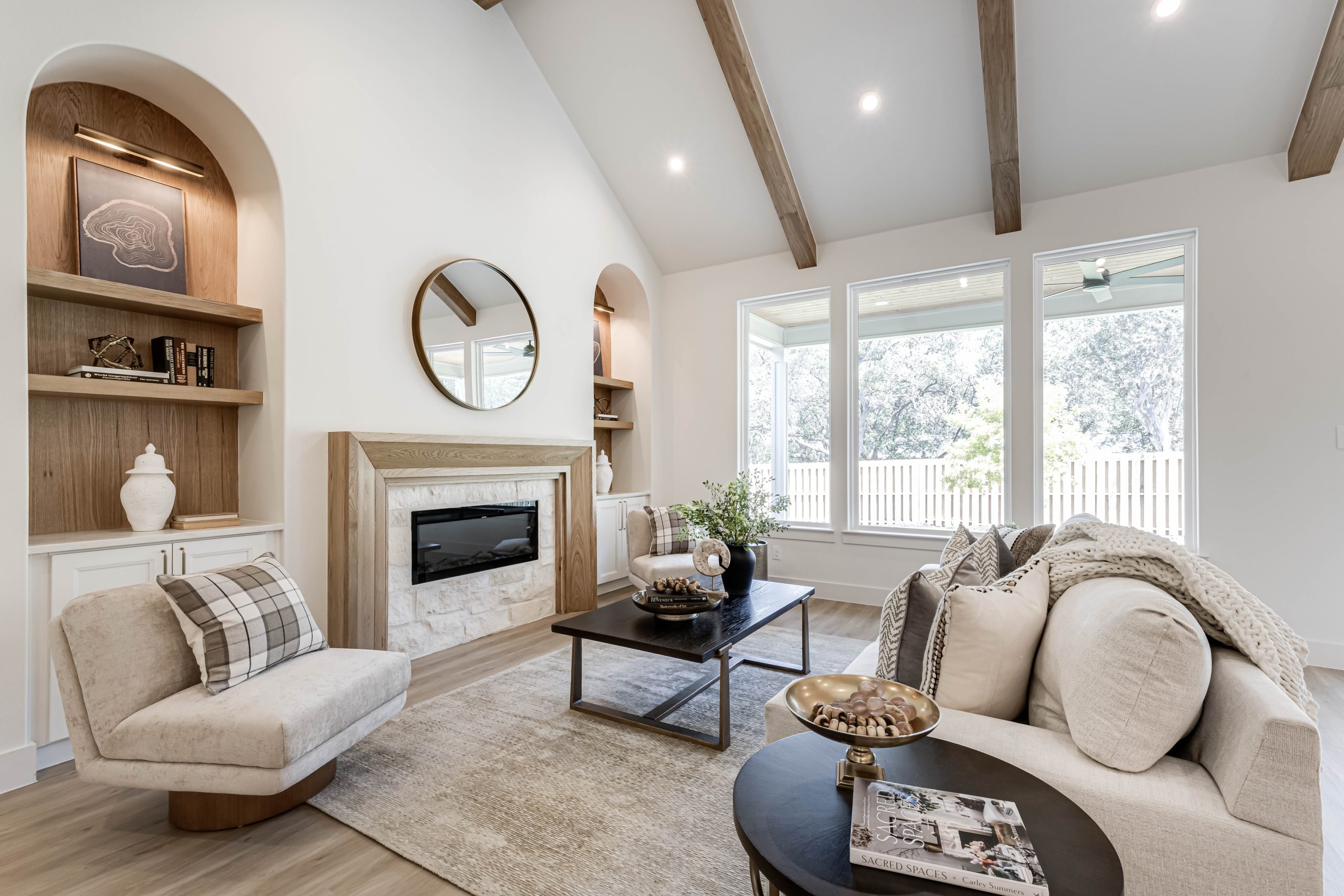
What passed for staging five years ago, a few furniture pieces or lower-quality furnishings placed in key rooms, increasingly falls flat with today’s more visually literate buyers. Eichstadt describes a shift toward more layered design: larger-scale art, more accessories, higher-end furnishings, and careful attention to proportion.
“The thing that will make the biggest difference in whether staging looks luxury or not is scale,” she says. Undersized rugs, small art, and modest accessories can make a home feel less expensive than it is; professional stagers increasingly use oversized elements, larger art pieces, and generously scaled rugs to elevate perceived value. That rising quality threshold creates a real barrier for agents or sellers attempting to stage a home themselves without a working knowledge of design principles; a space filled with furniture that’s too small for the room reads as cheap no matter what it cost.
An Industry Without a Unified Voice
Despite strong survey data supporting staging’s impact on both price and speed, the practice still isn’t standard across the industry; NAR’s own data shows fewer than a third of listing agents stage a seller’s home before putting it on the market. Eichstadt attributes part of that gap to fragmentation: most stagers are solo operators without shared advocacy or a coordinated voice. “The staging industry has been so fragmented. We have not really spoken as one voice. We have not done a great job of advocating for staging as an industry,” she says.
Practical Realities Agents Miss
The most common operational mistake agents make with staging involves timing. Homes need to be fully complete, all contractor work finished, paint dry, countertops installed, before a staging team can come in. “We were just at a project yesterday where we sent our team and the house was still being painted and the countertops were not in yet,” Eichstadt says.
Professional stagers can typically accommodate a staging request within a week, with installation itself taking no more than a day. The bottleneck is almost always upstream, on the construction or renovation side, particularly with investor flips where timelines tend to slip. When a home won’t be ready, communicating that in advance lets stagers rearrange their schedule rather than making a wasted trip.
As Texas inventory continues to climb and listings sit longer than sellers have grown used to, the pressure to treat staging as standard practice, not an optional add-on, is likely to keep building. The comparison sellers should be running isn’t staging cost versus zero. It’s staging cost versus the price reduction that follows once a listing stalls.
About the Expert: Andress Eichstadt is CEO and co-owner of Staging Studio, a San Antonio-based home staging company with two decades of experience in the market.
This article is based on information provided by the expert source cited above. It is intended for general informational purposes only and does not constitute legal, financial, or real estate advice. Readers should conduct their own research and consult qualified professionals before making any real estate or financial decisions.
Similar Articles
Explore similar articles from Our Team of Experts.