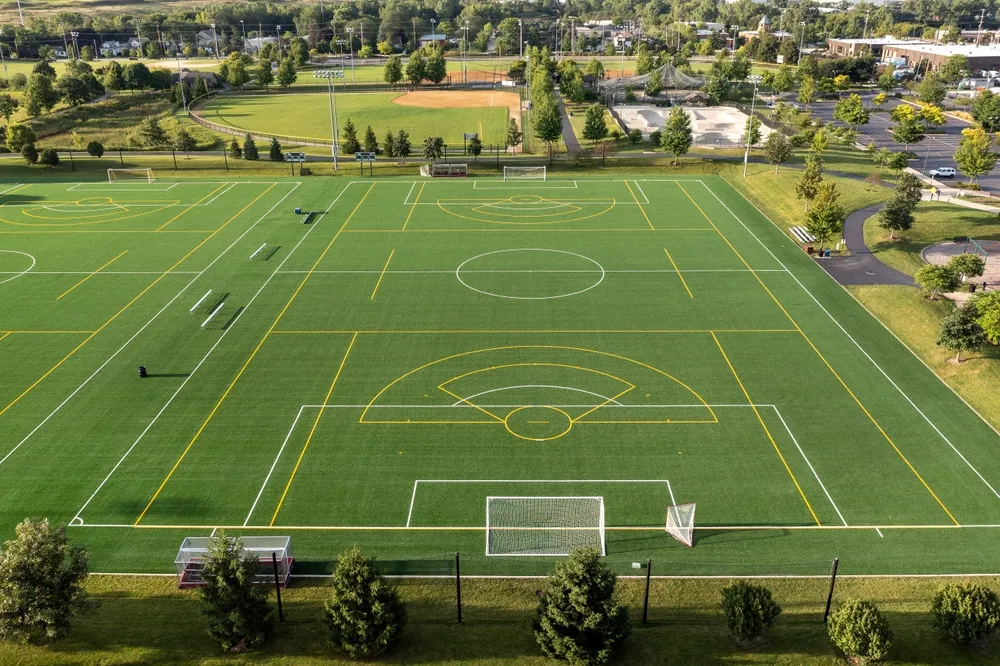
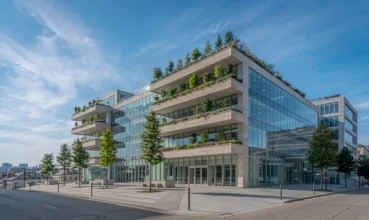
The youth sports tourism industry has grown large enough to anchor entire mixed-use developments, not just stadiums or standalone facilities, but full districts of hotels, retail, restaurants, and multifamily housing built around tournament-capable venues. In Lebanon, Ohio, a development group is betting that a field sports facility focused on soccer and lacrosse can serve as the economic engine for a project that includes hospitality, residential, and commercial components designed to feed off each other.
The project, led by Athletic Community Experiences, is structured around Total Performance Sports, a facility with indoor and outdoor pitches and a human performance center. From there, the plan sequences outward: a hotel built nearly simultaneously with the sports facility, followed by multifamily housing, retail, office space, and eventually a second hotel.
Beth Underhill, Co-Founder & Principal of ACE, describes the logic directly. “When you can have something unique, such as the sports facility, add another dimension to it; it’s just going to be a win-win,” she says. The tournament programming is designed to draw from Columbus, Indianapolis, Pennsylvania, Michigan, and beyond, not just the Cincinnati metro.
Why Smaller Municipalities Move Faster
One notable feature of the project is how smoothly the entitlement process has gone. The land was zoned general commercial and needed to be changed to a mixed-use PUD, a planned unit development designation that allows multiple building types on a single site. Underhill says that rezoning was easier to secure than some of the permits and variances her construction company routinely seeks on smaller projects.
The explanation she offers is structural. “When you are dealing with these smaller cities, smaller municipalities, it’s easier to get to the right person so much sooner versus when you’re dealing with your larger metropolitan areas,” she says. Lebanon’s city government had already identified adding a hotel as a short-term priority, which gave the development team a natural point of alignment. The city gets a hotel and jobs; the developers get TIF funding support, tax increment financing in which future increases in property tax revenue help pay for current infrastructure costs.
The school board is also involved in conversations, adding another institutional layer that smaller jurisdictions can coordinate more readily than larger ones.
Financing Non-Cash-Flowing Land Is the Hardest Part
For buyers, sellers, or investors accustomed to conventional real estate transactions, the capital structure of a sports-anchored development looks unfamiliar. The challenge starts with the land itself: it generates no income until vertical construction is complete, which makes traditional lenders reluctant to participate.
Underhill is candid about this constraint. “There are a lot of lending institutions that don’t like to lend on land because it’s not cash-flowing. Your traditional banks want to see money coming back to them,” she says.
The team has had to look beyond traditional banks to specialty lenders, private investor groups, and family offices. The difficulty is not just finding capital but finding capital partners willing to collaborate rather than seize control. Underhill says finding “the right group that wants to align with you” and is not “looking to take the project away from you” has been harder than sourcing debt for a straightforward apartment acquisition.
A market study completed before planning supported the hotel component, and hoteliers who have reviewed the site have responded favorably. But the land itself has not yet closed, which Underhill acknowledges is the single biggest remaining unknown.
How the Team Came Together
The ACE partnership formed through a combination of real estate syndication experience and sports industry knowledge. Underhill entered real estate in 2018 through single-family fix-and-flip projects, then moved into multifamily syndications, pooled investment structures where multiple investors fund a single large acquisition. While working on purpose-built student housing acquisitions, she connected through social media with a contact involved in soccer who had been developing the concept for a sports facility with two partners.
That contact and his partners had identified a gap: Cincinnati lacked a local facility capable of hosting field sports tournaments, forcing families to travel to other markets. They had mapped out what an ideal venue would look like based on facilities they had seen elsewhere. Underhill and members of her team offered to bring the capital structure, equity and debt sourcing, land acquisition, and vertical development expertise. One of the original sports partners joined ACE, creating a five-person founding group that has been working together for at least three years.
Each partner contributes distinct expertise. Underhill focuses on the broader development, the surrounding hospitality, retail, and residential components, while the sports-side partner leads facility operations and programming. “This was more of his dream for the facility, whereas my dream was really more about the ecosystem and building that piece out,” Underhill says.
The Development Sequence
The phasing plan reflects how tournament-driven demand creates cascading needs. The sports facility comes first because it generates the visitor traffic that justifies a hotel. The hotel comes nearly simultaneously because tournaments require overnight accommodations to draw teams from multiple states. Multifamily housing follows because sustained foot traffic and employment from the facility and hotel create residential demand. Retail and office space fill in as the population of daily users grows. A second hotel arrives last, justified by demonstrated occupancy at the first.
Green space and walking trails will occupy portions of the acreage that are not buildable, serving both tournament visitors during downtime and future multifamily residents.
A Replicable Model, Not a One-Off
ACE is positioning this development as a template. The group has already identified other markets, primarily in the Midwest and Southeast, where the model could work, though the specific components would vary based on what infrastructure already exists nearby. A market that already has nearby hotels might not need one; scale might differ based on local conditions.
The underlying thesis is that youth sports tourism is growing fast enough, and that field sports like soccer and lacrosse are expanding geographically enough, to support purpose-built venues surrounded by complementary development. Lacrosse, once concentrated on the East Coast, has spread into the Midwest. Soccer participation continues to rise nationally. “With the youth sports tourism just on the rise, we’re looking to capitalize on that and see what we can do to be part of it,” Underhill says.
For the Lebanon project, the next milestone is closing on the land. After that, the sequencing is set: TPS and the first hotel break ground together, and the surrounding development fills in behind them.
About the Expert: Beth Underhill is Co-Founder and Principal of Athletic Community Experiences (ACE), a development group behind a youth sports-anchored mixed-use project in Lebanon, Ohio.
This article is based on information provided by the expert source cited above. It is intended for general informational purposes only and does not constitute legal, financial, or real estate advice. Readers should conduct their own research and consult qualified professionals before making any real estate or financial decisions.