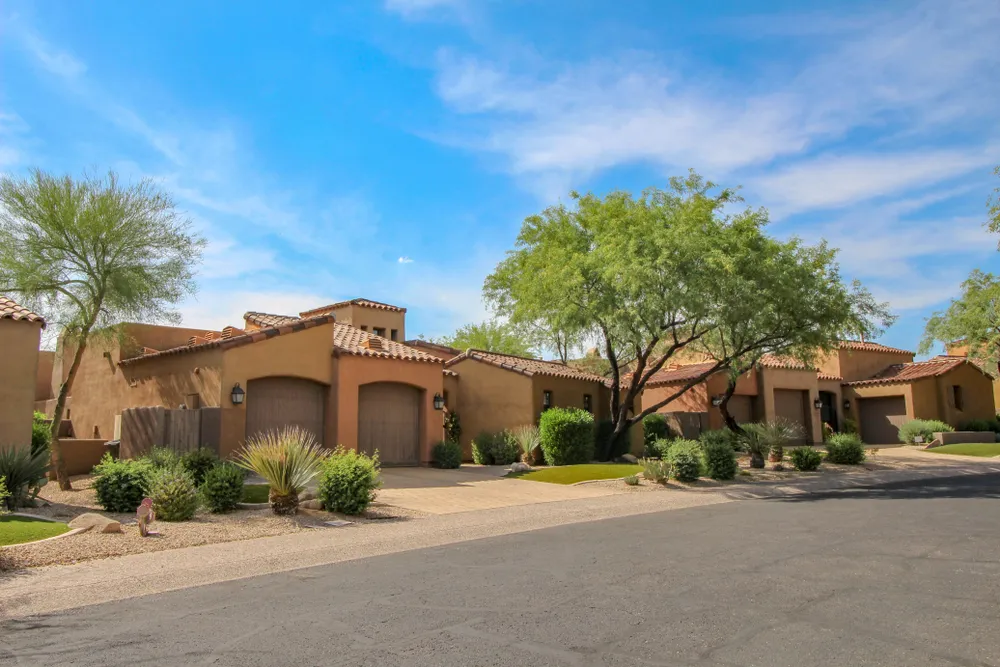
Six cities in the southeast corner of the Phoenix metro are in a seller’s market. A short drive south, in Maricopa, inventory has accumulated to a degree that could take years to absorb. The difference has less to do with demand, which remains relatively healthy across both areas, and more to do with where new homes can physically be built.
That geographic split is shaping how buyers, sellers, and investors approach the East Valley right now, from pricing strategy to concession negotiation to long-term hold decisions. Mindy Jones, who leads the Amy Jones Group, a 15-agent residential team brokered with Real Broker, describes the dynamic plainly: the closer a property sits to the center of the valley, the more constrained the supply. The further out, the more new construction competes for buyers.
“If you figure, like, the center of town, pretty landlocked, right?” Jones says. “And then as you go out, Arizona is pretty spread out, and there’s lots of land, and so the further you go out, there’s more new construction on the outside.”
The Inventory Imbalance
The pattern is also driven by migration within the valley. Jones describes homeowners who bought on the outskirts where they could afford, gained equity over the past few years, and are now listing those homes to move closer in. The result is a steady supply of resale inventory on the outer edges and tightening conditions in cities like Chandler and Gilbert.
Maricopa represents the extreme end of this imbalance. Jones says the area is in a buyer’s market deep enough that a shift back to balance will not happen quickly. “This isn’t something where the market could shift overnight, and it certainly couldn’t shift in six months,” she says. “They just have a ton of inventory down there, and it’s just going to take them a while to eat up that inventory before they would ever be in a balanced market.”
Where HOA Costs Are Reshaping Affordability
Across the East Valley, condos and townhouses with aging infrastructure are sitting longer than single-family homes. Many of these properties were built in the 1990s and now require roof replacements and major system upgrades. Those costs flow through to HOA fees, some of which have climbed to $200 or $300 a month. For buyers trying to keep monthly payments manageable, a $75 HOA on a nearby single-family home can meaningfully increase purchasing power.
Jones says this has pushed her team toward a pricing approach that goes beyond comparable sales. Rather than comparing list prices alone, the group compares estimated monthly payments across competing property types. If a nearby new-construction community offers rate buy-down incentives that lower a buyer’s monthly cost, a resale listing needs to be priced so its payment is competitive, not just its sticker price.
“We’re looking at what is a monthly payment that someone can expect when they go to the new home community, and then comparing that to what your house would have to be listed at to have a comparable monthly payment,” Jones says.
Condos that combine high HOA fees with dated interiors face the steepest challenge. Jones says the condition of these properties has to be strong enough that buyers do not feel they need to invest further after purchase, because adding renovation costs on top of elevated monthly fees pushes many buyers toward single-family alternatives instead.
Concessions as a Market Feature, Not an Exception
Seller concessions have become a standard component of transactions in the East Valley. According to Jones, about half of closed transactions include concessions, averaging roughly $10,000 to $15,000 per deal, before accounting for agent compensation. Buyers are directing those concessions primarily toward rate buy-downs with their lenders, though some use them for closing costs, prepaid HOA dues, or home warranty products.
The prevalence of concessions also complicates how headline price data should be read. Jones notes that before prices would visibly decline in a slower market, concession levels would need to contract first. The current volume of concessions suggests the market still has flexibility that has not been exhausted, meaning sticker prices alone do not capture what sellers are actually giving up per transaction.
What Investors Are Watching
For investors considering the East Valley, Jones points to a shift in new-construction policy. Builders who previously restricted purchases to primary homeowners now generally allow investors to buy in and access the same interest rate incentives. That access to below-market financing on a new home is difficult to replicate on the resale market.
Arizona’s rental market also provides a built-in fallback. According to Jones, prices in the valley have been relatively flat over the past couple of years, unusual for a market that typically appreciates, meaning some recent buyers lack the equity to sell and move. For those owners, short-term rental conversion has become a practical alternative. For investors, the depth of the rental population provides optionality if a hold period needs to extend beyond the original plan.
Jones recommends tracking local business growth as a leading indicator for housing demand. She specifically names the Chandler Chamber of Commerce, Gilbert Chamber of Commerce, and Town of Queen Creek websites as sources that outline planned commercial development. When a project like the expansion of Dignity Hospital in Gilbert brings an estimated 1,000 new jobs, those workers need housing, and the surrounding neighborhoods absorb that demand directly.
Pent-Up Demand Is Showing Up in the Data
Despite the seasonal slowdown that typically characterizes Arizona’s third quarter, Jones says her team stayed busy through the summer. She attributes that to accumulated demand from homeowners who have waited out price increases, rate volatility, and broader uncertainty for several years.
“At some point life catches up with you, and you just have to make a move regardless of all of these things that you can’t really control for,” she says.
Jones sees that demand continuing. Prices have held flat rather than declining despite higher interest rates, a signal, in her view, that the underlying market remains strong even during a period of limited appreciation. For buyers waiting for a clearer entry point, the trade-off is that inventory in the most desirable central cities may tighten further as pent-up demand continues to release. For sellers on the outer edges, pricing competitively against new construction, measured in monthly payments, not list prices, will determine how quickly their homes move.
About the Expert: Mindy Jones leads the Amy Jones Group, a 15-agent residential team brokered with Real Broker, covering the East Valley of Phoenix, Arizona.
This article is based on information provided by the expert source cited above. It is intended for general informational purposes only and does not constitute legal, financial, or real estate advice. Readers should conduct their own research and consult qualified professionals before making any real estate or financial decisions.