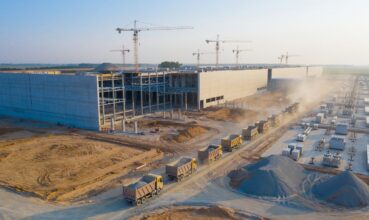
Real estate development has a well-documented problem with time. Projects run over budget, timelines slip, and by the time a deal falls apart, months of work and capital have already been spent. What gets less attention is how much of that risk is introduced before a single shovel hits the ground, during the pre-development phase, when site selection, cost modeling, and financial feasibility are still being worked out.
That gap is what Block and Mortar, a pre-development platform for commercial real estate, is designed to close. It’s one of several platforms attempting to address this stage of the development process, and its inclusion here reflects the perspective of its founder rather than an endorsement of the product. Founded by Usman Wajid, the platform brings together developers, general contractors, lenders, and investment partners during the earliest stages of a project, before commitments are made and costs become difficult to reverse. The core idea is straightforward: the earlier stakeholders can align on assumptions, the less likely a project is to run into expensive surprises later.
How Pre-Development Works
The pre-development phase in commercial real estate is largely manual, fragmented, and slow. Teams rely on spreadsheets, email chains, and disconnected software tools. Different departments – design, finance, construction – operate in silos, and external partners like lenders and contractors are often brought in too late to influence project assumptions meaningfully.
Block and Mortar’s approach addresses the full stakeholder chain rather than optimizing for a single participant. In practice, a developer can use the platform to move from site selection through cost modeling to financial analysis, while bringing in relevant partners at each stage. “A lot of the current solutions just focused on one user base, and in that created data silos that have become hard for the industry to collaborate,” Wajid explains.
The workflow is structured around three principles: automating administrative tasks so decision-makers can focus on judgment calls, enabling earlier collaboration between internal teams and external partners, and surfacing insights to support a clear go-or-no-go decision. The goal is to compress the timeline for concluding a project’s viability. “If you’re going to get to a no in six months, it’d be a lot better if you got there in a few days,” Wajid says.
Expanding Across Asset Types
Block and Mortar entered the market in late 2024, initially focused on retail and multifamily development. The retail vertical was a deliberate choice. Quick-service restaurant chains and drive-through concepts have become increasingly efficient at the construction phase, with some builds completing in under 90 days. But that speed advantage is often undermined by delays in pre-development.
The logic is direct: every day saved in pre-development is a day closer to an operating asset generating revenue. “If I can add five days to getting you to construction sooner, that means your asset opens five days sooner,” Wajid notes.
The multifamily focus reflects Wajid’s background at a technology startup in the multifamily development space, where he saw firsthand how workflows break down. The platform is currently being extended to cover office, industrial, and data center development, with a target of supporting all five asset types by Q4 2027.
Where AI Helps
Artificial intelligence is embedded in the platform, but Wajid is deliberate about its role. “We’re not an AI tool; we’re a real estate development tool, but we have AI features,” he says. Within the platform, AI aggregates unstructured data, automates routine administrative tasks, and frees decision-makers to focus on judgment rather than data entry.
His concern with the broader industry is practical. When AI tools became widely accessible, many real estate and construction firms began exploring whether to build proprietary solutions in-house. Wajid thinks this misallocates resources. “When Salesforce and all the CRM tools came out, did companies go and decide, ‘We’re going to go build our own CRM tool’? No, they let the technology companies build the right tool, and then they just integrated it into their workflow.”
There is also a longer-term dimension. Citing a Wall Street Journal report on baby boomers’ retirement, Wajid points to a coming loss of institutional knowledge in the construction and development industry. Block and Mortar is positioning its platform as a way for organizations to capture and retain that expertise by building proprietary AI models trained on a company’s own historical data.
Data privacy is built into the product design. Each client’s data trains only its own model, not a shared one. “What makes them them is the data and knowledge that they’ve gathered over the existence of their company,” Wajid says. “Our tool is very diligent in how we bring in any of their data, so that way their model is only training their model, not their competitors’ model.”
Industry Adoption
Technology adoption in construction and development is often framed as a cultural problem, but Wajid sees it differently. The more common barrier, in his experience, is the complexity of existing systems. Most firms run multiple point solutions that do not integrate, and introducing a new platform raises legitimate questions about compatibility. “It’s not that they don’t like technology – they hate wrong technology,” he says.
Beyond adoption, Wajid identifies a structural issue: the absence of standardization across the industry. Pro formas, bid formats, and project validation processes vary significantly from firm to firm, creating friction at every handoff between stakeholders. A developer’s financial model has to be manually reformatted before a lender can review it. A contractor’s cost estimate doesn’t map cleanly onto the developer’s assumptions.
He draws a comparison to healthcare and fintech, both of which resisted standardization for years before introducing common frameworks that accelerated technology adoption. “We don’t need to share all of our data, but we could standardize how we do our bids and how we build out our pro formas and how we validate projects, because that will allow all stakeholders to get insights faster.”
Investor Relationships
Block and Mortar recently brought on Clarkson and Global as investors, both active operators in the development and construction space. Rather than treating investors purely as capital sources, Wajid views their operational experience as a direct input into the platform’s development. Clarkson, with over a century of operating history, brings long-form institutional knowledge that is difficult to replicate through user research alone. “The thing I don’t want to do as a technologist is assume people’s problems and then not actually listen to my users,” he says.
What Comes Next
With early traction in retail and multifamily, and conversations underway with large enterprise clients, Block and Mortar is building out its use case library and expanding its partner network. The platform’s roadmap through 2027 covers additional asset classes and deeper integrations with property management and building management systems.
For an industry facing rising construction costs, uncertain interest rates, and a thinning pipeline of experienced professionals, the case for investing in pre-development tools is becoming harder to ignore. Block and Mortar is one platform attempting to answer a specific question: whether the available tools are actually built around how development decisions are made, rather than around a single participant’s workflow. Other firms are approaching pieces of this problem, from cost estimation to feasibility modeling, but the integrated, multi-stakeholder approach is what distinguishes this effort, according to Wajid. Whether the industry is ready to adopt a shared platform at this stage remains an open question.
About the Expert: Usman Wajid is the founder of Block and Mortar, a pre-development platform for commercial real estate that connects developers, general contractors, lenders, and investment partners during the earliest stages of a project. The platform launched in late 2024 with an initial focus on retail and multifamily development.
This article is based on information provided by the expert source cited above. It is intended for general informational purposes only and does not constitute legal, financial, or real estate advice. Readers should conduct their own research and consult qualified professionals before making any real estate or financial decisions.