The data center sector rewards long-term planning. Multi-decade asset lives, massive infrastructure commitments, and years-long power interconnection timelines are supposed to favor developers with stable, well-considered strategies. Yet some active developers are recalibrating rapidly enough to raise questions about what communities and investors can reliably expect when they commit to a project.
Daniel Kaufman, a real estate professional and principal of Kaufman & Company, says his firm has shifted its data center strategy at least twice in recent years – moving from micro data centers to adaptive reuse of industrial buildings to geodesic dome construction. Each pivot responded to new information or newly available technology.
“Our thesis is we are always going to move, we’re not going to be rigid,” Kaufman says. “If a better technology or opportunity presents itself, then we will pivot.”
That willingness to change direction is presented as a competitive virtue. But the frequency raises a practical question: when developers change course, municipalities that shaped zoning around stated plans and investors who underwrote specific asset types absorb the downstream effects.
The Micro Data Center Dead End
Kaufman’s first data center strategy targeted micro data centers – smaller distributed facilities designed to bring computing capacity closer to end users. Smaller footprints would reduce community opposition, lower capital requirements, and allow faster deployment. Kaufman says the company pursued this direction before concluding it failed on two counts.
“We decided the best way to do this is shrink this and build micro data centers, which we’re still working on, but they don’t have enough demand,” Kaufman says. “They’re not powerful enough, so it really doesn’t solve the problem.”
The micro data center thesis attracted significant investment across the industry, with multiple developers pursuing distributed edge computing as a complement to hyperscale facilities. If the conclusion that micro data centers lack sufficient scale and demand holds broadly, it represents a costly miscalculation for a segment that received considerable capital.
Adaptive Reuse as a Bridge Strategy
The company’s next direction was adaptive reuse – converting former industrial buildings, particularly in markets like Detroit, into data center facilities. Underutilized industrial stock offered large floor plates and a narrative of urban revitalization that could ease community relations.
Kaufman says adaptive reuse has been deprioritized rather than abandoned. “We looked at trying to adapt structures for data centers, particularly in industrial markets, and that is still an investigation, but this technology, which came available to us recently, really changed our direction,” he says.
The company is now directing its adaptive reuse interest toward residential and affordable housing rather than data centers. “We haven’t completely forgotten about the adaptive reuse of structures for data centers,” Kaufman says. “We are looking more at residential use and affordable housing for them. This just right now has been the easiest path forward.”
What Constant Pivoting Signals
Kaufman frames strategic adjustment as intellectual honesty rather than instability. “We’re constantly learning, and we’re never saying we’re right about anything,” he says. “If we learn something new, we’re always ready to take a step back or a step forward or a step to the left or a step to the right.”
AI infrastructure demand has accelerated on a timeline few developers anticipated, and technology for cooling, power generation, and structural design has shifted in a short period. A developer who holds rigidly to a strategy formed under earlier conditions may be at a disadvantage relative to one who updates. But from a community planning perspective, each pivot means a previous commitment – one that may have influenced zoning decisions, infrastructure investments, or public expectations – no longer applies.
The industry positions itself as stable, long-duration infrastructure. The degree of strategic uncertainty at the developer level complicates that positioning.
Kaufman & Company’s Current Direction
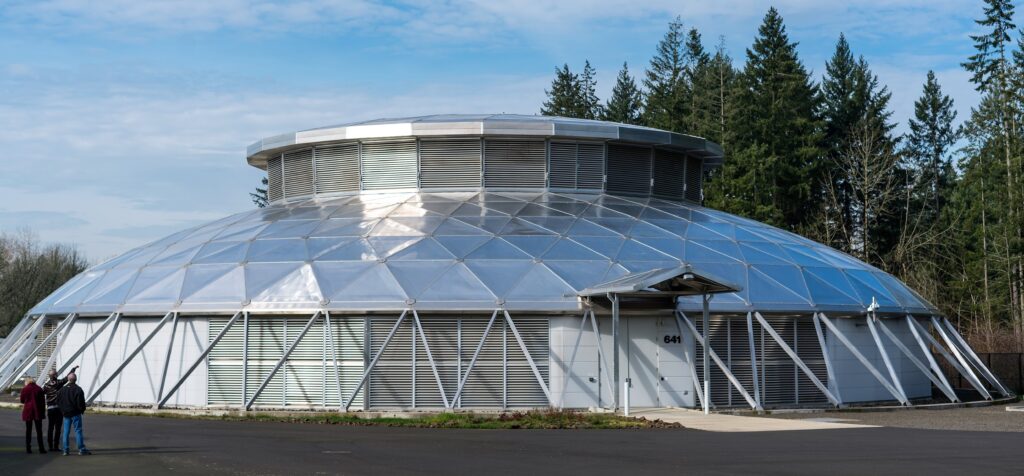
Kaufman & Company now builds geodesic dome data centers in partnership with Server Domes, with active projects in Utah and El Paso, Texas, and conversations underway in India, Europe, and Canada. The company has secured 24,000 acres in Texas and says the first two projects are fully funded. Kaufman names Meta, Google, Oracle, Microsoft, and the Department of Defense among its partners on these projects.
Ryan Wallace has been named to lead the data center initiative going forward. Kaufman says Wallace “is one of the most intelligent, capable people in the industry” and will run the division with a team spanning AI, energy, and infrastructure.
Kaufman describes the server dome technology as the approach that finally addressed the concerns earlier strategies tried to solve – combining low water use, behind-the-meter power, modular scalability, and what he says is a 12-month deployment timeline. In Utah, Kaufman says the dome design changed the permitting conversation with the local community. “When the community saw the server dome, it changed the whole conversation,” he says. “There are other traditional data centers that are just big boxes. That is not us.”
For communities weighing whether to approve these projects, the question is straightforward: a developer’s current strategy may be well-suited to present conditions, but a stated philosophy of constant recalibration means the project a municipality approves today may not resemble the project that eventually gets built. Kaufman’s own framing – that the company will always move in response to new information – is either reassurance or warning, depending on what commitments have already been made on the other side.
Daniel Kaufman is the founder of Kaufman & Company, a Los Angeles-based private investment and holding firm with portfolio companies spanning real estate development, workforce housing, venture investment, and infrastructure. His workforce housing platform, Olduvai, focuses on delivering attainable housing in undersupplied markets across the United States.
This article is based on information provided by the expert source cited above. It is intended for general informational purposes only and does not constitute legal, financial, or real estate advice. Readers should conduct their own research and consult qualified professionals before making any real estate or financial decisions.