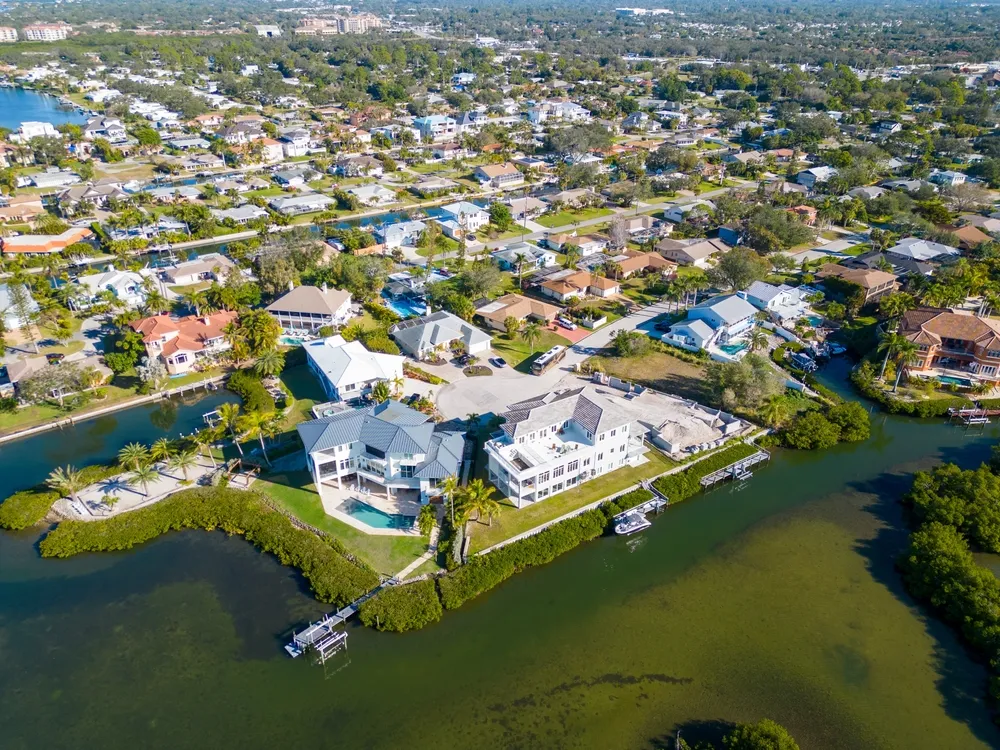
In much of coastal Florida, rising insurance costs and storm damage have slowed buyer activity and left damaged properties sitting unrepaired. In Sarasota County, something different is happening: nearly half of all transactions are cash, according to Tom Cail, Co-Founder of the Cail Grande Group at RE/MAX Alliance Group in Sarasota, who has worked the market since 1992. That capital concentration is reshaping how the barrier island market responds to the same pressures facing the rest of the state’s coastline.
The dynamic is straightforward. When buyers don’t carry mortgages, they aren’t required to carry flood insurance. That removes one of the biggest cost variables currently suppressing demand in other Gulf Coast markets. And in a place where developable land on the barrier islands is effectively gone, cash buyers are absorbing older properties – even flood-damaged ones – at prices that never fell as far as most observers expected.
What’s Selling and Why
The luxury segment is leading activity. “We’ve had more high-end sales this past year than we’ve had in quite some time,” Cail says. The common thread among these transactions isn’t architectural distinction; it’s land quality.
“At the end of the day, the value of real estate is always the dirt,” Cail says. “The structure itself is a depreciating asset from the time it’s completed.”
That principle is playing out in real time. Developments along Big Pass on the Gulf of Mexico are producing 15,000-square-foot homes expected to trade at $25 million or more. Meanwhile, a canal-front lot on Siesta Key’s Woodside Street recently sold for $1.9 million, only $50,000 below what a comparable lot fetched the year before the hurricanes hit.
Properties where owners overbuilt relative to lot size are the exception. Cail points to cases where a 15,000-square-foot lot is divided into 7,500-square-foot parcels with too much house on them; those are the listings that struggle.
The Post-Storm Market
After the storms, many local professionals expected steep discounts on flood-damaged barrier island properties, canal-front lots with older homes dropping from the $1.8–$2 million range down to $1.1–$1.2 million. It didn’t happen.
“The demand for the properties and for being here was so much that there were a few of them that sold at a great discount,” Cail says. “Had those people held on, they would have been right back where they were.”
The contrast with neighboring markets is visible. Cail describes driving through St. Pete Beach recently and seeing hurricane-damaged homes still standing behind fences, unrepaired and undeveloped. In Sarasota’s barrier islands, he says, the post-storm landscape looks as though nothing happened.
New Construction as Flood Insurance
On the barrier islands, new construction carries a functional premium beyond aesthetics. Homes built to current flood elevation sustained virtually no damage in recent storms, “landscaping was about all that they sustained,” according to Cail. Older homes built below base flood elevation, even beautifully renovated ones, face a pricing ceiling buyers won’t exceed.
Cail estimates that the same home, elevated to current flood standards, would command roughly a million dollars more. That gap is driving a steady replacement cycle: buyers purchase older homes, often with cash, and either use them as short-term vacation properties while planning a future build, or tear them down immediately.
Many of these cash buyers are self-insuring, reasoning that their real investment is the land rather than the structure. Cail says a good portion view the purchase through a four-to-five-year lens, they secure the lot now because they expect barrier island land values to outpace appreciation in the markets they’re coming from, then build to current standards when they’re ready to retire permanently.
Who’s Buying
Sarasota’s traditional feeder markets were Midwestern – Chicago, Ohio – a pattern Cail traces to the historic Ringling Circus railway connection. More recently, the buyer base has expanded to include significant Northeast and California migration, drawn by no state income tax, a top-rated school system, and what Cail describes as a fundamentally different character from South Florida’s east coast.
Inventory stood at four months as of the interview, with June showing what Cail described as a 9% increase in median sales price and a 15% increase in sales year over year. The lock-in effect from low mortgage rates compounds the supply constraint: owners who refinanced near 3% have little incentive to list unless motivated by life events rather than market timing.
The combination of constrained inventory and continued in-migration is what Cail points to when explaining why the correction many outside observers anticipate hasn’t arrived. Unlike 2008, when overleveraged buyers with 100% financing created systemic fragility, today’s ownership base carries minimal debt. A market dominated by cash holders doesn’t produce forced sellers when economic conditions tighten.
What’s Ahead
One variable Cail is watching closely: a fall ballot measure on homestead exemption and property taxes. “If we do away with property taxes on homesteaded properties, then I think it could really open up the floodgates to people coming here,” he says.
Beyond policy, the trajectory Cail sees is continued neighborhood-level redevelopment, older homes replaced by new construction at an accelerating pace, driven by the volume of capital entering the market. Weather remains the one uncontrollable variable, but the market’s response to recent storms suggests that even significant hurricane seasons accelerate the replacement cycle rather than depress values. For buyers considering barrier island properties, the practical calculus has narrowed: the land is the asset, new construction is the hedge against insurance costs, and the window to secure either is constrained by a buyer pool that doesn’t need to wait for rates to fall.
About the Expert: Tom Cail is co-founder of the Cail Grande Group at RE/MAX Alliance Group in Sarasota, with over three decades of experience in the Sarasota County market dating back to 1992.
This article is based on information provided by the expert source cited above. It is intended for general informational purposes only and does not constitute legal, financial, or real estate advice. Readers should conduct their own research and consult qualified professionals before making any real estate or financial decisions.