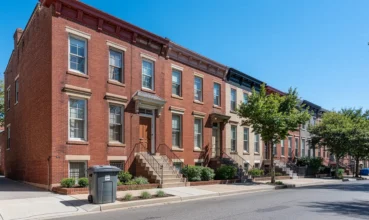
Property management rarely makes headlines the way sales markets do. Still, for investors navigating Lancaster County’s rental landscape, the decisions made at the management level are increasingly where returns are won or lost. Jeremy Ganse, owner of Our Town Management, has been working through those decisions since 2011, building a portfolio of more than 250 units across residential, commercial, and association properties in South Central Pennsylvania.
From Accidental Landlords to Commercial Portfolios
The client base at Our Town Management reflects how people are entering the landlord business differently than they did a decade ago. Rising home values and historically low mortgage rates from the pandemic era have created a wave of property owners who never planned to become landlords.
Many end up renting out former primary residences after relocating for a job or personal reasons. Before 2019, that rarely made financial sense. Now, owners who locked in low purchase prices and favorable rates can rent those properties and generate positive cash flow. “That was not the case before COVID,” Ganse says.
The math behind that shift is significant. Lancaster County’s average sale price sat around $175,000 before 2021. By May 2026, that figure had climbed to roughly $425,000. Rental rates have followed a similar upward trajectory, with most residential units now commanding between $1,500 and $2,000 per month, a floor that barely existed five years ago.
For owners who bought early, the numbers work clearly in their favor. Some of Ganse’s clients purchased properties in 2013 for $65,000 that are now worth $200,000 and generating $1,500 a month in rent, nearly double what they collected five years ago.
The picture is considerably different for more recent buyers. Anyone who purchased in the last six to eighteen months with debt service attached is likely operating at a loss or break-even, regardless of current rent levels. “Your garden variety investor who buys a home for $400,000 right now would be crazy to turn around and try to rent it,” Ganse says. “It just doesn’t make financial sense unless they’re a long-term play.”
What Gets Missed Without Active Management
One of the clearest illustrations of what passive ownership costs investors comes from a commercial case Our Town Management worked through recently. Local business owner Bob Bremer had three triple-net-leased properties in Northwest Business Park that had gone largely unmanaged for five years. The leases contained structured rent increases and provisions requiring tenants to cover their own utility costs and common area fees, terms that were simply never enforced.
When Our Town Management audited the situation, the gap between what had been collected and what was contractually owed came to roughly $114,000. The team identified the correct amounts, began collecting them immediately, and then calculated the historical shortfall. Working with legal counsel, they structured settlement agreements with two of the three tenants, ultimately recovering about $78,000.
The process took about three months, but the outcome reframed what active management is actually worth to a property owner.
Residential takeovers carry their own complications. A six-unit property acquired in late 2025 arrived with no written lease agreements for any of its tenants, no security deposits on file, and one tenant who had stopped paying rent entirely. Over two months, the team collected whatever documentation tenants had retained from prior agreements, began enforcing rent collection, completed an eviction, and addressed a backlog of deferred maintenance. By March, all five remaining tenants had signed new six-month lease agreements.
“It sounded like a home run when we first talked about it, but once we started to collect the data, we realized there wasn’t any data,” Ganse says. “We probably didn’t charge them enough.”
How Properties Get Evaluated
Beyond recovering lost revenue, Ganse’s approach to new properties follows a consistent framework built around documentation. Current lease agreements, rental payment history across the last one to three years, and a comparison of existing rates against current market conditions form the basis of every initial analysis.
“We start with the data, and then we try to find opportunity,” Ganse says. That opportunity often lies in leases that have fallen behind market rates over time, either because they were never actively managed or because the original terms didn’t account for the pace of rent growth in the region.
The firm deliberately keeps its geographic footprint tight, operating within roughly a thirty-minute radius of Lancaster. “If we can’t reach out and touch it, we’re just not going to be effective,” Ganse notes. That focus has kept the business predominantly local, though some clients have relocated out of state while retaining their Lancaster holdings.
A More Litigious Environment
As tenant rights awareness grows across Pennsylvania, Ganse flags one trend he believes will increasingly separate professional management from self-managed properties: legal exposure. The gap between what landlords are required to do and what many self-managed owners actually do is widening.
The downstream cost of that gap, whether in legal fees, lost rent, or protracted disputes, can quickly outpace the savings from avoiding a management fee. “A lot of self-managed property owners just simply don’t know and don’t follow the guidelines,” Ganse says.
For investors who bought at the right time and have held their properties through Lancaster County’s appreciation cycle, the current environment remains relatively favorable. Occupancy across Our Town Management’s portfolio is strong, with vacancies largely tied to pricing decisions rather than demand. The one outlier, Ganse notes, is a property sitting vacant because “the owner is unrealistic” on price, a reminder that even in a tight market, fundamentals still apply.
The broader takeaway from Lancaster County’s rental landscape is that returns are increasingly tied to when you bought, how well your leases are written, and whether someone is actively watching the details. In a market where the margin between a profitable rental and a money-losing one has compressed, those details matter more than they used to.
About the Expert: Jeremy Ganse is the owner of Our Town Management, a property management firm operating in Lancaster County and South Central Pennsylvania since 2011. The firm manages more than 250 units across residential, commercial, and association properties within a roughly thirty-minute radius of Lancaster.
This article is based on information provided by the expert source cited above. It is intended for general informational purposes only and does not constitute legal, financial, or real estate advice. Readers should conduct their own research and consult qualified professionals before making any real estate or financial decisions.