“I was telling them, ‘This is going to put us on the map, and people are going to start noticing us,'” recalls Sebastian Tobon, one of the visionary entrepreneurs behind Ícaro (on Airbnb here), Colombia’s most unique luxury accommodation. “A week later, like magic, you came knocking on our door.”
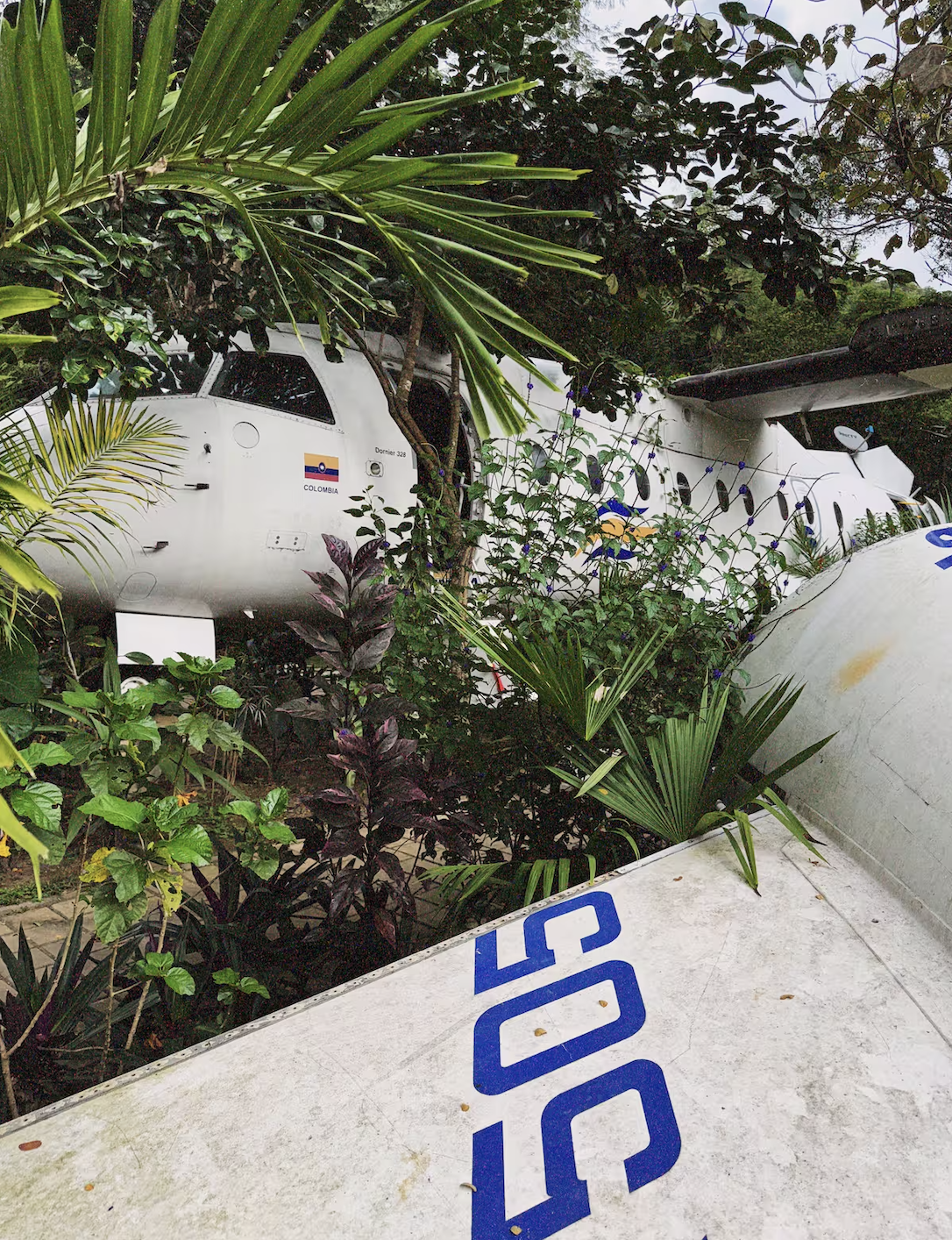
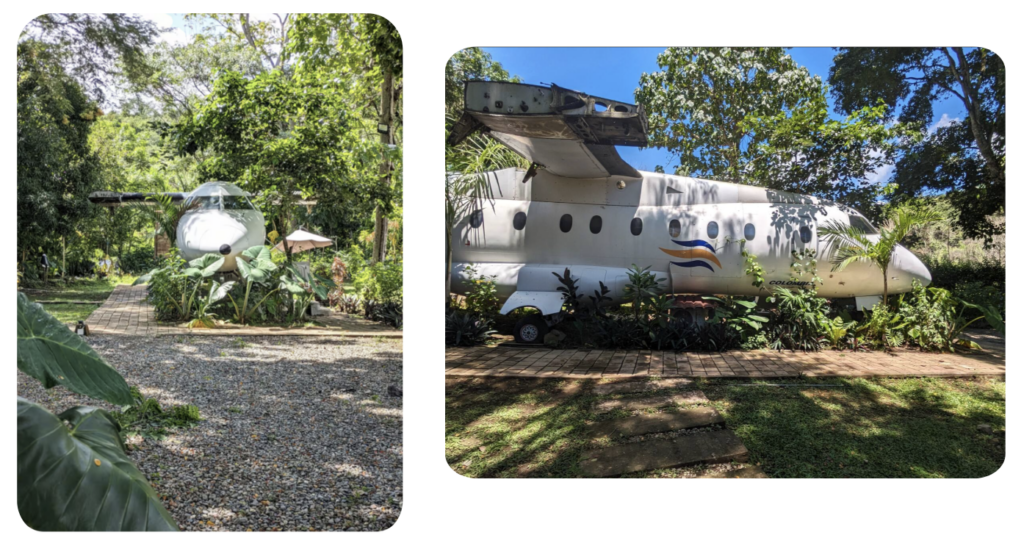
Just 90 minutes outside of Medellín in the lush countryside of Antioquia, an extraordinary hospitality concept has taken flight— once, quite literally. Ícaro, named after the mythological figure who flew too close to the sun, offers guests the chance to spend the night in a luxuriously retrofitted commercial airplane nestled in Colombia’s verdant landscape. This isn’t just another glamping experience; it’s a masterclass in creative adaptive reuse and experiential hospitality.
The Engineer Who Chose Happiness Over Stability
Before becoming a hospitality entrepreneur, Sebastian Tobon was on a conventional path as a mechanical engineer working for Pepperidge Farm in Connecticut. Despite a promising career where he “was doing the job of two or three engineers at the same time,” something was missing.
“I realized I was happier when I couldn’t wait for the time to finish my day as an engineer to go be a waiter,” Tobon explains, describing his side job at a Colombian restaurant. “In that moment, I was able to talk to people, serve them, make them happy—not just by bringing dishes to the table, but by making them have an experience.”
This realization sparked a dramatic career pivot. What was supposed to be a three-month backpacking adventure through South America turned into a two-and-a-half-year journey of self-discovery. “My mom was always worried, asking ‘How are you going to make money?’ I told her, ‘Mom, don’t worry. I’m poor, but I’m happy—that’s the most important thing.'”
From Backpacker to Hospitality Developer
Tobon’s entrepreneurial journey began modestly in Peru near Machu Picchu. With just $3,000, he rented an abandoned space and transformed it into a hostel using reclaimed materials—second-hand mattresses on the floor and furniture fashioned from river driftwood.
“When I started my first hostel, it was very hippie-type,” he recalls. “I was painting, breaking walls, finding construction leftovers to build with. My first bar was made from a piece of wood I found in the river.”
Despite its humble beginnings, the hostel quickly gained popularity. Within a few years, Tobon had expanded to include a bar, restaurant, and eventually opened a second location in Cusco. The properties achieved remarkable success, with the Machu Picchu location ranking as the top accommodation on TripAdvisor for 13 consecutive years.
The Airplane Opportunity: From Abandoned Asset to Luxury Experience
The journey to creating Ícaro began at a business workshop about conscious entrepreneurship that Tobon taught after spending two months in the Amazon jungle working with a shaman. There, he met a designer who introduced him to a property owner in Antioquia with an unusual asset—a decommissioned commercial airplane.
The plane came from a defunct Colombian airline that had gone bankrupt years earlier. “This guy had 10-20 airplanes sitting in the airport, and it was so expensive—he had to pay like 20 million pesos (approximately $5,000 USD) a month for every plane,” Tobon explains. The owner’s solution was to sell or relocate the aircraft—and one found its way to a piece of land in San Pedro de los Milagros.
Transporting the plane to its current location was a logistical feat worthy of a reality TV show. “They moved it from José María Córdova Airport by truck,” Tobon recounts. “They took the wings out, removed the engine. When they were going under bridges, they had to deflate the truck tires to make it fit.”
Conceptual Design: Narrative-Driven Real Estate Development
What sets Ícaro apart from other adaptive reuse projects is its commitment to storytelling through design. When Tobon and his partners—David, Oscar, Ana, and Jonathan—first visited the property, the plane was already being used as a basic Airbnb with four beds inside, but they envisioned something far more compelling.
“We said, ‘Let’s do this, but in a luxury way,'” Tobon explains. “This is meant to be for a couple, not a family accommodation.”
The Explorer’s Plane: When Fiction Drives Design
During a coffee break with his partners, Tobon sparked the creative direction: “We create a story around the plane – like there was this explorer coming in this plane, trying to find an indigenous tribe.” This narrative seed quickly blossomed into a comprehensive design concept that would transform the aircraft from simple accommodation into an immersive experience.
“We invited a friend of mine, who’s super creative and was working with me at the hostel in Peru, to help develop the story,” Tobon recalls. Together, they elaborated on the fictional narrative of a British explorer who crash-landed while searching for a lost tribe, then transformed the plane into his permanent jungle residence.
Rather than investing in expensive new furnishings, Tobon approached the design with resourcefulness. “I don’t like to go crazy and buy a lot of stuff. For me, it’s about finding something cheap that you can implement fast and play with colors, murals, and textures—that’s what I did with both my hostels.”
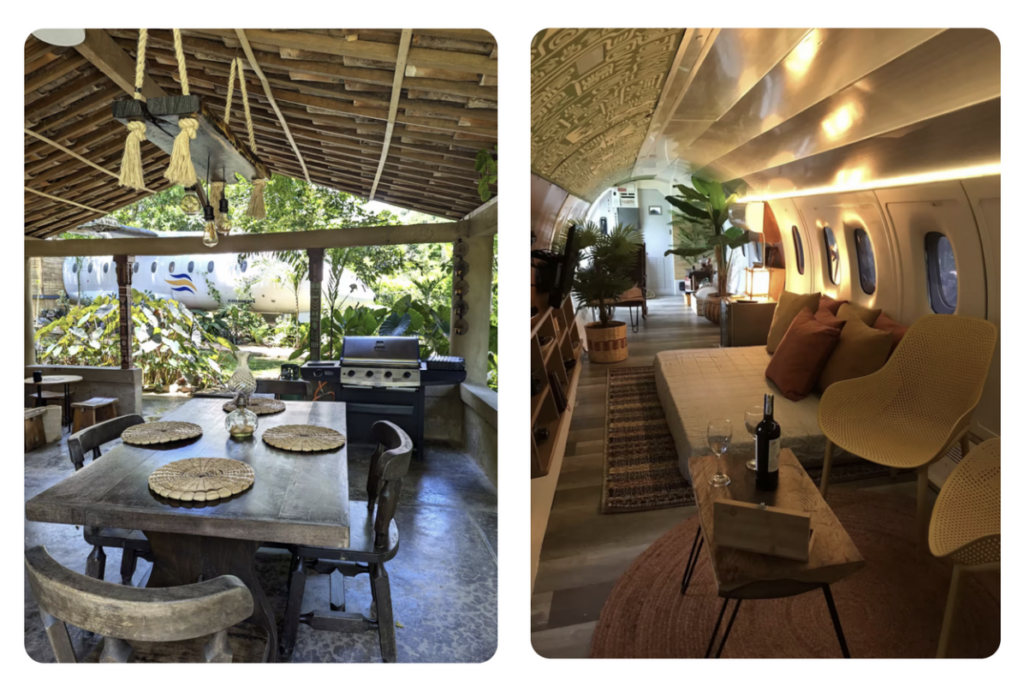
The design team hunted for authentic pieces that reinforced their explorer narrative—vintage maps, explorer’s chairs, navigation instruments, and artifacts that might have been collected during expeditions. The abundant indoor plants create the sensation that the jungle is gradually reclaiming the aircraft, while the indigenous-inspired patterns and textiles suggest cultural exchange with the fictional lost tribe.
“It has to have a lot of plants inside. It has to have an indigenous kind of design. It has to be something that you think could be made from materials found in the jungle,” Tobon explains of their design philosophy. Every element—from the lighting fixtures to the bed placement—supports the story of a sophisticated explorer who adapted aircraft components into comfortable living quarters.
La Mona: The Hippie’s Trailer with a Rock and Roll Past
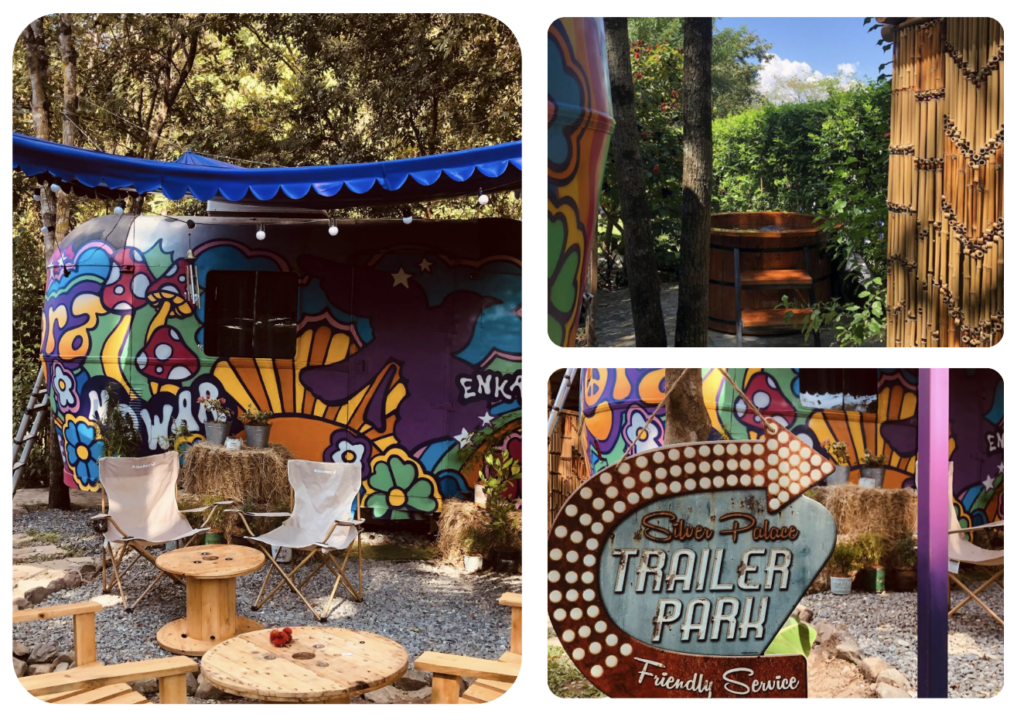
The property’s narrative expanded when the team discovered an abandoned trailer on site. “When we saw that trailer, which was not part of the deal, I was like, ‘Hey, we can do something with that,'” Tobon remembers. When they inquired about it, the property owner revealed its storied past: “In real life, that trailer was used by a famous band when they went to Bogotá—they did their makeup and everything there.”
Although they’re still searching for photographic evidence, the owner claimed the trailer had been used by none other than the Rolling Stones. This rock and roll provenance inspired the team to create a counter-narrative to the explorer’s sophisticated aesthetic.
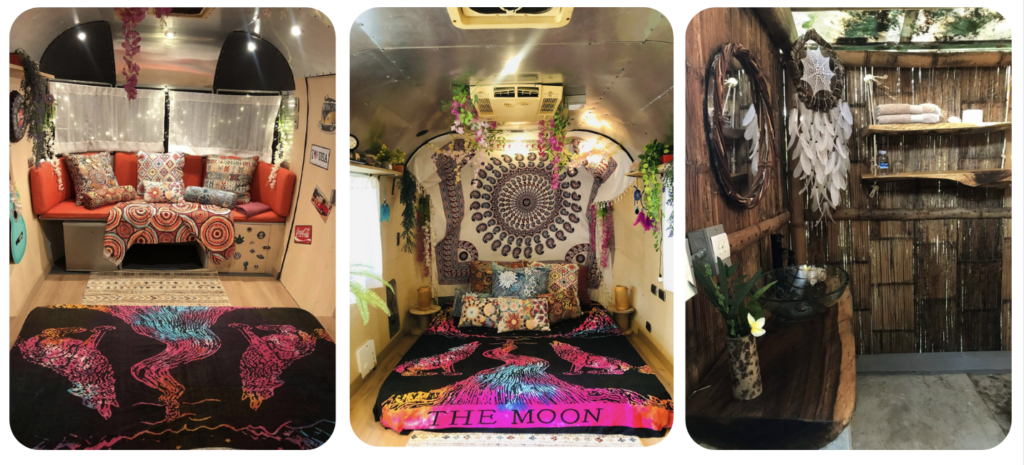
“I said, ‘Let’s make it really hippie,'” Tobon explains. Thus was born the character of “La Mona,” a free-spirited Argentinian woman who attended the Woodstock festival, experimented with “mushrooms and LSD,” and eventually drove her colorful trailer into the South American jungle where she encountered the crashed explorer.
The trailer’s design reflects this fictional backstory with psychedelic colors, vintage 1960s and 70s furnishings, peace symbols, and bohemian textiles. Record players, vintage posters, and handcrafted items create an authentic time capsule of counterculture aesthetics.
“La Mona and the Explorer ended up being partners,” Tobon says of the fictional characters, hinting at the romantic narrative that connects the two distinct accommodations on the property. This intertwined storytelling creates a cohesive guest experience despite the contrasting design languages.
The detailed backstories serve multiple purposes: they guide design decisions, create marketing hooks, and offer guests a richer experience. Visitors aren’t just renting unique accommodations—they’re stepping into fictional worlds with developed characters and histories, transforming a simple overnight stay into an immersive story in which they become participants.
Upscale Amenities in an Unexpected Setting
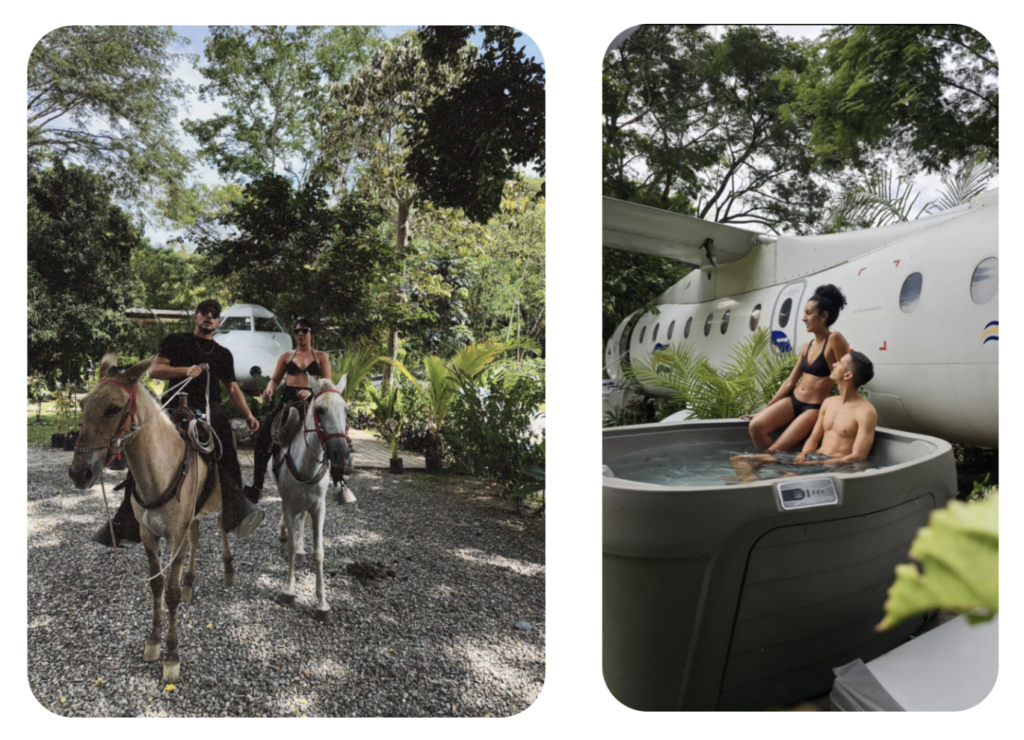
Despite Tobon’s background in budget-friendly hostels, Ícaro unabashedly targets the luxury market with amenities including:
A fully-stocked mini bar
Private jacuzzi
On-site chef for breakfast and barbecue service
Outdoor movie screen
Fire pits
Massage services and couple’s ceremonies
“You can make someone stay in a plane and pay a little bit more instead of a hostel,” Tobon notes pragmatically. “We set up the barbecue and other amenities that many other types of glamping offer, but it came out pretty good.”
The business structure is equally innovative, with five partners (some individuals, some couples) bringing diverse expertise to the project. Oscar handles operations, Jonathan contributes real estate and marketing experience, and others bring expertise in design, hospitality, and wellness.
The Future: Wellness-Focused Hospitality Portfolio
For Tobon, Ícaro represents more than just a successful Airbnb listing—it’s part of a larger vision to transform hospitality through wellness and holistic experiences.
“What I’m doing now is changing all my hostels from party-type or social-type hostels to focus more on bringing wellness and holistic experiences to any type of traveler, but keeping the environment and openness of a hostel,” he explains.
This vision extends beyond Colombia, with plans to develop similar concepts throughout Latin America. “I don’t think there are many options like this in the world,” Tobon notes, identifying a market gap for budget-friendly accommodations that incorporate wellness elements.
Investment Opportunity and Strategic Partnerships
Ícaro’s success has positioned the team to scale their concept. They’re currently seeking three types of strategic relationships:
Investors who connect with their holistic business philosophy
Property owners with unique assets ripe for creative development
Strategic partners in the wellness and luxury travel sectors
“There are a lot of people who have incredible places and don’t know what to do with them,” Tobon observes. “They sell them or rent them out, but sometimes they don’t see the opportunity or they see it but don’t want to develop that type of project.”
For Tobon, these partnerships must align with his deeper purpose. “If I can bring an experience that can help you grow in some way or open something in your heart—that’s my mission. If we don’t reconnect with Mother Earth, we’re not going to stay here much longer.”
This article was sourced from a live expert interview.
Every month we conduct hundreds of interviews with active market practitioners - thousands to date.
A sudden rise in mortgage rates has not landed evenly across Hampton Roads, Virginia. Over three weeks to a month, rates climbed almost a full percentage point, according to Bubba Hutchison, who leads Hutchison & Co. at RE/MAX Connect in Yorktown. Freddie Mac’s weekly survey tracked the same climb: the average 30-year fixed rate rose ...
For most of the past two decades, the conventional playbook for condominium buyers in San Francisco followed a predictable arc: buy a studio, sell in five to seven years, move up to a one-bedroom, repeat. Appreciation was reliable enough that buyers could treat each purchase as a stepping stone. That assumption no longer holds, according ...
Harford County, Maryland, never gave back its pandemic-era gains. Prices in the rural county 30 minutes north of Baltimore rose slowly and without a dip from 2020 until about May of this year, according to Lee Tessier, who leads the Lee Tessier Team of eXp Realty in Bel Air. Over the same stretch, he says, ...
Data center construction is pushing smaller buyers to the back of the line for sand, gravel, and stone. Wherever large campuses go up, they claim local supply before anyone else places an order. When a quarry commits its stock to one of those projects, the homeowner building a pool or the small developer pouring a ...
Brokers tend to talk about MLS fragmentation as a tax on growth – the cost of joining one more system every time a team pushes into new territory. For the brokerages large enough to pay their way around it, fragmentation also works as a competitive barrier against everyone who can’t. Close to 500 MLSs still ...
An inherited house arrives with decisions its new owners didn’t plan for: whether to fix it up, list it, or take a cash offer, and how much effort any of those paths is worth. Each option comes down to a tradeoff between the time a sale takes and the money it brings in. In greater ...