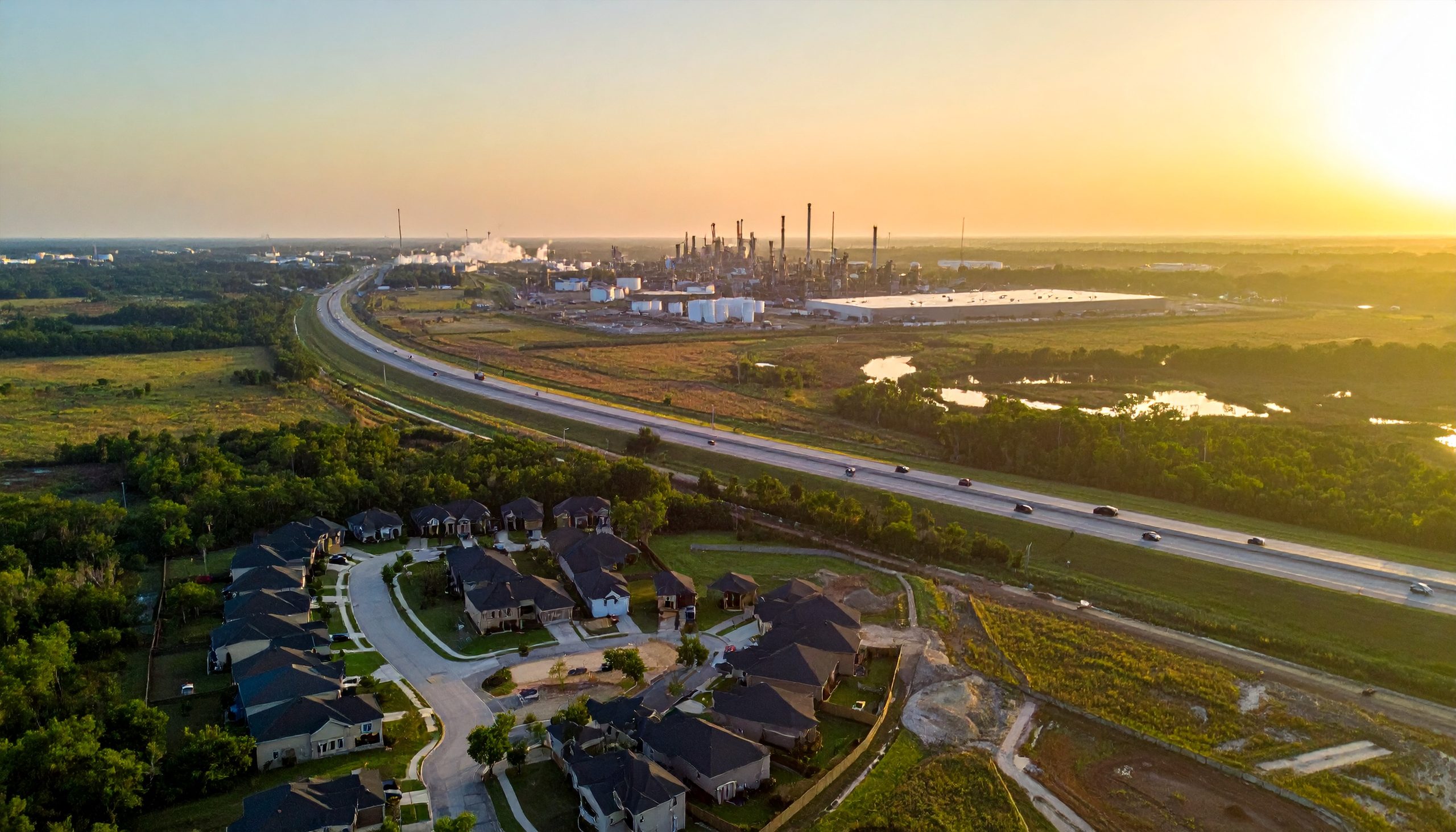
For decades, Houston’s residential growth has followed a familiar map. Master-planned communities and commuter suburbs pushed the metro outward to the north, west, and south, while the east side, home to the refineries and petrochemical plants that anchor the regional economy, stayed comparatively thin on rooftops. That pattern is shifting in the Baytown and Mont Belvieu corridor, where industrial expansion, new highway capacity, and commercial development are pulling housing toward land that sat open for years.
Rob Roca, who leads the Rob Roca Realty Group in Mont Belvieu, moved to the area 12 years ago partly because of that gap. Houston, he says, is “pretty well developed when you look at it geographically, north, south and west.” The east side, where the oil and gas industry is concentrated, was not, possibly because people shied away from living near the plants. “There was just so much land and so much property that was undeveloped that when we first moved here, it was pretty quiet,” he says.
The open question for the housing market is how quickly industrial investment turns into buyers. In Roca’s experience, some of that demand is already arriving, while some of the most discussed sources of new jobs have yet to show up in his pipeline.
Industry Builds First, Housing Follows
Mont Belvieu is the center of the U.S. market for natural gas liquids such as propane and ethane. Its fractionators, plants that separate those liquids into products for fuel, plastics, and export, keep multiplying. Energy Transfer says it expects to start up another by year-end, and Enterprise Products Partners approved one more this summer. The plants also support a steady contractor workforce on site every day.
Nearby, TGS Cedar Port, which trade press calls the country’s largest rail- and barge-served industrial park, keeps adding warehouses and plants. Access by train and water lets companies move heavy bulk goods like plastic resin without relying on trucks, which has drawn petrochemical-linked distributors to the park.
Roca sees a direct line from that activity to residential demand. “As commercial builds up in the area, that’s going to bring more revenue in the sense that you can have more employees working for those different companies and they’re going to need homes,” he says. Oil and gas workers relocating from other parts of Houston to be closer to work are, in his words, “a pretty regular thing for us.” Movement within the industry also cuts both ways: he notes that some employees are shifting toward Beaumont as new plant capacity opens there.
A Highway Improved Commute
Infrastructure has done as much as industry to reposition the east side. A few years ago, the Texas Department of Transportation finished a major extension of the Grand Parkway, Houston’s outermost highway loop, linking New Caney to Baytown. The parkway now runs without a break from the East Freeway in Baytown, around the north and west of the metro, to the Southwest Freeway in Sugar Land.
For east-side housing, the change is access. Workers can reach the Mont Belvieu and Baytown industrial base from the northeast suburbs without passing through central Houston, and residents of the corridor gain the same reach in the other direction. Roca describes the highway as a key reason development started moving east. “It’s gold,” he says. As more comes into the area, more people will need to live there.
The highway is also drawing commercial building directly. Roca says commercial warehouses are being developed right off State Highway 99, and several of Cedar Port’s newest distribution buildings carry Grand Parkway addresses.
Data Centers: Expected
The next wave of demand the corridor is watching is digital infrastructure. Three prospective data center projects have been undergoing extensive due diligence in the Baytown and Chambers County region, according to The Baytown Sun, which also notes that about 37 percent of Baytown is classified as rural, undeveloped land, mostly in Chambers County. In September, Baytown City Council took up a proposed code amendment that would define data centers in its land development code so they are not reviewed as generic industrial projects.
Talk of a facility in the Mont Belvieu area has circulated, and if one arrives it could bring new jobs and new neighbors, though such projects are controversial locally.
Schools and Reinvention
Jobs bring buyers to the corridor, but schools often decide where they settle. Roca points to the local school district as a major draw for families moving to Mont Belvieu.
Baytown is also working to change how it is perceived. Roca acknowledges the city has not always had the best reputation, but says it is “literally going through and revitalizing the area both residentially and commercially,” with new construction, new stores, and new commercial projects visible across Baytown and Mont Belvieu. Prices now span a wide range.
The result is a broad buyer mix. Roca describes first-time buyers, households relocating into the area, and households relocating out of it. Investors are active, he says, but the local housing stock is not especially well suited to them. One current client from Miami is buying a second home in Mont Belvieu to be closer to family who settled there, with plans to possibly move full time. Roca sees that as a sign the area is drawing attention beyond the Houston market.
What Turns Investment Into Households
The pieces that make the corridor a growth story are mostly in place: a deep petrochemical employment base, a completed highway link to the rest of the metro, available land, and a highly rated school district. What remains uncertain is timing. Roca says buyers across the market are holding back while they watch the Federal Reserve and wait for clarity on economic policy, and that hesitation slows how quickly new jobs translate into home purchases.
The near-term signals are concrete. Energy Transfer’s next Mont Belvieu fractionator is scheduled to start up this December, Enterprise’s is due in 2028, and Baytown’s data center rules will shape whether that sector arrives at all. For agents and builders on the east side, the question is no longer whether Houston’s growth will reach the corridor, but how fast.
About the Expert: Rob Roca leads the Rob Roca Realty Group, a residential real estate team affiliated with eXp Realty that he runs with Brittany Roca. The team serves Baytown, Mont Belvieu, and the east Houston area, where Roca has worked for 12 years.
This article is based on information provided by the expert source cited above. It is intended for general informational purposes only and does not constitute legal, financial, or real estate advice. Readers should conduct their own research and consult qualified professionals before making any real estate or financial decisions.