Market Stadium is advancing how institutional investors evaluate multifamily opportunities by bringing granular, data-driven insights to market-level analysis through a synthesis of real estate expertise and data science. Founded by Ryan Kang and Dennis Lee, the company has established itself as a leader in advanced market analytics for the multifamily sector.
The company’s story begins at NYU’s Real Estate program, where Kang and Lee first crossed paths during their graduate studies. While Kang had been drawn to real estate for its tangible nature after exploring various finance sectors, Lee brought a passion for data research and urban planning technology. This combination of perspectives would prove crucial in developing Market Stadium’s unique approach to market analysis.
“Dennis was really into data research before. Back then, I didn’t have much knowledge of real estate data or technology, so he pretty much introduced the real estate tech world to me,” Kang explains. “He always talked about how real estate urban planning technology could change real estate investment.”
After graduation, both founders gained valuable industry experience – Kang in private equity focusing on multifamily acquisitions and development, while Lee joined one of the largest data-driven real estate private equity firms. Their vision for Market Stadium crystallized during a pivotal investment committee meeting where Kang needed to present a deal in Raleigh, North Carolina. Lee’s detailed market analysis, incorporating unconventional metrics like patents per employee to demonstrate innovation potential, helped secure committee approval and validated their approach.
Today, Market Stadium distinguishes itself through its comprehensive market-level analysis. “We provide more than 500-plus type of data points that have high correlation with multifamily investment decision-making process, and then we let the users choose and create their own custom dataset,” Kang notes. “They’re creating their own custom index using their own investment thesis, reflecting their own perspective on the market.”
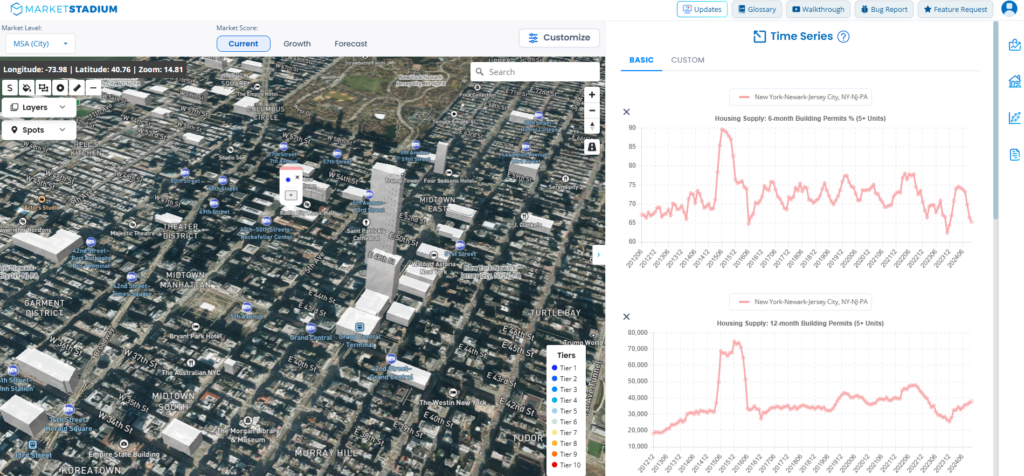
This approach addresses a significant gap in the market. While existing platforms excel at providing building-level metrics like sales comps and tax data, Market Stadium delves deeper, incorporating everything from venture capital funding flows to university R&D investments. The platform’s urban intelligence capabilities analyze commuting patterns and identify major employment and retail clusters, providing investors with a detailed view of market dynamics.
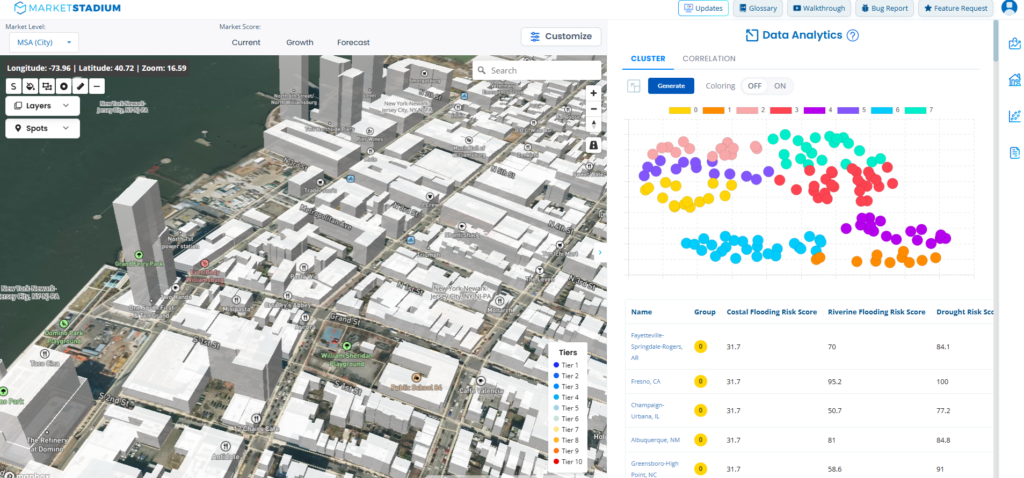
One of the platform’s key features emerged directly from client feedback: the ability to find markets with similar characteristics to areas where investors have already succeeded. Their cluster analysis tool can identify 10-20 comparable locations across different metros, allowing national investors to efficiently scale their geographic footprint while maintaining their investment thesis.
The company’s development process leverages the founders’ complementary strengths. Kang handles most client communications, gathering insights about user needs and pain points, while Lee leads product ideation and design. This collaboration, supported by their technical and data teams, enables rapid iteration and refinement of features based on real user feedback.
Looking ahead to 2025, Market Stadium is expanding beyond its current focus on acquisitions and development teams to serve asset management professionals. The company plans to introduce automated reporting capabilities that will help portfolio managers track market trends on a monthly basis, complementing their existing forward-looking analytics.
With a team that includes PhD-level urban planning and data science experts, Market Stadium continues to advance market analysis methodology. Their research team regularly publishes original insights, contributing to the industry’s understanding of market dynamics while demonstrating their analytical capabilities.
For an industry that has historically relied on conventional metrics and local knowledge, Market Stadium represents a sophisticated approach to data-driven decision making. By combining traditional real estate expertise with data science and urban planning intelligence, they’re enabling institutional investors to make more precise decisions in today’s complex market environment.
About Market Stadium: Market Stadium provides advanced market analytics for multifamily and single-family rental investors, with a specific focus on acquisitions and development teams. Their platform offers over 500 unique data points and sophisticated urban intelligence capabilities to help institutional investors make more informed investment decisions. Learn more at marketstadium.com.
This article was sourced from a live expert interview.
Every month we conduct hundreds of interviews with active market practitioners - thousands to date.
Twice in two years, Austin’s residential real estate market has built momentum toward recovery – and twice, external economic disruptions have stalled it. The pattern points to a market not in decline but in a holding pattern shaped more by geopolitical uncertainty than by local fundamentals, according to Brooke Roeder, Principal of the Roeder Group ...
In most real estate transactions, the sequence of financial commitments works against the buyer. Non-refundable due diligence fees, earnest money deposits, inspection costs, and appraisal fees are all paid before the buyer has a clear picture of a property’s actual condition. When problems surface – foundation damage, structural issues, faulty wiring – buyers who walk ...
For much of the past several years, sellers in St. Paul, Minnesota, had the upper hand. Low inventory, intense buyer competition, and rapid price appreciation made it easy to list a home and attract multiple offers. That dynamic is changing. Listings in St. Paul are up roughly 12 percent over last year, according to Shawn ...
The combination of snow load, seismic, wildfire, and energy requirements means every new home is a luxury product by default – and the market is adjusting accordingly New construction in most mountain resort towns is expensive. In Truckee and North Lake Tahoe, California, the cost of code compliance alone prices out all but the luxury ...
Most cash offers in Marin County don’t come from tech workers carrying suitcases of stock-sale proceeds. They come from parents funding a child’s purchase, or from buyers drawing on personal IRA accounts and securing conventional lending afterward. The distinction matters because the popular narrative – that the Bay Area’s cash-heavy markets are simply a function ...
The Philadelphia region never saw the extreme price run-ups other markets did, so it never took the sharpest drops either, and it remains one of the more affordable markets in the country. That steadiness hasn’t kept every seller’s expectations in line with the current market. Anne Rubin, a partner at Century 21 Advantage Gold who ...