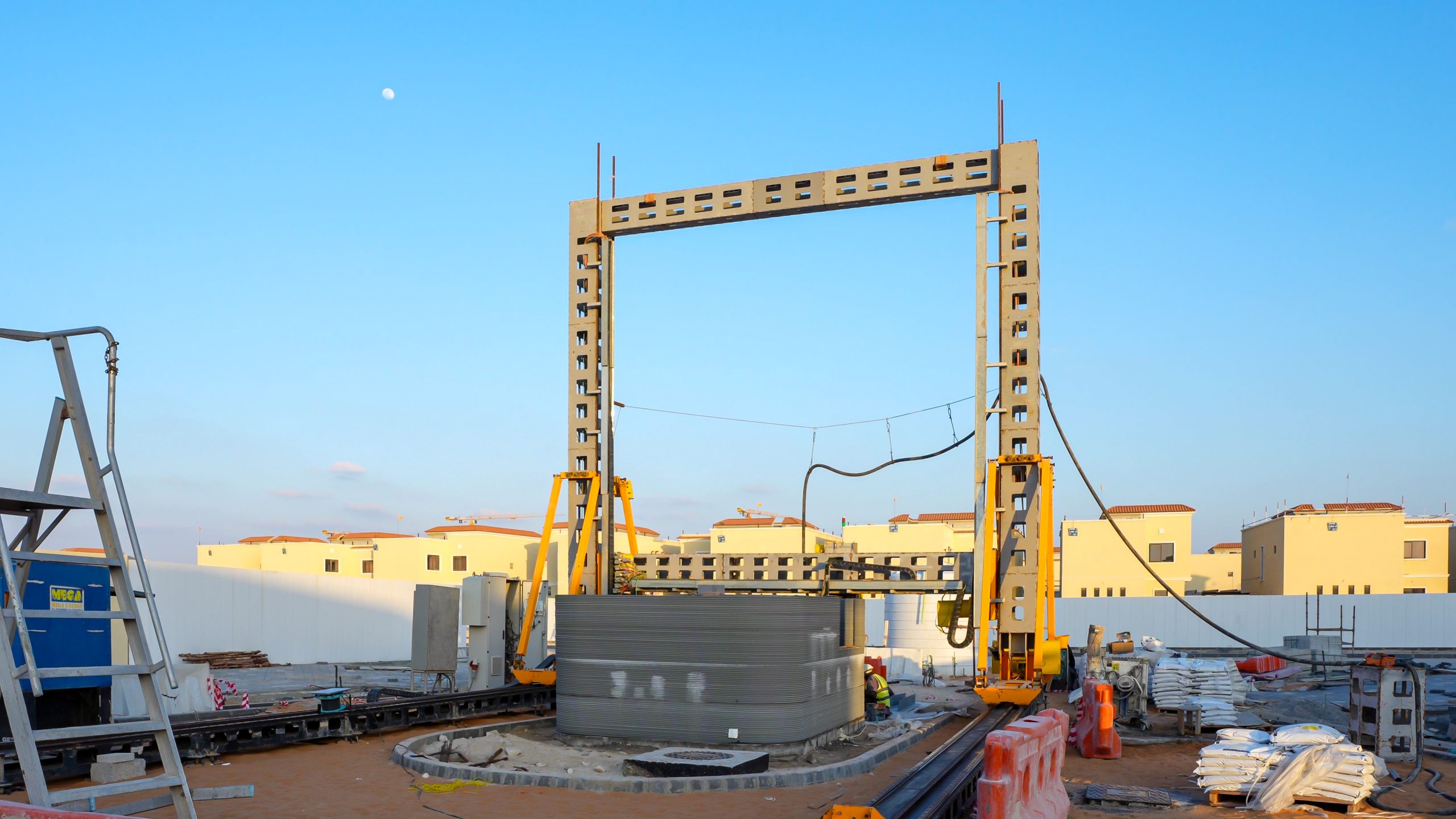
Early claims that 3D-printed construction would be 100 percent cheaper and 200 percent faster than conventional building went undelivered, eroding investor confidence. Now, with roughly 150 single-family homes completed in the United States and up to 300 more under construction across multiple communities, according to Boris Kozlov, Founder & CEO of AC3D (Automated Construction 3D), the industry is entering what practitioners describe as a more realistic commercial phase, one where the advantages are narrower but verifiable.
Boris’s company, a Delaware-incorporated business currently operating out of Dubai, works both sides of the technology: manufacturing 3D printers and acting as a specialized subcontractor.
Where the Economics Work
The cost savings from 3D printing are real but narrower than early promoters suggested. Boris describes the technology as competitive rather than revolutionary at present. “Maybe if you delete the word ‘much,’ then it’s trending to become true,” he says of the original pitch. “3D printing is competitive in price. It is really faster, maybe not 200 percent faster, but it can easily be like 30 percent faster than conventional technology, which already is significant, especially at scale.”
Boris points to a recent infrastructural project as an illustration of where the numbers work. By printing insulated panels that eliminate the need for additional cladding and by creating non-removable formwork for pillars, shifting walls from steel structure to reinforced concrete, 3D printing can reduce both material layers and steel consumption. But Boris is candid about the comparison: the advantage holds against top-tier precast concrete panels with additional insulation, not against cheaper alternatives like sandwich panels. “If you are comparing to solid precast concrete panels with additional insulation – like AAA infrastructures – then this is where we are winning,” he says.
Why Single Homes Don’t Move the Needle
Unit economics improve substantially at community scale, according to Boris. A single home still requires the full pre-construction cycle – permits, structural design, MEP design, architectural design – making standalone projects disproportionately expensive relative to output. Boris describes this as a strategic imperative: “It’s much better to print a community of 10, 20, 100 homes rather than making standalone projects. That’s also where economics start to become better at scale.”
Boris says the U.S. market appears to be following this logic: after one community of approximately 100 units was completed, three more communities of similar size are now in construction. For ADUs, which Boris identifies as a strong entry point for the U.S. market given government support in various states, site constraints may require off-site printing and on-site assembly rather than direct on-site printing, adding logistical complexity but not eliminating viability.
The Trust Problem
Developer adoption remains slower than the technology’s readiness might suggest. Boris describes a recurring friction: even when a developer’s innovation department is enthusiastic, internal resistance from contracting departments or main contractors frequently slows projects. “We are in half of our projects struggling with the main contractor being somewhat against the 3D printing subcontractor,” he says. “The only guess is that they see us as a risk.”
The deeper misconception, in his view, concerns what cost savings actually mean relative to developer margins. If a home retails for $1 million and costs $300,000 to produce with land, reducing production cost to $250,000 is meaningful but does not reshape the developer’s overall economics. “Developers expect it to be almost for free, which is unrealistic,” Boris says.
Resilience as a U.S.-Specific Advantage
In markets where stick-built construction dominates, 3D-printed concrete structures offer inherent resilience advantages: fire resistance, wind resistance, termite resistance. Boris notes that in hurricane-prone areas like Florida, 3D printing can create aerodynamic wall profiles that outperform even conventional concrete. The technology also enables precision in energy efficiency by creating internal wall geometries calculated to deliver specific insulation values, something difficult to replicate with standard framing.
The labor argument reinforces the case. The U.S. faces both high construction labor costs and a shortage of skilled workers. Each printer requires only two to three operators, according to Boris. “In the U.S., construction automation will have more impact than in the Middle East,” Boris says, noting that Gulf states have abundant affordable labor from South Asia, making the automation case less compelling there.
What Comes Next
The technical frontier is expanding automation beyond walls, into foundations, rebar placement, and installation of components like windows and doors. Boris sees AI integration as the path toward making 3D printers function more like general construction robots. One persistent challenge: hairline cracking in printed concrete, caused by shrinkage in thin layers under variable climate conditions. “If I had a magic wand and I would cure one problem in 3D printing, that would be cracks,” he says, noting they may not be structural but damage the perception of the finished product.
The broader signal investors are watching for, Boris says, is whether pilot projects convert into repeat, larger-scale orders. The trajectory he describes – from one completed community to three in construction – suggests that confirmation, where it exists, is arriving incrementally rather than all at once.
About the Expert: Boris Kozlov is Founder and CEO of AC3D (Automated Construction 3D), a Delaware-incorporated company currently operating out of Dubai that both manufactures 3D construction printers and operates as a specialized subcontractor on building projects.
This article is based on information provided by the expert source cited above. It is intended for general informational purposes only and does not constitute legal, financial, or real estate advice. Readers should conduct their own research and consult qualified professionals before making any real estate or financial decisions.