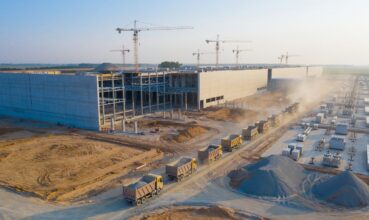
Sourcing materials for a $50 million construction project typically takes two to three months. For billion-dollar developments, that timeline stretches to six months. Architects must specify thousands of individual products, from facade panels to door handles, then email dozens or hundreds of suppliers, compare specifications manually, and negotiate pricing through email chains, PDF spec sheets, and spreadsheets. It remains one of the most time-intensive, least digitized processes in construction, and one that AI-driven tools are increasingly targeting without touching the creative work that architects actually value. Construction is a global market of more than $13 trillion, among the least digitized large industries.
Architecture projects require coordination across three distinct groups: architecture firms, general contractors, and material suppliers. Each group operates with different incentives, different workflows, and different definitions of what a successful outcome looks like. A single building of moderate scale involves more than 1,000 individual construction materials, and sourcing them still depends on spreadsheets, email chains, and supplier catalogs.
The friction compounds at scale. Firms with 50 to 2,000 employees working on large residential and commercial projects feel it most acutely. A 50-unit residential project or a major commercial development generates enough compliance documentation and material specifications to occupy procurement teams for weeks. Smaller projects, a two-story house with perhaps 50 materials, do not produce enough volume to justify platform adoption. The return shows up on projects large enough to involve hundreds of suppliers and thousands of line items.
Aurora Zelia I Sam Hui, Founder and CEO of BIM Engine, an AI startup automating repetitive architecture workflows, puts it: “We have Amazon for daily goods; we have Instacart or DoorDash for grocery products or meals. But why don’t we have one for construction materials?”
Matching Materials Through Context
A version of this approach is BIM Engine’s Material Engine product. Rather than requiring suppliers to manually list products on a marketplace, the platform reads public supplier websites and parses published PDF specification sheets to populate listings automatically, addressing the cold-start problem that plagues construction marketplaces. On the architect’s side, the system semantically matches specified materials to available products using project context: location, weather conditions, compliance requirements, and building classification.
Aurora describes a typical use case: a library project in San Francisco’s Soma neighborhood needing facade material. The system already knows local weather patterns and compliance requirements, whether the material is exterior-facing, and screens for the fire-performance documentation the application may require, such as a Class A flame-spread rating under ASTM E84 for an individual material. Assembly-level requirements such as NFPA 285 evaluate a full wall assembly rather than a product in isolation, and final compliance remains subject to professional review.
According to Aurora, procurement timelines on this platform compress from approximately 11 weeks to less than one week. General contractors can request quotes from all suppliers simultaneously with a single action rather than contacting each individually, and some platforms in this space now offer net-30 and net-60 terms, so contractors preserve cash through the build, while suppliers can accept a small discount to be paid early rather than waiting out those terms.
Sorting tools illustrate the broader shift toward automated optimization: sorting by budget can award the lowest-priced supplier, subject to the firm’s spending limits and approval rules, while sorting by lead time prioritizes delivery speed, eliminating the problem where manually collecting lead-time quotes from 10 suppliers takes two days, by which point the earliest quotes are already stale.
The Marketplace Problem
Building a platform that serves architects, contractors, and suppliers simultaneously is operationally demanding, since each group has fundamentally different needs: architects want specification matching and time savings, contractors want faster quotes and payment terms, and suppliers want increased revenue through broader client access.
“A marketplace is already difficult to build, especially a three-sided marketplace with a lot of money involved and a lot of companies involved and in such a legacy industry,” Aurora says. Reconciling those incentives, rather than any single feature, is the harder engineering problem that platforms in this space have to solve, and it’s part of why construction marketplaces have lagged consumer equivalents by years.
Where AI Fits
The push to digitize procurement challenges the dominant narrative around AI in design industries. Rather than replacing creative work, the highest-value applications target compliance paperwork, inspection reports, and procurement logistics, work that is language-heavy and repetitive.
“The right question is what are architects and construction professionals actually doing today and which parts deserve human intelligence,” Aurora says. Design judgment, client relationships, and solving complex problems on site remain irreplaceable. No language model will sit down with a real estate developer to discuss a project, and no AI agent will walk a construction site catching problems in real time.
That distinction, between paperwork that can be automated and judgment that can’t, is likely to shape how procurement technology develops industry-wide. As more platforms build out material-matching, compliance-checking, and payment tools, the underlying need extends beyond any single solution: a fragmented, catalog-and-phone-call process that has resisted digitization for decades, on projects large enough to make the overhead worth solving.
About the Expert: Aurora Zelia I Sam Hui is Founder and CEO of BIM Engine, an AI-native company automating architecture workflows and programming robots for site inspection and material handling. Its Material Engine product automates construction materials procurement.
This article is based on information provided by the expert source cited above. It is intended for general informational purposes only and does not constitute legal, financial, or real estate advice. Readers should conduct their own research and consult qualified professionals before making any real estate or financial decisions.