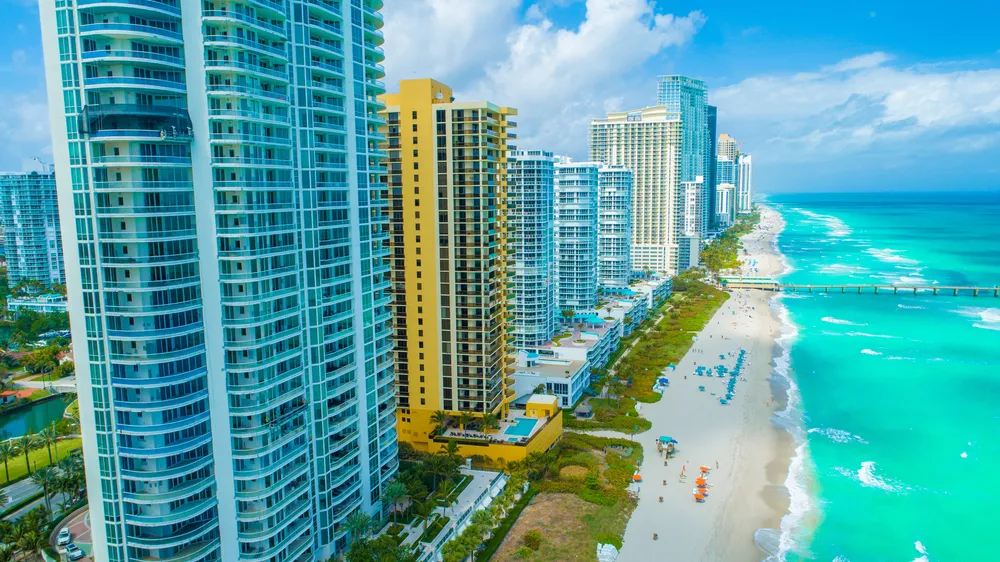
In the stretch of coastline running from Hallandale Beach through Hollywood, Aventura, and Sunny Isles, the condo market is not experiencing a single correction. Two distinct markets are operating under the same geographic label – one defined by scarcity, the other by oversupply – with the dividing line falling near the million-dollar mark.
Below that threshold, particularly in the $300,000 to $800,000 range, older buildings are sitting with 20 to 35 units listed simultaneously, representing one to two years of supply. Above it, large-format condos – 2,500 square feet and up, priced between $1 million and $2.5 million – are in short supply, with multiple qualified buyers competing for limited inventory. For buyers and sellers operating in this corridor, understanding which side of the divide a property falls on determines whether the transaction will be competitive or stagnant.
Where Inventory Is Piling Up
The oversupply is concentrated in buildings that are 20 to 40 years old, where unit owners are holding firm on prices that no longer reflect market conditions. Stuart Berger, Team Co-Lead of the Stu Berger and Ana Aizenstat Team at Coldwell Banker Realty, says sellers in that segment are waiting for a market recovery that is unlikely to arrive.
“We’ve never had a lot of appreciation here,” he says. “The appreciation we had was because of Covid and the South Americans, and it boomed, and now that’s over.”
According to Berger, a buyer who can afford a $400,000 condo still faces $1,500 to $1,600 per month in maintenance and $8,000 in annual taxes. At that price point, carrying costs are the deterrent, not the purchase price itself. Meanwhile, units priced attractively relative to their competition still move. The team recently listed a unit in a Sunny Isles building with roughly 35 active listings; priced below the cluster, it sold immediately.
The High End’s Rules
Above the million-dollar line, the constraint is supply, not demand. Berger says he currently has buyers looking for single-family homes in Hollywood willing to spend between $1.5 million and $3.5 million, with nothing suitable available. The team recently sold a condo at $1.535 million, a unit that had sat for over a year at $1.8 million under a previous agent. A buyer had offered $1.5 million a year earlier, and the seller declined. The property sat empty while she continued paying maintenance and taxes.
“The high-end stuff, if something’s renovated, they sell almost immediately,” Berger says. In a low-inventory environment, condition and pricing accuracy determine whether a property moves in days or lingers for months, because buyers at that level have fewer options and act faster when something fits.
The Buyer Profile Has Changed
The international capital that once supported South Florida’s condo market has largely disappeared from this corridor. South American buyers, who previously purchased condos as safe-haven assets without expecting rental returns, are “almost non-existent” compared to pre-COVID levels, according to Berger. The current buyer base is predominantly local or relocating from other U.S. states for full-time residency, not second-home purchases, not investment plays.
“Pretty much everybody buying is familiar with the area,” Berger says. “They’re just not coming here for the first time.”
This shift has practical consequences for pricing. Safe-haven buyers paid cash and tolerated negative carry, monthly losses where expenses exceeded rental income. Full-time residents scrutinize carrying costs against alternatives, including the new rental construction now competing for the same demographic.
New Construction Rental Supply
A wave of new apartment buildings – Berger estimates around 10,000 units within 10 miles of his office – is pressuring rental rates for existing condo owners. Buildings offering two months of free rent and modern amenities are pulling tenants away from older units. According to Berger, a condo that previously rented for $4,000 to $4,200 per month is now fetching roughly $3,500.
For foreign investors who purchased condos expecting rental income to cover expenses, the losses are compounding. Berger describes clients who bought $500,000 condos on advice that they would generate positive returns and are now losing $1,500 per month after maintenance, taxes, and financing costs, with the underlying asset worth approximately $100,000 less than what they paid five years ago.
What This Means
Berger’s advice to investors considering residential deployment in the area is direct: unless they can identify a genuinely distressed asset or have a viable short-term rental strategy, the numbers do not work for buy-and-hold at current pricing.
“If you’re looking residential, they probably need to look north of Palm Beach County, unless they’re really skilled at finding a distressed property,” he says. “Anything that’s on the market, I don’t see how they’re going to make money on it unless it’s a special circumstance.”
The split in this market also carries implications for sellers. Owners holding units in the $300,000 to $800,000 range in 20-to-40-year-old buildings face a choice between pricing to where current buyers will act or continuing to absorb monthly losses while waiting for conditions that, according to Berger, are not returning. At the high end, sellers who price accurately and present renovated properties are still seeing fast closings, but the margin for error on pricing is narrow precisely because supply is thin and buyers know what alternatives exist.
About the Expert: Stuart Berger is Team Co-Lead of the Stu Berger and Ana Aizenstat Team at Coldwell Banker Realty, serving the South Florida coastal corridor from Hallandale Beach through Hollywood, Aventura, and Sunny Isles.
This article is based on information provided by the expert source cited above. It is intended for general informational purposes only and does not constitute legal, financial, or real estate advice. Readers should conduct their own research and consult qualified professionals before making any real estate or financial decisions.