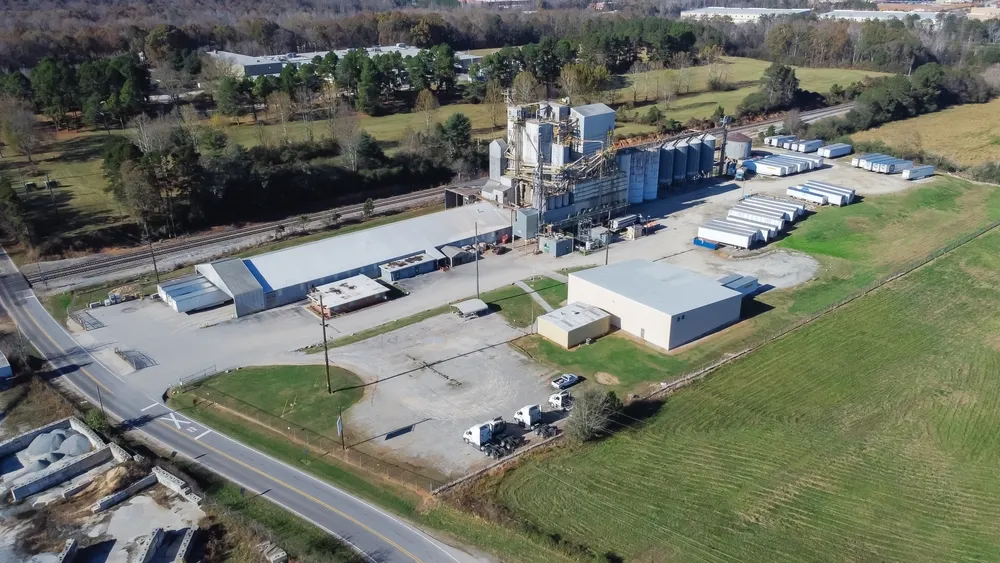
New spec construction along Georgia’s 400 corridor is almost exclusively targeting tenants who need 50,000 square feet or more. The small industrial spaces that once let entrepreneurs move out of a garage and into their first commercial lease are not being replaced – even as demand for them persists. At the same time, lease rates in the area have more than doubled, creating a market where small operators face both fewer options and higher costs than at any point in recent memory.
According to Scott Hanlon, Associate Broker at Powell Property Group who has worked commercial and industrial deals along the 400 corridor since the mid-1980s, the entrepreneurial character of Forsyth County hasn’t changed – but the available inventory has.
“The newer buildings that they built now are built for larger corporate companies that are 50,000 square feet up,” Hanlon said. “So the smaller guys are having a harder time finding small spaces to lease right now.”
He describes a growth arc he’s witnessed repeatedly: a company leases 4,000 square feet, outgrows it, buys a 10,000-square-foot building, expands to 20,000, and eventually builds a 40,000-square-foot facility on purchased land. That pipeline depends on available small starter spaces – a category new construction isn’t replenishing. For businesses at the earliest stage of growth, the practical consequence is that their first step out of a home office now requires either paying significantly more or looking in adjacent counties where smaller inventory still exists.
Lease Rates and Tenant Sticker Shock
The pricing shift compounds the supply problem. Hanlon notes that industrial lease rates in the area have moved from the $5 to $6 per square foot range to $13 to $15 per square foot. For tenants who last signed a lease at the old rates – or who are coming out of a home office and entering the commercial market for the first time – the gap creates friction.
“That’s kind of a shock to some of the tenants,” Hanlon said. “They don’t really grasp the true market value of the properties today.”
On the sales side, office-warehouse condos are trading at $250 to $275 per square foot for 4,000-square-foot units. Hanlon says anything priced below market moves immediately. Deals still take longer when a prospective tenant believes rates should be $10 to $12 when the market says $15. In those cases, Hanlon says the work is educational, explaining current comparable rates and letting the tenant decide whether to act now or wait and risk losing available space to a faster-moving competitor.
Land Prices Holding Firm
Despite national narratives about a slowdown in commercial real estate, Forsyth County’s industrial land market has not followed suit. Hanlon estimates at least a half dozen industrial developers are actively looking for land sites in the county. Parcels that can be rezoned to industrial are being purchased if the numbers work, and prices that rose sharply two to three years ago have not retreated.
“There’s probably half a million to a million square feet of spec building coming out of the ground right now that’s being developed, with more than that proposed out there,” Hanlon said. “We have not seen any kind of slowdown.”
Landowners who have held property for extended periods are in no rush to sell below their number. “It doesn’t hurt them to hold it. It just gets better,” Hanlon said. “You keep growing trees.” For buyers, this means there is no distressed-seller dynamic to exploit – land pricing reflects long-term confidence in the corridor’s trajectory, and owners can afford to wait.
Cautious Optimism, With Infrastructure Questions
The mood among buyers and landowners is somewhat more cautious than a year ago, Hanlon observes, particularly among those who lived through 2008 and 2009. But activity hasn’t stalled. One potential catalyst is an inland port that recently opened in Hall County near Gainesville, which some market participants believe could attract larger last-mile distribution facilities to the area. The port has only been open a few months, so its effect on local industrial demand is not yet measurable.
On the infrastructure side, express lanes are planned for Georgia 400, but completion is five to seven years out. MARTA rapid transit stops at Windward with no plans to extend further north. Traffic remains a constraint that shapes where businesses locate and when employees commute. For companies weighing a move into the corridor, the practical question is whether their workforce can reach the site during peak hours. This calculation won’t change meaningfully until the express lanes are finished.
Hanlon identifies one persistent misunderstanding that affects how outside investors and companies evaluate the area: they associate it with Atlanta’s crime statistics. Once outside the city proper and into north metro Atlanta, crime rates drop significantly. Hanlon says the 400 corridor benefits from a concentration of executives who live in the area and want to work closer to home, a dynamic that Forsyth County is trying to reinforce by attracting businesses northward so residents don’t have to commute south to Alpharetta and Roswell.
What the Market Needs Next
The central tension in Forsyth County’s industrial market is straightforward: demand from small and mid-size companies remains strong, but the development pipeline is oriented toward larger users. If spec developers continue targeting 50,000-square-foot-plus tenants, the entry point for entrepreneurial companies, the segment that has historically fed the corridor’s growth, could narrow further. For small business owners evaluating the area today, the practical constraint is not whether demand supports their business, but whether they can find appropriately sized space at a rate that works before those remaining smaller units are absorbed.
About the Expert: Scott Hanlon is a Broker at Powell Property Group, Inc., with experience dating to the mid-1980s serving the Georgia 400 corridor from Roswell and Alpharetta north through Forsyth County, with a focus on industrial leasing, land sales, and investment properties.
This article is based on information provided by the expert source cited above. It is intended for general informational purposes only and does not constitute legal, financial, or real estate advice. Readers should conduct their own research and consult qualified professionals before making any real estate or financial decisions.