Requesting historical utility bills from sellers is a standard step in residential due diligence. But according to Tim Stanislaus of Pearl, the practice produces data so compromised by occupant behavior that it cannot predict a buyer’s actual costs and may actively mislead them.
The Occupancy Problem That Invalidates Seller Bills
Stanislaus argues that the utility bill request is built on a flawed premise: that the current occupant’s energy consumption reveals something meaningful about the home’s efficiency. The number of people living in a home, their daily habits, their work schedules, and their preferences for temperature and hot water all drive utility costs in ways unrelated to how efficiently the home itself operates.
The example he offers is deliberately mundane: “I have six people living in the home, and three of them like to take 30-minute showers every day. That may not be the experience I’m going to have in the home.” A buyer with two people and different habits will see a completely different cost profile in the same house, but the seller’s bills won’t reveal that.
Buyers believe they are collecting predictive data about future costs. What they are actually collecting is a record of someone else’s behavior in a home whose underlying efficiency remains unknown.
What the Bills Actually Tell You and What They Don’t
“Seeing the existing owner’s utility bills gives me a sense of their patterns and of their behavior, but it doesn’t give me a sense of how efficient the home really is,” Stanislaus says.
A highly efficient home occupied by a large, energy-intensive household will produce high utility bills. A poorly insulated, drafty home occupied by a single person who travels frequently will produce low ones. Neither set of bills accurately represents the home’s underlying performance.
For buyers trying to compare two homes on operating cost, this creates an apples-to-oranges problem. The utility bill request persists as a due diligence standard not because it produces reliable comparative data, but because it is the closest thing to cost information buyers can easily obtain. In the absence of a better metric, a flawed one fills the gap.
The consequences show up after closing. A buyer who selects a home partly because the seller’s utility bills look manageable may discover that their own usage patterns, or simply the home’s poor insulation, produce costs far above what they anticipated. By that point, the transaction is complete.
Why the Industry Hasn’t Fixed This
Residential real estate has developed sophisticated tools for evaluating visible, aesthetic features of homes while largely ignoring the data infrastructure needed to evaluate how homes actually perform. Listings describe kitchens, bathrooms, and square footage in detail. They rarely describe how much a home costs to heat, cool, and maintain, or how that cost compares to a similar home down the street.
Stanislaus argues that buyers need a normalized efficiency metric, one that controls for occupancy and behavior and allows genuine comparisons across homes. The analogy he reaches for is automotive: “Think about it as the miles per gallon sticker on a car. Miles per gallon can really vary depending on how you drive and where you drive. So you need to have a normalized apples-to-apples number to be able to understand how efficient this home is versus that home.”
The miles-per-gallon standard exists because regulators and consumers demanded a consistent, comparable metric. No equivalent standard has been widely adopted in residential real estate, leaving buyers to make do with occupant-specific utility data that cannot support the comparisons they are trying to make.
This gap matters increasingly as energy costs rise and buyers focus more on total cost of ownership. A buyer who cannot accurately compare the energy efficiency of two homes is making a partial financial decision, one that may look reasonable at closing and prove costly over the following years.
Pearl’s Normalized Efficiency Metric
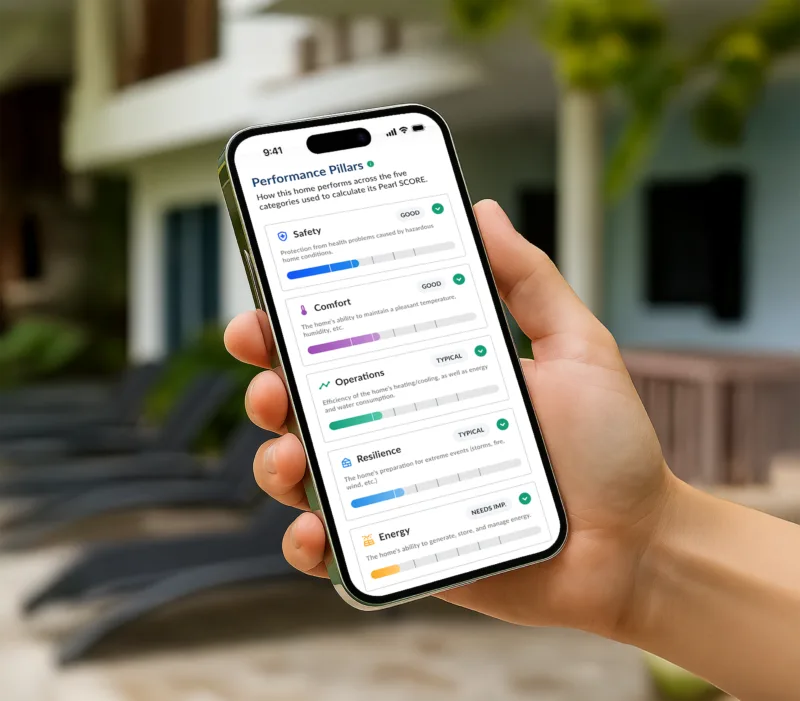
Pearl is one company working to fill this gap. Its Pearl SCORE™ is designed to give buyers a standardized view of a home’s energy consumption profile, one that controls for occupancy and behavior and allows direct comparison across properties.
“What Pearl and Pearl Score will provide to a prospective buyer is a normalized view of the energy consumption profile of that home,” Stanislaus says. “That is a much more valuable view for home buyers versus asking for the actual utility bills from the owner.”
The framework draws on data from 97 million U.S. homes, according to the company, and was developed using data from research co-sponsored with realtor.com. That co-sponsored research found that new construction homes cost $25,000 less to operate over 10 years than comparable existing homes, a difference Stanislaus says is driven primarily by the building code to which a home was originally constructed, not by occupant behavior. That finding is only visible when you look at normalized efficiency data rather than occupant-specific bills.
According to Stanislaus, energy codes have evolved meaningfully over the last 15 to 20 years, and the performance gap between homes built to modern code and those built to older standards shows up clearly in operating costs. For buyers, the practical takeaway is straightforward: the year a home was built and the code it was built to are stronger predictors of future energy costs than anything a seller’s utility bills will show.
If normalized home efficiency ratings were to become a standard part of real estate listings, the way miles-per-gallon ratings appear on vehicle window stickers, buyers could compare homes on operating cost the same way they compare cars on fuel economy. That standard does not yet exist, and Pearl is one of several efforts attempting to establish it. For now, buyers who want accurate efficiency comparisons must seek out that data themselves rather than relying on the seller’s bills sitting in their due diligence folder.
About Pearl: Founded in 2013, Pearl is a ratings and standards company building the national standard for home performance. Pearl SCORE™ rates every single-family home in the U.S. across five key pillars, Safety, Comfort, Operations, Resilience, and Energy, so home buyers, homeowners, and real estate professionals can understand how a home performs in daily life. As a Certified B Corporation, we’re accountable not only to our shareholders, but also to the homeowners and communities we serve. For more information, visit pearlscore.com.
This article is based on information provided by the expert source cited above. It is intended for general informational purposes only and does not constitute legal, financial, or real estate advice. Readers should conduct their own research and consult qualified professionals before making any real estate or financial decisions.