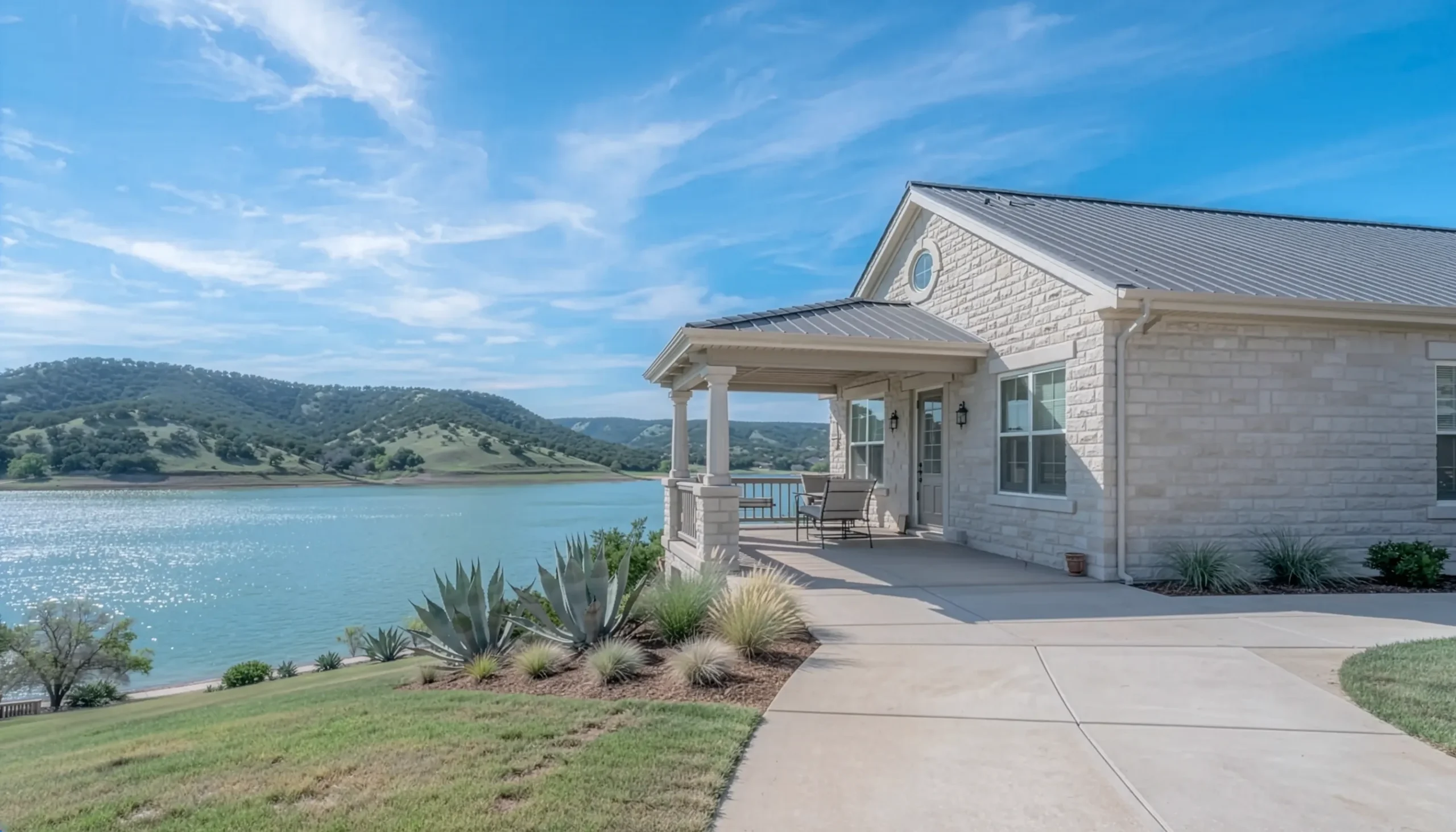
Most Austin-area real estate conversations focus on the city proper or its fast-growing northern suburbs. But about 45 minutes northwest, the communities lining the north shore of Lake Travis – Lago Vista, Jonestown, Point Venture – are working through a correction that has lasted far longer than what metro Austin has experienced. With 10 months of inventory and homes routinely selling for steep discounts from their original list prices, this small lake market shows how post-pandemic pricing distortions persist in areas that lack the commercial infrastructure and new-build pipelines of their suburban competitors.
Emily Dieckmann, who runs the largest real estate firm on the north side of Lake Travis with about 15 agents and over a hundred listings in the 78645 zip code, says the area has not seen a seller’s market since the pandemic spike. “We are hundreds of days on market,” she says. “It’s really tough.”
A Price Band That Won’t Move
One persistent pattern in the area predates the pandemic: homes priced between roughly $550,000 and $800,000 are difficult to sell. Properties under $500,000 tend to move, and homes above $1 million do too. But the middle band stalls.
Dieckmann attributes the gap to the area’s buyer profile. The north shore attracts retirees looking to downsize, young families drawn to the school system and tight-knit community, and wealthier second-home buyers – often from Houston or Austin – who want lake access and hill country scenery. What the area does not attract in large numbers are the move-up families, typically with children entering high school and more household income, who would naturally occupy that middle tier. “We just don’t have as many of those,” she says. The pattern held before COVID and has continued through the correction.
Competing Without Commerce
The north shore’s main competition is Leander and Liberty Hill, suburbs along the 183/35 corridor that offer similar commute times to Austin but come with big-box retail – Costco, Target, and the associated commercial density that attracts families prioritizing convenience. A lake town without that infrastructure faces a structural disadvantage in drawing volume buyers.
That disadvantage compounds the correction. Before COVID, the area typically saw about 4 percent annual equity growth in homes, according to Dieckmann. The pandemic spike pushed prices well above that trendline, and the market has been working its way back down since. “We’re still trying to find the bottom of our market here, which reacts so differently than Cedar Park, Austin, Leander, any of the other regions,” Dieckmann says.
The concessions reflect how far pricing has shifted. With 10 months of inventory, buyers are negotiating aggressively – not just on price but on inclusions. Dieckmann describes current offers that bundle hot tubs, golf carts, and furniture. She has watched homes listed at $2.4 million sell for less than $1.2 million. “Buyers are kind of writing their own ticket,” she says.
600 Lots, Limited Infrastructure
The north shore carries roughly 600 vacant lots on the market – a number rooted in the area’s unusual development history. In the 1950s, streets were laid out and parcels sectioned into third- or quarter-acre lots, but much of the underlying infrastructure – sewer and water – was never installed. Those lots were sold to military families, retirees, and overseas investors. Decades later, many of those back streets remain undeveloped because running utilities can cost hundreds of thousands of dollars.
Before the pandemic, a builder called Brohn Homes bought hundreds of lots, installed its own utility infrastructure, and built entry-level homes starting around $250,000 to $270,000. That wave of construction brought first-time buyers into the community and modernized parts of the area’s roads and utilities. But Brohn has since shifted to more lucrative markets like Cedar Park and Leander, and the smaller builders who followed have also moved on. “Now we’re in kind of a lull with new home builders,” Dieckmann says.
Today, lot buyers fall into two categories: those planning to eventually build with a custom builder, and those who purchase a lot simply for access to Lago Vista’s nine private waterfront parks – a benefit that comes with annual property owner association fees of $240. Before COVID, lots without utilities sold for as little as $3,000 to $5,000.
A Lake That Moves
Lake Travis is not a constant-level lake, and that introduces a pricing variable most out-of-area buyers do not anticipate. When the lake recedes, waterfront property values soften. When it rises, prices stabilize. The psychological effect matters as much as the physical one: buyers struggle to visualize what a low-water property will look like when the lake returns.
Dieckmann says the lake has been up for roughly nine months, long enough for buyer confidence to return somewhat. “It takes people about this amount of time to kind of forget how low it can go,” she says. “And then we start seeing buyers come back out and prices hold a little bit more steady.”
When the lake drops, though, the north shore’s shallower shoreline exposes more dry ground than the cliffside south shore around Lakeway and Rough Hollow. That visibility makes recessions harder to ignore for buyers looking at north shore properties – and gives the south shore’s waterfront listings an advantage in holding value during low-water periods.
Bracing for a Longer Correction
Dieckmann says she is preparing her team for three more years of soft conditions. She frames the broader challenge not as interest rates alone but as a mismatch between incomes and housing costs. “It’s not just a rate thing,” she says. “It’s the lack of our income keeping up with the times, and the cost of houses.”
Sellers, meanwhile, are only beginning to accept the new reality. Dieckmann says agents across the area have not been pricing homes correctly, which explains the volume of price reductions. But she acknowledges the difficulty: the market is a moving target, and no one has confidently identified the floor. She has had homes sell off-market or within a day or two when priced aggressively – but those results are unpredictable. “Buyers are not interested in buy-down rates. They’re not interested in carpet allowances,” she says. “If that first price doesn’t grab them with something interesting about the home, they’re going on to something else.”
Her advice to sellers is blunt: not every real estate purchase ends in a profit. “Not all real estate investments turn out to be super lucrative,” she says. “Maybe you can’t sell your home at the price that you purchased it. But that’s your cost of living, and you got to raise your family in that place.”
About the Expert: Emily Dieckmann leads a real estate firm of about 15 agents on the north shore of Lake Travis, covering Lago Vista, Jonestown, and Point Venture in the 78645 zip code, Texas.
This article is based on information provided by the expert source cited above. It is intended for general informational purposes only and does not constitute legal, financial, or real estate advice. Readers should conduct their own research and consult qualified professionals before making any real estate or financial decisions.