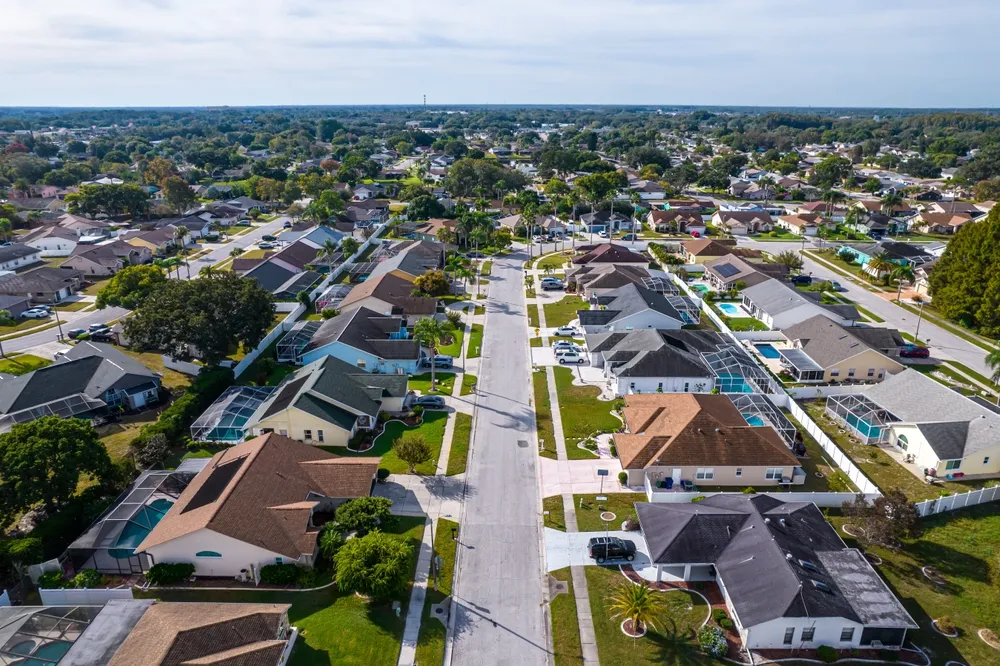
In the stretch of Central Florida running from Kissimmee through St. Cloud and Davenport, new construction is moving faster than existing homes, not because buyers prefer new finishes, but because the economics currently favor it. Builders are covering closing costs and offering better rates that resale sellers cannot match, according to Jose Santana, a Realtor with Norkis & Co. The tradeoff is location: buyers choosing new builds are pushing further from job centers, while those who want proximity to Orlando’s core pay a steeper price per square foot for older inventory that takes longer to sell.
Central Florida’s development pattern – low-density, horizontal sprawl rather than vertical density – means that growth pushes buyers further from employment hubs. Santana says commute times have roughly doubled since he began working the market. “When I came to Orlando back in 2013, driving was like 25 minutes to anywhere. Right now, driving is 40 to 45 minutes, on average.”
That shift has made price per square foot, rather than list price alone, the more useful metric for buyers evaluating where to land. The further a property sits from the Orlando International Airport – which Santana uses as a geographic reference point for the market’s pricing gradient – the lower the cost per square foot. Buyers face a straightforward decision: shorter commute and higher cost per square foot, or more space further out.
Resale Sellers Are Adjusting
The resale market is sluggish in part because seller expectations have not caught up with current conditions. Prices have come down from their recent peaks, but many sellers still anchor to what they believed their homes were worth a year or two ago. Santana describes it as a mindset problem. “We’re coming from the point that houses were selling more than we thought. And now little by little it’s getting down to restructuring again with the rate.”
In the $275,000 to $375,000 range, the segment where most first-time buyers compete, inventory is tighter, and sellers are less inclined to offer concessions. Homes in that bracket tend to be older, which makes inspection findings a more common negotiation point.
First-Time Buyers Dominate
Santana estimates that roughly 85% of his clients are first-time home buyers, many of them Spanish-speaking transplants who rented first to learn the area before purchasing. That buyer profile shapes how deals get structured: these are not cash-rich investors but households making careful calculations about what they can sustain monthly.
The prevailing caution among these buyers stems from a mismatch between income growth and cost-of-living increases. “Inflation, everything has gone up in price – food and gas and cars – and everyday life has gone up in price, and the economy hasn’t balanced that with most of the people,” Santana says. Many are also waiting for rates to drop, a strategy he advises against. He points out that the long-term average mortgage rate is around 7%, making today’s rates in the mid-sixes unremarkable by historical standards. “We’re not gonna see 3% again ever,” he says.
His argument against waiting: when rates decline, prices will rise by $30,000 to $40,000, eliminating the savings. “You marry the price, and you date the rate.” Buyers who lock in a purchase now secure a price they can hold, then refinance when rates fall.
Growth Corridors
Several submarkets are investing in infrastructure designed to pull population toward them rather than waiting for spillover from Orlando’s core. St. Cloud is adding new construction and retail, including a new Walmart. Lake Nona is getting a Target. Davenport is expanding rapidly. Clermont is planning a sports complex, and Kissimmee has a project called New City. Santana describes these as deliberate efforts by communities to create self-sustaining demand in areas previously considered too far out.
Meanwhile, established neighborhoods closer in – Lake Nona, Winter Garden, Winter Park – continue to attract steady buyer interest regardless of broader market speed. For buyers priced out of those areas, the emerging corridors offer more square footage at a lower cost, with the bet that infrastructure investment will close the convenience gap over time.
A Tax Incentive
Looking ahead, Santana expects a new wave of buyers drawn by a homestead-related tax reduction for first-time home buyers in Florida. “A lot of people are more looking to buy in Florida because you can have a better tax bracket in your home taxes,” he says. Combined with Florida’s lack of a state income tax, the property tax advantage could pull additional relocators from higher-tax states, a dynamic Santana sees as a near-term catalyst for the Central Florida market.
For first-time buyers weighing whether to wait for lower rates or act now, the convergence of builder incentives, potential tax relief, and current pricing before the next demand wave arrives creates a window that may not stay open once rates do decline and prices adjust upward in response.
About the Expert: Jose Santana is a Realtor with Norkis & Co. Realty, serving the Central Florida corridor from Kissimmee through St. Cloud and Davenport with a primary focus on first-time home buyers.
This article is based on information provided by the expert source cited above. It is intended for general informational purposes only and does not constitute legal, financial, or real estate advice. Readers should conduct their own research and consult qualified professionals before making any real estate or financial decisions.