Few housing markets in Texas rode the pandemic-era boom as hard as the small cities strung along the Interstate 35 corridor between Austin and San Antonio. The years since have been a slow unwinding – prices adjusting, timelines stretching, and expectations on both sides of the transaction getting a hard reset.
The stretch of Interstate 35 running between Austin and San Antonio has spent the past few years working through the aftermath of one of the more dramatic real estate run-ups in Texas. New Braunfels, sitting squarely in the middle of that corridor, is now navigating what brokers on the ground are calling a correction rather than a collapse – a meaningful distinction for buyers, sellers, and investors trying to make sense of where things stand heading into the second half of 2026.
A Correction, Not a Crash
The numbers tell a clear story. Inventory in New Braunfels currently sits at roughly 6.6 months of supply, and homes are taking between 120 and 140 days to sell on average. Neither figure would have seemed plausible during the 2022 peak, when properties moved quickly, and buyers routinely paid above asking price.
Yitzchak Pierson, a broker associate with eXp Realty working the I-35 corridor from Kyle and Buda in the north down to Schertz and Converse in the south, has been having frank conversations with sellers about what that means in practice. One recent example captures the situation well: a client who purchased a home priced at $475,000 in 2022 – after negotiating it down and believing they had secured a deal – is now looking at a realistic sale price in the high $300,000s.
The builder had originally listed the home at $445,000, then raised it to $459,000, and finally to $475,000. The buyer thought they were getting a discount, but the builder had already inflated the price. “Those people thought they were getting a deal,” Pierson says. The correction now underway is, in part, the market recalibrating from those inflated baselines.
On the positive side, property tax assessments have begun to decline, offering some relief to homeowners who have stayed put. For sellers not under pressure to move, the current environment is manageable. For those who bought at or near the peak and need to sell, the math is harder.
Where Inventory Is Piling Up
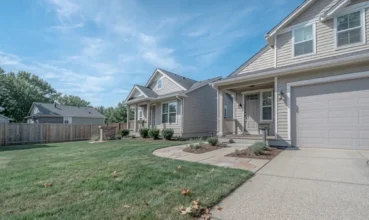
The heaviest inventory burden falls in the $200,000 to $400,000 price band, concentrated largely in production-builder communities – neighborhoods where homes share similar floor plans, finishes, and lot sizes, offering little to differentiate one listing from the next.
“If it’s not a deal or a diamond, it’s not moving,” Pierson notes. In cookie-cutter subdivisions where builders are still actively selling new homes, resale properties face a particularly difficult competitive position. A buyer comparing a two-year-old resale home with a brand-new build by the same builder at a similar price point has an obvious reason to choose the latter.
Established neighborhoods with mature trees, walkable access to downtown, and proximity to dining and retail are a different story. Pierson recently described being in a multiple-offer situation on a home in one of those more desirable pockets – a reminder that demand hasn’t disappeared but has simply become more selective.
At the upper end, the $700,000-and-above segment – including communities like Vintage Oaks and Copper Ridge – is also sitting on the market longer. Buyers at that price point have enough options to take their time, and they are.
Builder Incentives Filling the Gap
While the resale market is constrained by seller psychology, new construction is moving more flexibly. Builders carry holding costs – Pierson estimates around $2,000 per month per unsold home, depending on size, which creates a practical incentive to deal that resale sellers often lack.
The range of incentives currently on offer reflects that pressure. Interest rate buydowns, closing cost contributions, appliance packages, and flex cash are common. More notably, some builders have loosened requirements for using their in-house lenders, which had previously been a condition for accessing many of those perks.
Pierson recently negotiated a home listed at $325,000 down to $309,000, with $10,000 in closing costs and all appliances included, using an outside lender. One community was offering free golf carts for purchases closed within a promotional window. Another was bundling Costco memberships alongside purchase incentives.
The International Investor Angle
Beyond local buyers adjusting to the new pricing reality, New Braunfels has attracted a quiet but steady stream of international investors. Many found the market through Pierson’s YouTube channel, which focused on local lifestyle content. Their interest is grounded in a straightforward thesis: the corridor between two major metros, supported by job growth, remote-work migration, and a steady influx of new residents, offers durable rental demand.
The strategy typically involves purchasing new construction with cash, conducting a third-party inspection to document any builder deficiencies before closing, returning the report to the builder for remediation, and then transitioning the property to a property manager. The timeline from purchase to placed tenant generally runs 30 to 90 days.
Pierson explains that his investors prefer new construction because they avoid major repair costs for the first seven to ten years. Structural warranties and first-year bumper-to-bumper coverage from builders reduce the maintenance risk that can erode returns on older stock.
Rental rates have come down from their 2022 and 2023 highs, modestly compressing yields, but investor confidence in the corridor’s long-term fundamentals hasn’t wavered. The arrival of major retailers, continued corporate relocations into the Austin-San Antonio region, and the area’s lifestyle appeal – two rivers, a strong festival calendar, and a small-town character – continue to support the investment case.
Appraisal Risk on the Horizon
As values continue to adjust, appraisal gaps are becoming an increasing concern. Pierson is now steering buyers away from strategies that inflate purchase prices to accommodate seller concessions, preferring instead to keep contract prices lean and reduce the risk of an appraisal coming in short.
“We want to keep the purchase price as low as possible because we want to make sure we don’t have any appraisal gaps,” he says. For sellers, the same logic applies in reverse: a higher accepted offer means little if the property doesn’t appraise for that amount.
Buyers Settling Into the New Normal
After a period of hesitation through much of 2025, buyer activity is picking up. The adjustment appears less about changes in market conditions and more about a psychological shift – buyers accepting that current interest rates are not a temporary anomaly to be waited out.
Pierson’s approach with buyers reflects that reality. Rather than working from a target purchase price, he starts with a comfortable monthly payment, works backward through lending options, and tailors the conversation to the buyer’s actual timeline. A household planning to move within three to five years gets a different discussion than one putting down roots for a decade or more.
For sellers who come in with pricing expectations anchored to 2022, the conversation is harder. Pierson describes walking away from listing opportunities where sellers aren’t willing to engage with current market data. “I’m not going to fight to get business if somebody doesn’t have realistic expectations,” he says – a position that reflects both professional discipline and a clear-eyed read on where the market actually is.
New Braunfels is not a distressed market. It is a market recalibrating after an unusual run, with enough underlying demand – from local buyers, remote workers, and international investors alike – to suggest the correction has more floor than ceiling. The question for the next several months is how quickly sellers and appraisals catch up to that reality.
About the Expert: Yitzchak Pierson is a broker associate with eXp Realty working the I-35 corridor in Central Texas, covering markets from Kyle and Buda in the north to Schertz and Converse in the south, with a focus on the New Braunfels area.
This article is based on information provided by the expert source cited above. It is intended for general informational purposes only and does not constitute legal, financial, or real estate advice. Readers should conduct their own research and consult qualified professionals before making any real estate or financial decisions.