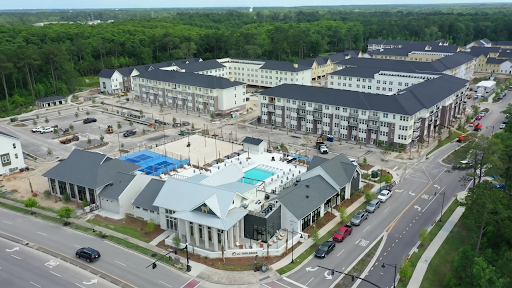
The appeal of building multifamily housing in fast-growing Sun Belt metros is obvious: job creation, population growth, and strong absorption fundamentals draw capital in waves. What gets less attention is the compounding operational stress that hits once dozens of developers enter the same market simultaneously and then, driven by lending cycles, start their projects within weeks of each other.
That compression dynamic is reshaping construction economics in markets like Charleston, South Carolina, Austin, Texas, and Nashville, Tennessee, according to Michael Mueller, Executive Vice President of Construction at Lifestyle Communities, a vertically integrated real estate company that develops and operates large-scale, mixed-use communities, bringing together residential, hospitality, and other multi-sector components, including its internally owned and operated brands, The Goat and Morning Ritual.
The Bottleneck Nobody Plans For
The core problem is that interest rate movements and lender willingness create a herd effect. Projects across a region get paused or delayed while developers wait for favorable terms. When conditions shift, those projects don’t start in sequence; they start together.
“What you’ll see is these projects all be paused or slowed until the interest rates get to where everybody wants to borrow and lenders are willing to lend,” Mueller says. “And so what it creates is a natural bottleneck of development and project starts.”
Subcontractors who planned their capacity around staggered timelines suddenly face simultaneous demands from multiple general contractors. A trade partner that could comfortably staff five projects spread across 18 months cannot staff the same five projects launching in a three-month window. Schedules slip, quality suffers, and costs compound, particularly for dynamic developments like LC’s, which take approximately 30 months to complete and require construction teams to phase resident occupancy alongside hospitality openings before total project completion.
Mueller notes that individual developers often fail to account for the fact that their competitors were waiting on the same lending signals. “Every developer wants things done cheaper and faster without sacrificing quality. Those things seldom co-exist.”
A Trade Base That Wasn’t Built for This
The labor supply problem predates the current cycle. Mueller traces the decline to the 2008–2009 downturn, which pushed workers out of the trades permanently, followed by insufficient new entrants over the past two decades. The result is a workforce that has deteriorated in both quantity and quality.
In growth markets like Charleston, the problem is also structural: the metro does not have a local trade base large enough to support the construction volume it attracts. Most subcontractors commute from larger cities, Atlanta, Tampa, Charlotte, Nashville, which introduces inconsistency and schedule risk that a local workforce would not.
“Where 30 years ago in the industry the trade reliability, the trade performance was much higher, you were able to operate with some leaner construction teams,” Mueller says. “Nowadays you have to have very well-versed, experienced, and diligent field teams in order to manage this trade base that has deteriorated as a whole.”
Immigration policy and enforcement add another variable. Depending on the political moment, labor supply can contract further in an industry already running short.
Municipalities Learning on the Job
Growth metros face a third compounding challenge: the regulatory bodies governing construction are themselves unprepared for the volume. Mueller describes authorities having jurisdiction – municipalities, utilities, code enforcement – creating rules and changing enforcement standards during active construction.
LC has experienced local code changes mid-project in Charleston, requiring real-time adaptation on developments already underway. During a 30-month build on 25 to 35 acres, a regulatory shift midstream directly impacts cost and schedule – the two variables developers protect most carefully. For LC, its mixed-use communities and the multisector components within them create additional complexity for municipalities to adapt to the scale and variety of uses within a single development.
Standardization as a Structural Response
LC’s countermeasure is product standardization. The company is templating its suburban communities around approximately 5 distinct building types, creating repeatability across markets while maintaining their unique take on connected communities that differentiate their developments. A standardized product allows faster iteration on design quality, a shorter lessons-learned cycle between projects, and the ability to enter national agreements with large-scale subcontractors.
Those national agreements address the labor problem directly. By offering volume across multiple markets, LC can partner with stronger trade partners at costs that would be uneconomical on a single-project basis. “If we can get with them on a nationwide or region-wide agreement, we’re able to get that cost efficiency with the quality, which in turn lends itself to very productive schedules,” Mueller says.
The approach also targets what Mueller identifies as a steep decline in design quality from architects and engineers, another industry-wide pressure that introduces cost uncertainty and coordination failures during construction. A standardized product means design gaps identified on one project can be corrected before the next one starts, rather than waiting a full project cycle to complete.
AI as a Data Tool, Not a Replacement
On artificial intelligence, Mueller draws a clear line: the technology is complementary, not substitutional. While LC has embraced AI integration across its family of companies to enhance the resident and customer experience, the Construction arm is applying the technology in targeted ways to improve quality, efficiency, and decision-making.
LC’s Construction team uses AI in three primary areas: quality control through real-time image capture and historical documentation, schedule analysis across thousands of activity lines, and as a search and data recall tool across the large volumes of data their construction portfolio generates. Their next endeavor in the AI space is drawing and plan analysis intended to combat the declining design quality and further strengthen their standardized suburban product line.
Mueller pushes back on the assumption that AI can reduce headcount in construction. The sophistication of coordinating building systems, the engineering, physics, and sequencing behind finished walls, requires human judgment that technology cannot replicate. “What AI can do is make construction individuals better. But it will never, in my opinion, replace the need for the human component of it.”
For developers entering growth markets, the lesson Mueller outlines is operational: the same lending signals that make a market attractive also guarantee that dozens of competitors will arrive at the same time, competing for the same limited labor, navigating the same unprepared regulatory bodies, and absorbing the same cost and schedule risk. The developers who survive that compression are the ones who build repeatability into their product and their partnerships before the bottleneck hits.
About the Expert: Michael Mueller is Executive Vice President of Construction at Lifestyle Communities, a vertically-integrated multifamily developer, building large-scale mixed-use communities across multiple states, including in the Charleston, Austin, and Nashville markets.
This article is based on information provided by the expert source cited above. It is intended for general informational purposes only and does not constitute legal, financial, or real estate advice. Readers should conduct their own research and consult qualified professionals before making any real estate or financial decisions.