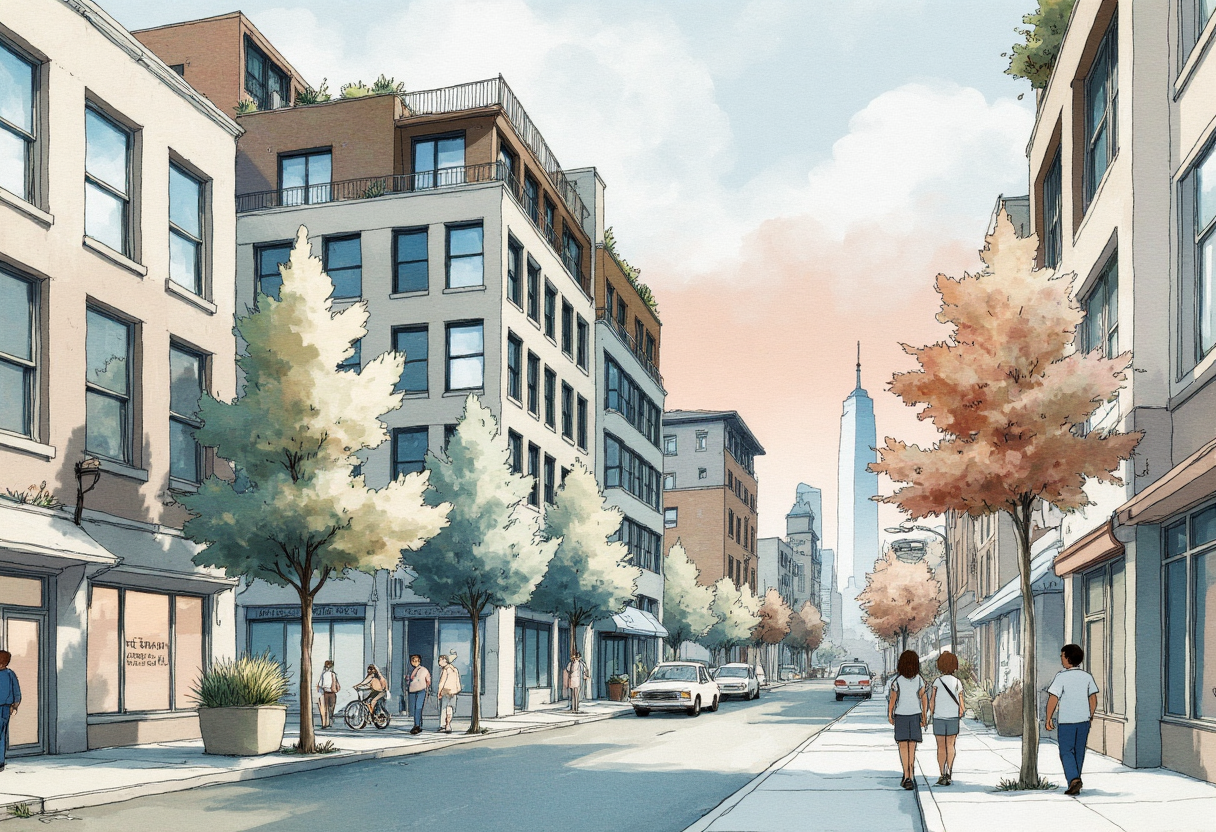
The ripple effects of New York City’s housing costs are changing development patterns across the tri-state area, with Jersey City’s McGinley Square emerging as an unexpected beneficiary of the region’s affordability crisis. As Manhattan and waterfront Jersey City properties reach new price thresholds, developers and investors are witnessing significant growth in previously overlooked neighborhoods.
Dave Denis, Principal and Chief Executive Officer of Speak to Dave, a property management and development company operating across Brooklyn and Jersey City, has observed this transformation firsthand from his development project in McGinley Square. “My neighborhood where I’m developing has blown up since January,” Denis notes. “A lot of new developments, new buildings have opened up, new developments are finishing up, and things are changing. I’ve seen the rents go up, more people in the neighborhood, and a lot of opportunity for commercial spaces and stores and retail.”
The Geographic Spillover Effect
The growth Denis describes reflects a broader pattern of urban expansion driven by economic necessity. “It’s the common shift in all cities,” he explains. “New York City has gotten pretty pricey, and people have hit the threshold of how much they can stay in New York and afford the rent.”
This displacement follows a predictable geographic pattern. The waterfront areas of Jersey City, once considered affordable alternatives to Manhattan, have themselves become expensive, pushing residents further out into neighborhoods like McGinley Square.
“The waterfront of Jersey City got so expensive that people started moving further out,” Denis observes. “Now those neighborhoods are filled and gentrified, and it’s starting to spill over into other parts. That’s kind of how cities start, right?”
The phenomenon extends beyond Jersey City. Denis points to similar patterns on Long Island, where communities are experiencing development pressure from Manhattan-based workers seeking more affordable housing options while maintaining reasonable commutes.
Demographic Shifts and Market Demand
The new residents moving into these emerging markets represent a specific demographic profile that developers are learning to accommodate. “I’m seeing professionals, married couples, couples with children, couples from Pennsylvania, Philadelphia, from different states that need to work in New York but want to have one foot in New York and one foot in Pennsylvania where their families are,” Denis explains.
This demographic seeks the best of both worlds: proximity to New York employment opportunities while maintaining connections to more affordable regions and family networks. Jersey City provides an ideal compromise location for these households.
The trend mirrors development patterns in other outer boroughs, particularly the Rockaways in Queens, where Denis notes significant high-rise and condominium development.
Amenity Evolution in Response to Market Demands
To attract and retain these new residents, developers are incorporating amenities that reflect changing lifestyle preferences and work patterns. Denis’s McGinley Square project exemplifies this approach with features designed for modern urban living.
“I’m offering amenities such as a dishwasher in every apartment, a washer dryer in every apartment, eco-friendly compactor room on every floor where glass, plastic, metal gets separated,” he details. The building also includes composting facilities, reflecting municipal initiatives toward environmental sustainability.
Recognizing the prevalence of remote work, the development includes dedicated workspace areas. “A rec room for people to rent, to use work spaces so they don’t have to stay in their apartment all day,” Denis explains.
Green space represents another key amenity category. Denis’ building features “three levels of green space” including rooftop access, fourth-floor outdoor areas, and additional space in the building’s rear courtyard, along with a 1,500-square-foot gym.
The building’s all-electric design eliminates gas connections, incorporating energy-efficient convection stoves and separate metering for utilities. Pre-wired internet infrastructure supports multiple providers with Ethernet connections in all rooms.
Technology Integration and Operational Efficiency
Modern developments are incorporating increasingly sophisticated technology solutions. Denis describes buildings with app-controlled amenity systems featuring “glass cabinets with items where you can rent out a Dyson, or a printer, or a Roomba” through mobile applications. These systems extend to vending capabilities for snacks and beverages.
Storage optimization represents another focus area, with Denis converting “any dead space” into storage units to maximize building utility and revenue potential.
Market Resilience and Tenant Selection
Despite broader economic pressures affecting some markets, Denis reports relatively stable performance in his residential portfolio, attributing this to selective tenant screening. “I hand choose my tenants. I want to feel good about the people I bring in,” he explains. “My business is primarily referral, or tenants that have lived in my buildings for a while.”
This approach has helped maintain low arrears rates in residential properties, though Denis notes more payment challenges in commercial spaces, particularly restaurants. “I’m seeing it more in commercial. I’m seeing it less with tenants,” he observes.
The company employs rent reporting to credit bureaus as both an incentive for timely payment and a tenant service, working with specialized rent reporting companies to help tenants build credit history through their housing payments.
Refinancing Challenges and Strategic Responses
The current interest rate environment has created significant challenges for property owners who secured low-rate financing in recent years. Denis provides a case study from a Williamsburg property managed by his company, where a building purchased in the mid-1990s recently underwent refinancing.
“We refinanced in April of 2020 at 3%, and now we’re refinancing at six and a half percent,” he explains. However, strategic rent roll improvements helped offset the increased carrying costs.
“Over a year ago, I was able to increase the rent roll tremendously. I even added a company to take over the basement to put in storage, which brings in $2,900 a month,” Denis details. These improvements increased the annual rent roll by approximately $150,000, helping counteract higher mortgage payments.
The strategy required disciplined leverage management. “He doesn’t over leverage himself. He doesn’t take out 75%. He takes out what he wants, and usually the banks are impressed because he can survive very well on not having to take out all the funds.”
For properties without similar improvement potential, Denis made the difficult decision to sell rather than face ongoing negative cash flow. “By the end of 2023, I was like, at this rate, there’s no way we’re going to be able to keep these buildings running on 6% mortgages, and we were forced to sell. Otherwise, we’d have to hold these properties for five years where every month we may have to take money out of our pocket.”
Looking Forward
The development patterns Denis observes in McGinley Square and similar markets reflect fundamental shifts in how the tri-state region accommodates growth and affordability pressures. As traditional urban centers reach price ceilings, previously overlooked neighborhoods are experiencing rapid transformation.
For developers and investors, these markets present opportunities to serve demographic groups seeking urban amenities at more accessible price points. Success requires understanding the specific needs of these residents, from workspace flexibility to environmental consciousness to technology integration.
The challenge lies in managing growth sustainably while maintaining the community character that initially attracted residents. As Denis notes, “As long as people keep building and developing and making nice homes, it seems like there’s always going to be a market for apartments. Everybody’s always in need of housing.”