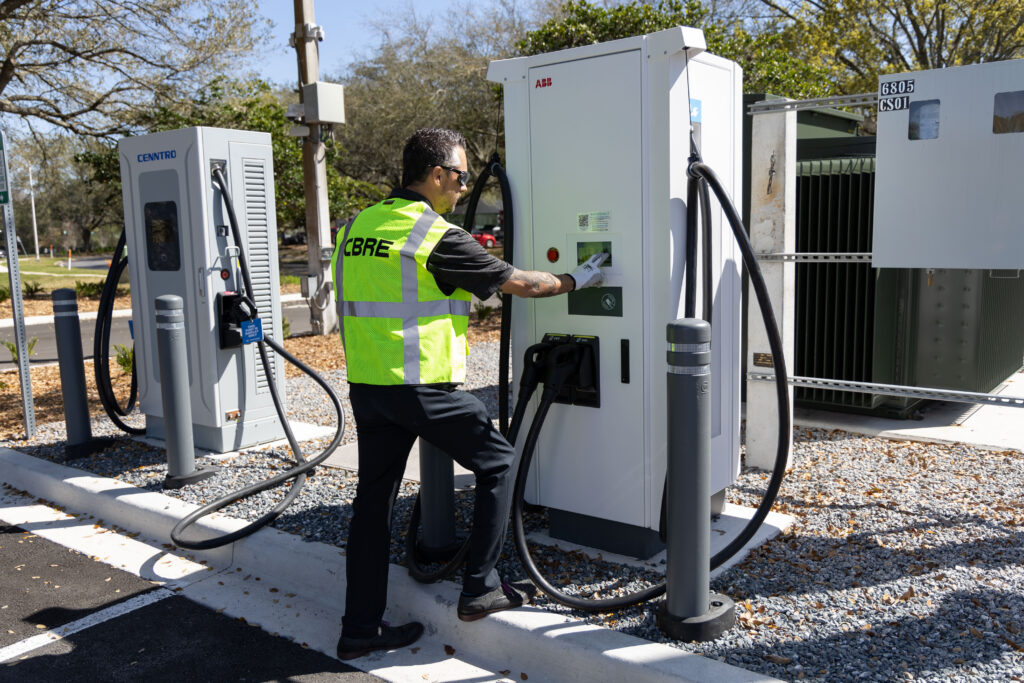
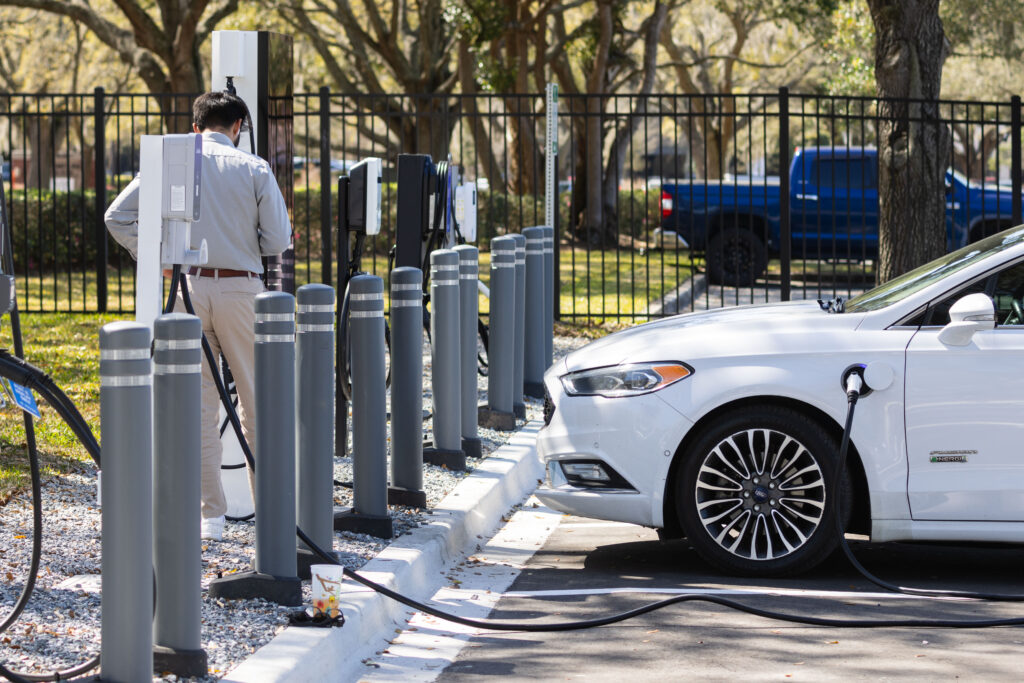
The world’s largest commercial real estate services firm isn’t just dipping its toes into the EV charging market – it’s leveraging its massive scale to fundamentally reshape how property owners approach the electrification challenge. CBRE has quietly built what may be the real estate industry’s most comprehensive EV infrastructure solution, turning the traditionally fragmented process of charging deployment into a streamlined operation that spans from site selection to ongoing maintenance.
“We’re able to score them. We’ve built our own internal scoring mapping system – it’s a GIS-based platform and our team has developed algorithms to help prioritize portfolios,” explains Jim Hurless, CBRE’s Global Real Estate Leader for Electric Vehicle Infrastructure. “I may have 500 locations, but these 50 are really great locations. The next 300 may be okay locations. And then the remainder may just not be ready for electrification yet.”
What makes CBRE’s approach particularly noteworthy is how it has weaponized its scale. With over 20,000 project managers overseeing $60 billion in capital spend globally, the firm can deliver cost efficiencies that smaller players simply can’t match. But it’s the maintenance piece that could prove most crucial – CBRE has turned its 23,000-strong network of facilities technicians into an EV infrastructure support team, providing the kind of reliable ongoing maintenance that has often been the Achilles’ heel of charging deployments.
The strategy is particularly timely given the challenging dynamics of today’s EV charging market. “When we start to look at REITs, developers and landlords that we have relationships with, they look at the fragmented market of EV charging and recognize there’s over 200 charge point operators and hardware providers within the United States, and they’re trying to figure out, how do we navigate who do we go to for equipment?” Hurless notes.
Perhaps most intriguing is CBRE’s behind-the-scenes work with utilities and municipalities. The firm has assembled a 170-person energy specialist team that maintains direct utility relationships – crucial for projects like 10-megawatt fleet charging depots. “We don’t have to call the 800 number,” Hurless points out. “We just pick up the phone and call our direct customer service rep.”
The company is also taking an unprecedented role in shaping local policy around EV infrastructure. “We go to specific cities in California and educate them on why an electrical depot is not the same as a traditional truck parking or truck depot or gas station,” Hurless explains. This includes addressing novel challenges like increased road wear from heavier electric vehicles – the kind of detailed planning that could make or break large-scale deployments.
Level 2 charging installations are currently seeing the highest deployment rates, with multifamily properties emerging as a key growth sector despite being historically underserved. This focus on multifamily could prove particularly significant given the sector’s crucial role in expanding EV adoption beyond single-family homeowners.
Looking ahead, CBRE sees private sector investment in EV infrastructure accelerating regardless of federal incentives. “I continue to see that EV adoption will continue to grow,” Hurless notes, drawing an interesting parallel to another transformative period in transportation: “I look at this very similarly as back when the automobile was first invented and the horse and carriage industry… they needed to build the gas stations. And as gas stations came, more and more adoption came, and we’re on a very similar path.”
This comprehensive strategy reflects how far CBRE has evolved beyond traditional real estate services. By leveraging its global platform and deep industry relationships, the firm isn’t just participating in the EV infrastructure boom – it’s actively shaping how commercial real estate approaches the electric future.
This article was sourced from a live expert interview.
Every month we conduct hundreds of interviews with active market practitioners - thousands to date.
Twice in two years, Austin’s residential real estate market has built momentum toward recovery – and twice, external economic disruptions have stalled it. The pattern points to a market not in decline but in a holding pattern shaped more by geopolitical uncertainty than by local fundamentals, according to Brooke Roeder, Principal of the Roeder Group ...
In most real estate transactions, the sequence of financial commitments works against the buyer. Non-refundable due diligence fees, earnest money deposits, inspection costs, and appraisal fees are all paid before the buyer has a clear picture of a property’s actual condition. When problems surface – foundation damage, structural issues, faulty wiring – buyers who walk ...
For much of the past several years, sellers in St. Paul, Minnesota, had the upper hand. Low inventory, intense buyer competition, and rapid price appreciation made it easy to list a home and attract multiple offers. That dynamic is changing. Listings in St. Paul are up roughly 12 percent over last year, according to Shawn ...
The combination of snow load, seismic, wildfire, and energy requirements means every new home is a luxury product by default – and the market is adjusting accordingly New construction in most mountain resort towns is expensive. In Truckee and North Lake Tahoe, California, the cost of code compliance alone prices out all but the luxury ...
Most cash offers in Marin County don’t come from tech workers carrying suitcases of stock-sale proceeds. They come from parents funding a child’s purchase, or from buyers drawing on personal IRA accounts and securing conventional lending afterward. The distinction matters because the popular narrative – that the Bay Area’s cash-heavy markets are simply a function ...
The Philadelphia region never saw the extreme price run-ups other markets did, so it never took the sharpest drops either, and it remains one of the more affordable markets in the country. That steadiness hasn’t kept every seller’s expectations in line with the current market. Anne Rubin, a partner at Century 21 Advantage Gold who ...