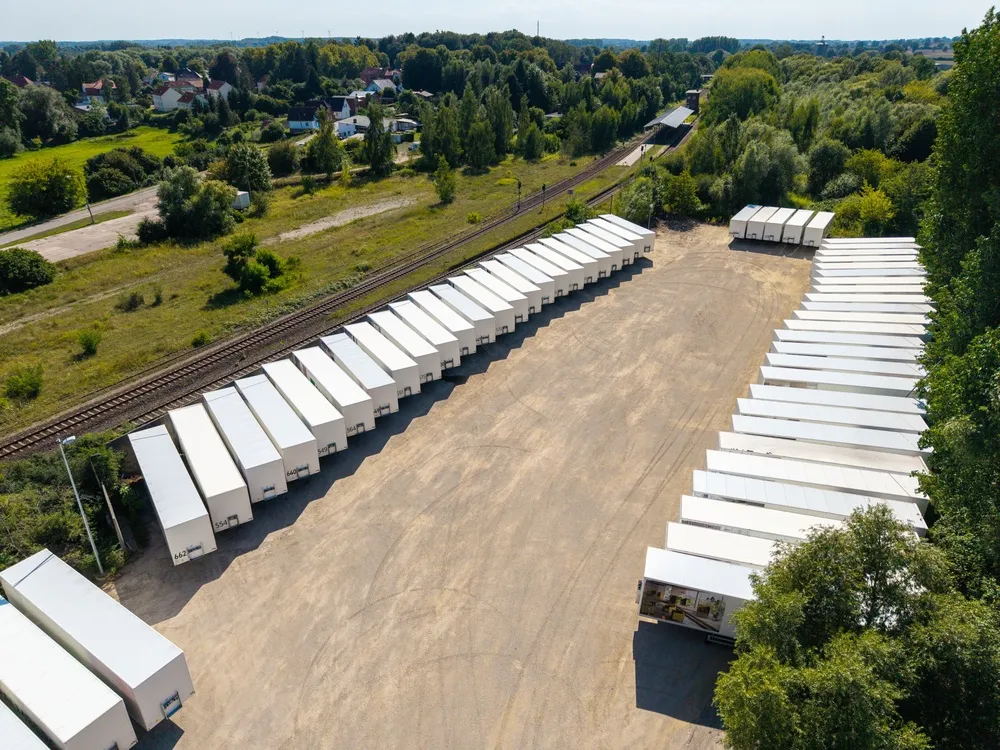
Industrial outdoor storage has spent the past few years pulling in more institutional capital than almost any other niche in commercial real estate. The sector is now estimated at roughly $218 billion, up from about $200 billion in 2025, nearly 9% growth in a single year, with transaction volume reaching $14–16 billion in 2025, up 15–20% over 2024, and early 2026 activity tracking ahead of last year’s pace. Regional lenders that once dominated the category have been joined by a wider field of specialist debt platforms, one has layered in roughly $600 million in financings since inception, another has surpassed $2 billion in borrowings across nearly 500 properties in 39 states, while private real estate credit managers have moved in behind them, with one market estimate putting private credit at 50–60% of all IOS lending activity today.
Multi-hundred-million-dollar portfolio financings have become almost routine: one refinancing closed this month at $672 million, part of what one report called a broader institutional pivot toward the asset class as traditional industrial rent growth moderates elsewhere, and another lender arranged $226 million for a 46-property, 212-acre IOS portfolio spanning 22 markets earlier this year.
That backdrop makes the financing story more complicated than a simple capital shortage. The real dynamic is a two-speed lending market: capital is arriving in record volume at the top of the stack, even as certain lenders, particularly regional banks working within fixed, relationship-based allocations, reach the limits of what they can put toward the category. Regional banks still finance roughly 90% of IOS transactions, filling a gap left by national lenders who historically lacked standardized products for the asset class, which means a disproportionate share of deal flow still runs through lenders with the smallest, most finite books.
Operators working in Texas, one of the country’s most active IOS markets, are feeling that split directly. The challenge isn’t sourcing deals or finding tenants; it’s finding a lender that still has room on its balance sheet for this specific asset class, even when a deal itself is well underwritten.
The Thesis Behind IOS
The core investment logic rests on a straightforward observation: industrial properties with excess outdoor yard space often have rents pegged entirely to the building, leaving the land component unpriced.
Savva Zakharov, Acquisitions Analyst at Outour, a Miami-based investment and management firm focused on IOS, is one investor operating on that thesis. “We believe that the land component of the industrial sector is undervalued,” Zakharov says. “We disaggregate the rent and look at it as a building and an excess yard sort of component.”
That disaggregation creates upside when a property’s existing tenant isn’t using the yard effectively – or isn’t paying for it. A common version of this play: a site where the current tenant’s business has little use for outdoor space gets repositioned toward a tenant type – trucking, heavy materials, equipment rental – whose operations depend on the yard and will pay a rate that reflects it, typically under a longer lease term.
Where the Financing Squeeze Is Real – and Where It Isn’t
The conventional narrative around IOS emphasizes supply constraints. Zakharov offers a different read, at least from where he sits: the bottleneck isn’t supply, it’s capital.
“It’s becoming much more difficult to have favorable financing terms because everyone is rushing in to buy these assets,” he says. “The lenders are filling up their bucket, and they can’t allocate an infinite amount of capital to IOS. They have their mandate and their hands are tied.”
That’s a real constraint for lenders with fixed, mandate-bound allocations – but it isn’t the whole capital picture. Other voices in the space describe the opposite problem: too much capital chasing too few sites. Nathan Kane, head of research at Realterm, has argued that scarcity in the category is better explained by zoning than by capital constraints, and the volume of fresh institutional debt moving into the sector this year supports that read at the top of the market. The tension both views point to is the same one playing out across IOS lending generally: allocation-limited regional and relationship lenders on one side, and an expanding bench of institutional and private-credit lenders on the other, each moving at a different speed.
For smaller-check operators, that unevenness creates the timing pressure Zakharov describes: a deal that would have closed smoothly with a regional bank two years ago now depends on whether that specific lender still has room in its IOS book, even as capital broadly becomes more available elsewhere in the stack.
New Supply Is Bifurcating the Market
In Texas, new industrial construction is introducing vacancy risk on paper, and independent market data backs up a bifurcation rather than broad oversupply. Texas industrial entered 2026 in its longest absorption cycle in state history; that cycle is decelerating but not breaking, and the deals closing are increasingly split, tight trophy infill space under 100,000 square feet versus the loosest bulk-distribution conditions in five years. In Austin specifically, more than 43 million square feet of new industrial space has come online since 2020, about 40% of total inventory, with vacancy expected to peak in the third or fourth quarter of 2026 before absorption strengthens.
Zakharov sees the same pattern from the ground: “These newer buildings, some tenants just cannot afford them,” he says. “So it’s sort of bifurcating the market.” For IOS specifically, older, land-heavy sites with functional but unglamorous buildings remain attractive to tenants priced out of new Class A construction, a gap that keeps demand flowing toward the properties IOS investors target, even as lenders look at aggregate new-supply figures for a submarket and grow more cautious about vacancy projections.
What Kills Deals
Site condition – specifically environmental issues and zoning constraints – is what most often derails an IOS acquisition, according to Zakharov, though the industry treats these findings less as automatic disqualifiers than as leverage for price reductions. “If the basis is low enough, then we’ll never say no to a deal,” he says.
Inspection quality is a separate, recurring frustration in the category: third-party inspectors sometimes walk a property without entering the warehouse or examining fence conditions, leaving gaps that only a second, more thorough inspection can fill, a diligence risk that shows up across IOS underwriting generally, not just in any single firm’s deal pipeline.
Where IOS Fits in the Broader Industrial Landscape
One common assumption – that data centers compete with IOS for the same parcels – doesn’t hold up well in practice. Many IOS tenants service data centers, making the data center buildout a demand driver rather than a competitor; logistics terminals, by contrast, compete directly for similar land.
A more persistent misconception is that IOS is just a car park. In reality, the category spans trucking yards, heavy equipment staging, materials storage for construction firms, and fleet parking for rental companies, each with different lease structures, space requirements, and rent tolerances. That variety is part of why operators can reposition a site toward a higher-paying use without building anything new, simply by matching the yard to a tenant whose operations demand it.
What This Means for Investors Going Forward
Population growth along corridors like Austin, ongoing industrial demand drivers such as large manufacturing investment in Texas, and the trajectory of long-term interest rates are the variables IOS investors are watching most closely heading into the rest of 2026. Rising long-term rates raise the cost of capital across the board; allocation limits at specific lenders constrain where that capital can go, even as the category overall keeps attracting record volumes of institutional and private-credit financing.
The net effect is a market that looks contradictory from the outside, abundant capital and a financing squeeze at the same time, but isn’t, once the lending landscape is broken into its parts. For investors evaluating IOS, the more useful question isn’t whether capital is available, but which lenders in a given deal’s size range still have room to deploy it.
About the Expert: Savva Zakharov is an Acquisitions Analyst at Outour, a Miami-based investment and management firm focused on industrial outdoor storage.
This article is based on information provided by the expert source cited above. It is intended for general informational purposes only and does not constitute legal, financial, or real estate advice. Readers should conduct their own research and consult qualified professionals before making any real estate or financial decisions.