San Antonio has long attracted relocating buyers, military families on PCS orders, civilian contractors, and professionals priced out of Austin, because of its relative affordability. But the math that once made the market accessible is now working against both sides of the transaction simultaneously.
Sellers who locked in mortgage rates below 3.5% recognize that even a profitable sale puts them back into a borrowing environment at 6.75%. Buyers face the compounding pressure of elevated home prices, high ownership costs and mortgage rates that fell to approximately 5.99% in late February before reversing sharply and returning to roughly 6.75% by early August, according to Brayson Verzella, Founder and Team Leader of Team Infinity Real Estate Group, who has worked the San Antonio and Austin markets since 2005. While closed transactions have shown unexpected resilience—with total sales jumping 15% year-over-year in June—forward-looking activity is signaling clear hesitation, as pending listings dipped 10% over the same period. This cooling pipeline momentum is occurring not because fundamentals collapsed, but because the cost of moving in either direction has become increasingly difficult to justify.
“Even if you’re doing well in life, you have to think to yourself, okay, if I sell this house and I do well, I’m going to have to go and buy this next house,” Verzella says. “I’m looking at a 6.75 interest rate. I’m looking at some of the highest sales prices on homes that have ever existed because they haven’t really corrected extremely.”
Verzella says many homeowners who bought 10 or 20 years ago and locked in rates below 3.5% feel no urgency to move, and are grateful they don’t have to. For those who do need to sell, the calculation is stark: they must weigh the gain on their current home against higher borrowing costs, elevated purchase prices, and property taxes that have kept pace with appreciation.
Where Motivation Is Showing Up
San Antonio’s upper-end market remains active, but it represents a smaller and more property-specific segment of the overall market. In June, 12.79% of area sales occurred between $500,000 and $749,999, while 7.99% closed at $750,000 or above. At higher price points, the market is best described as selective rather than broadly declining. Buyers have more inventory to consider and are less inclined to overlook condition, location or aggressive pricing. As a result, homes that begin materially above what the market will support may require substantial adjustments, particularly when the seller becomes motivated.
Verzella has encountered some individual properties originally offered near or above $1 million that ultimately traded in the $700,000s and $800,000s. Those transactions can create compelling opportunities, but they are not representative of every luxury property and should not be interpreted as evidence of a market-wide 20% or 30% decline. In many instances, the difference reflects a reset from an ambitious original asking price rather than an equivalent loss in established market value. The broader takeaway is that accurately priced, well-presented upper-end homes can still perform, while listings that are undifferentiated, dated or initially overpriced may remain exposed to longer marketing periods and progressively larger concessions. This can create selective opportunities for patient investors who carefully evaluate each property’s individual economics.
Motivation is unevenly distributed, however. Verzella notes that many listings are canceling with fewer than 30 days on market, a pattern he attributes partly to sellers pulling listings after receiving little to no showing activity. The causes vary, pricing, presentation, condition, but the underlying dynamic is consistent: buyer pools in certain niches and price ranges have shrunk, and properties that don’t immediately attract attention are sitting.
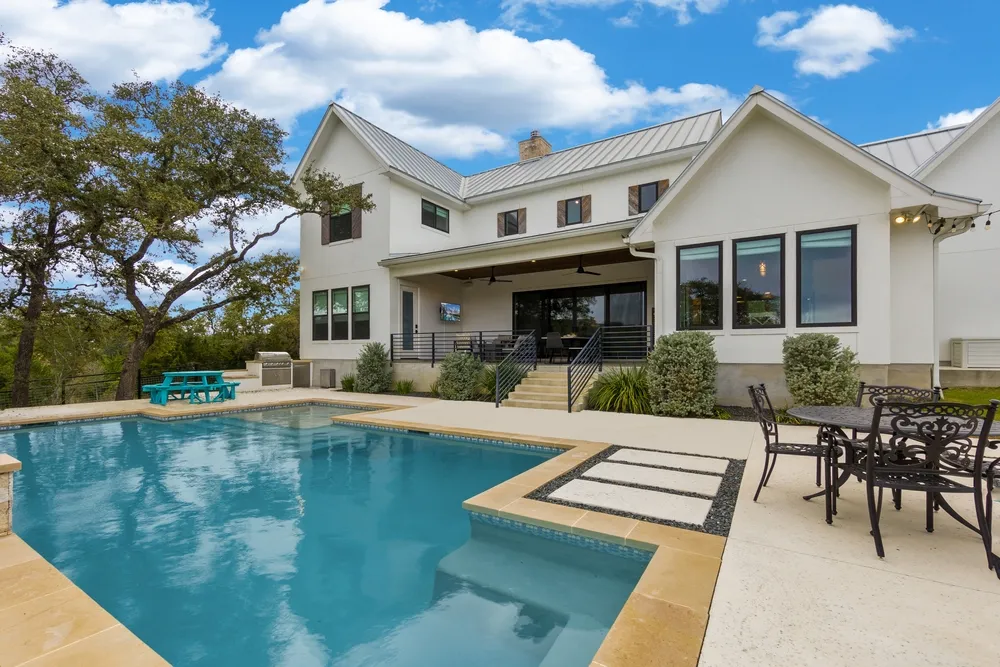
The exceptions are what Verzella calls “unicorns,” homes on land with privacy, strong landscaping, pools, and good interior condition, priced correctly. “Those kinds of properties are still doing really well, all things considered, and still getting a great price relative to their peers,” he says. For sellers, this means that condition, presentation, and accurate pricing now separate homes that sell quickly from those that stall; generic listings in an average state cannot rely on broad demand to carry them.
The Military Buffer and Its Limits
San Antonio’s military presence – including Joint Base San Antonio and its associated medical and defense contractor ecosystem – has historically provided a demand floor that insulates the market from the sharpest national swings. Military buyers operate on non-negotiable timelines dictated by orders, which means they transact regardless of the rate environment. Combined with a tourism economy anchored by the Riverwalk and historical sites, and a medical sector spanning both military and civilian institutions, San Antonio has structural demand drivers that many mid-tier metros lack.
These buffers have limits. Verzella rates current residential affordability at a 3 on a 1-to-10 scale, with the trend still deteriorating. Fix-and-flip conditions score similarly at a 3. Commercial REITs rate a 6, the most favorable category on his algorithm, though still not strong. “A lot depends on what the Fed does,” he says, referencing the decision to hold the fed funds rate steady. “If they bring the rates down, I think we’ll see real estate follow ultimately, even if it’s lagging.”
What the Investment Case Looks Like Right Now
For investors willing to deploy capital, Verzella’s advice centers on building protection at every stage of a transaction. Buy below market from a motivated seller, create a cushion there. Be conservative on renovation spend, another cushion. Price the exit conservatively, a third layer of protection. The goal is to insulate against rate volatility by compressing timelines.
“If you can flip something in 60 days, you don’t have to worry so much about a dramatic rate change the way that you might if you take six months to renovate something,” he says. For buy-and-hold investors with a five-to-ten-year horizon, he views the current environment more favorably, noting that historical data across multiple decades shows upward trends over each ten-year period.
The practical opportunity, as he describes it, lies in properties that need modest work, exterior landscaping, design updates, some sweat equity, owned by sellers who can’t afford or don’t want to invest further. The key constraint is doing the math in advance: forecasting renovation costs, realistic exit prices, and ROI before committing capital. “In this environment where rates are very volatile, and rates are probably the biggest threat, creating cushion everywhere that you can is probably the smartest way to invest,” Verzella says.
Hyperlocal Conditions Still Override Broad Trends
Even within San Antonio, market performance varies block by block. Verzella points to recent flooding in the Boerne area as an example: some homeowners experienced catastrophic damage, while a listing he holds in Lost Creek, a community in the same area but at higher elevation and farther from the nearest watershed, received multiple showings in its first week and an offer within days. The buyer of that home might never have known flooding occurred miles away.
Verzella says outperformance is ultimately a characteristic of each individual home rather than of entire neighborhoods. A seller’s equity position, the home’s condition, and realistic pricing can make a property competitive even in a struggling submarket. Conversely, when every characteristic works against a listing, unmotivated seller, poor condition, overpriced relative to what the market will bear, he advises sellers to wait rather than waste time and emotion on a listing that won’t move. “I would just rather let you down now than disappoint you later,” he says.
For buyers with cash or patient capital, the current combination of motivated sellers, compressed luxury prices, and reduced competition from sidelined borrowers creates conditions where selective purchases can be made at prices well below recent peaks, provided the buyer does the math before committing.
About the Expert: Brayson Verzella is Founder and Team Leader of Team Infinity Real Estate Group, serving the San Antonio and Austin, Texas markets since 2005.
This article is based on information provided by the expert source cited above. It is intended for general informational purposes only and does not constitute legal, financial, or real estate advice. Readers should conduct their own research and consult qualified professionals before making any real estate or financial decisions.